At the risk of this post sounding like a big I-told-you-so-moment, yet another study has been published confirming what I've been saying for eons.
If you've read either of my books, especially The Fat Loss Bible, or even spent a reasonable amount of time on this here site, you'll know I've repeatedly emphasized the highly dubious nature of self-reported dietary data. This is the kind of data used to 'determine' the food and caloric intake of subjects in epidemiological and free-living (i.e. non-metabolic ward) clinical trials.
This is extremely important, because the results of both free-living clinical trials and especially epidemiological studies have been widely used for the last sixty odd years to formulate and vigorously recommend numerous nutritional guidelines to the general public.
But if the data these recommendations are based on is unreliable, what does that say about the recommendations themselves?
Suspect food intake data hasn't just been embraced by mainstream authorities; the purveyors of numerous fad dietary approaches such as veganism, vegetarianism and low-carbing have also eagerly used this data to support their pseudoscientific theories.
But again - if the intake data these dietary sectarians employ is of highly questionable quality, what does that tell us about their hyperbolic claims?
Cherry-Picking Food Intake Data 101
If you've read The Great Cholesterol Con or The Fat Loss Bible, then you've seen the graphs showing average US per capita intakes of calories, fat and carbohydrates during the 20th century. Those graphs were constructed using what is known as "food disappearance" data, compiled by the United States Department of Agriculture (USDA).
Others aren't so keen on discussing this data, instead preferring to cite Centers for Disease Control (CDC) food intake data in support of some rather fanciful claims. You know, claims like "carbohydrates, not an excess of calories, caused the obesity epidemic!"
I discussed this very topic a couple of weeks ago, in Why You Can’t Trust the ABC (or Gary Taubes & Robert Lustig) to Report the Truth About Diet, Exercise & Fat Loss. Taubes and Lustig both recently appeared in an anti-sugar segment on the ABC show Catalyst making claims that, quite simply, had absolutely no basis in sound science. For example, along with comparing sugar to thalidomide, Lustig made the bold claim there had been no increase in dietary fat intake during the obesity epidemic. The inference being, of course, that if there was no per capita increase in dietary fat, then it had to be carbohydrates that made America obese.
In making this claim, Lustig parrots Taubes, whose best-selling book Good Calories, Bad Calories presented data also showing that US per capita dietary fat intake barely changed during the obesity 'epidemic'.
But while the graphs in Taubes' book show no increase in dietary fat intake, those in The Fat Loss Bible do.
Why the disparity?
Consider the Source
As I explained in the Why You Can’t Trust the ABC... post, there are two sources that provide per capita US dietary intake data for the period covering what is known as the "obesity epidemic" (I can't help but shake my head every time I hear that term; I'm sure there's a hungry mother somewhere in Africa, looking down at her starving baby, shaking her head in disgust at the thought of an epidemic caused by too much food. We really have become a bunch of spoiled soft-cocks here in the West).
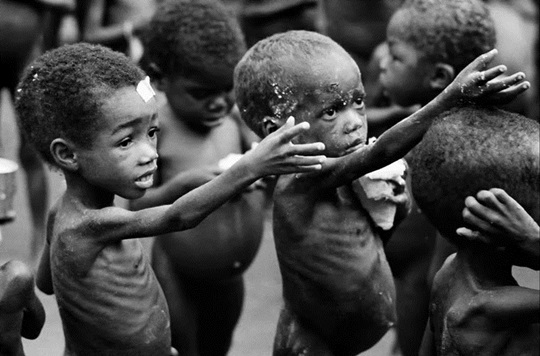
Go ahead, tell these kids the tragic, heartbreaking story of how you can't lose weight because you don't like exercise and can't help eating an entire packet of crisps in one sitting. I'm sure they'll be touched.
The largest, and oldest, source of US food intake data comes from the USDA. The USDA determines the total amount of food available in the US, then calculates what remains available for human use after deducting exports, farm and industrial uses, and end-of-year inventories. This amount is then divided by the population of the US to give a per capita “food disappearance” figure.
The obvious flaw of food disappearance data is that it cannot account for food wastage; both food outlets and households discard significant amounts of food due to expiration, spoilage and incompletely consumed meals. As a result, USDA food disappearance data tends to overestimate individual caloric and macronutrient intakes.
The second source, the one readily embraced by folks like Taubes and Lustig, comes from the CDC. In his regrettably influential infomercial Good Calories, Bad Calories, Taubes cites a 2004 CDC article reporting that total fat intake increased among women by a mere 6.5 grams but decreased among men by 5.3 grams[1]. This gives the impression overall fat intake has remained relatively unchanged.
Thus, we have:
1): USDA data showing a substantial increase in calories, fat and carbohydrate (along with a rather negligible increase in protein) during the period spanning from the early 1980s to 2000;
2): CDC data purporting to show an increase in carbohydrate intake, but no real increase in fat intake during the same period. What Taubes, Lustig et al aren't so keen to mention is that this CDC data also shows a per capita increase in caloric intake, albeit not of the same magnitude as that observed in the USDA data.
The obvious question is why do the USDA and CDC data deliver differing intake data for the US population?
The obvious answer is that they use totally different methods of data acquisition.
The calorie, carbohydrate and fat intake changes reported by the CDC were derived from the National Health and Nutrition Examination Surveys (NHANES) conducted by the government agency to track food consumption trends.
Unlike the USDA's food disappearance data, these surveys involve face-to-face interviews with relatively small samples of randomly recruited US citizens.
In other words, they rely on the ability of people to accurately and truthfully recall their food intake, and they involve only a small portion of the US population.
Given that human beings are creatures who have been well documented to forget, make mistakes, downplay or omit embarrassing or incriminating facts, and tell outright lies, it doesn't take an intellectual giant to begin to see why there could be serious issues with the NHANES data.
In contrast to the USDA data, which covers the entire US population, in NHANES the sample sizes ranged from 14,167 men and women in NHANES III (1988-1994), to only 3,733 men and women in NHANES 1999-2000[1]. In what some would consider a rather substantial leap of faith, these samples were then assumed to be representative of the entire US population.
Each of the men and women from these samples took part in a single dietary recall interview about the foods and beverages they consumed during the preceding 24 hours; this 24-hour recall was then assumed to be a reliable representation of each subject’s diet for the 1- to 6-year periods covered by each NHANES project.
Yep, there's a lot of assuming going on with the NHANES dietary data.
As I discussed a couple of weeks back, both the USDA and CDC/NHANES food intake data have serious shortcomings. There is, however, a significant advantage to the USDA data:
Greater consistency.
Unlike NHANES, which involves small, random fragments of the US population, which vary in size, the USDA data always involves nationwide data encompassing the whole of the United States.
Unlike NHANES, the USDA data does not involve food recall surveys, and therefore is not prone to the well-established phenomenon of under-reporting and recall bias.
That last point is critical. In both paper questionnaires and face-to-face interviews, most - not some but most - people will under-report their food and caloric intake[2]. Furthermore, this under-reporting is most pronounced with dietary fat, a nutrient that has been subject to an immense amount of hysteria over the last fifty years.
And on top of that, obese people are far more likely to under-report their caloric intake than normal-weight individuals.
And while women routinely demonstrate a stunning ability to recall every single word you uttered during a heated argument 15 years ago, for some reason they have an especially hard time providing accurate dietary recalls. Yep, while men are hardly bastions of accurate self-reporting, study after study shows that women are even more likely to under-report their food intake than blokes.
We'll get back to all this in a moment, but first, let's take a look at a recently published paper that decisively calls BS on the widely-used NHANES data.
Just Wait'll We Get Our NHANES On You
Recently, researchers from the University of South Carolina cast a critical eye over the NHANES data, and promptly detected the distinct aroma of what is known in scientific circles as bovinus excrementus.
Curious as to what exactly was causing this smell, they did what a number of researchers had previously done to dietary data from other studies: They subjected it to what is known in scientific circles as a Good Bloody Reality Check (GBRC)[3].
How to Perform a Good Bloody Reality Check
I need to warn you upfront: Not just anyone can do a GBRC. In fact, some of the most highly decorated researchers in the nutrition and health arena have proven themselves utterly incapable of performing even the most basic of GBRCs. It takes a special kind of researcher, one who is well aware of the pervasive nature of human dodginess, and hence is not prepared to simply accept self-reported dietary data at face value.
So how exactly do you perform a Good Bloody Reality Check on self-reported dietary data? It's so simple, it's almost funny. What's not funny is that a lot of people who spent years at university accumulating fancy initials after their names, and then proceeded to become decorated figures who have influenced both nutritional scientific consensus and public health guidelines, are too dopey to even know about this simple procedure.
Here's how you do it:
You compare the self-reported energy intakes of a group of subjects with their actual energy requirements. If the first is lower than the latter, but the subject has maintained or even gained weight, then you know their claimed self-reported intake is a load of hogwash.
So how do researchers determine someone's actual energy needs?
Well, they can confine the subject to a metabolic chamber, but this is a rather time-consuming and expensive method. Thankfully, there are other methods such as formulas that reliably estimate energy requirements, and the doubly labeled water method. Let's start by taking a look at the use of formulas.
Detecting Unlikely Data with Energy Expenditure Formulas
After years of observing human beings in metabolic chambers, we know there is a minimum amount of energy expenditure required to maintain basic bodily functions, even if you do nothing but lie in bed all day. This expenditure varies somewhat from person to person due to such factors as total body weight, body composition (percentage of lean mass versus percentage of fat mass, the latter generally being higher in females), and hormone levels (thyroid, testosterone, and growth hormone levels, for example, can affect basal metabolic rate). Nevertheless, even the most hypothyroid, hypogonadal individual still requires a certain amount of calories to keep his basic functions plodding along.
The amount of energy expenditure required to maintain these basic bodily functions in a resting state is often referred to as basal or resting metabolic rate (BMR) and is usually cited in 24-hour terms. In other words, if your BMR is 2,000 calories, then that's the average amount your body consumes every 24-hours just to maintain essential functions.
Of course, few people truly spend all day in bed. Most of us who don't live in the Playboy mansion need to get out of bed each morning and do stuff like shave, shower, keep our houses from looking like war zones, get to and from work, shop for food/bike parts/boots, and so on. An ever-decreasing portion of us work physically active jobs, and some of us like to do stuff like riding carbon fibre objects up and down steep hills, belt the crap out of stuffed bags, and lift heavy objects before putting them back down on the spot where we found them (these activities all fall under the umbrella of exercise). Others like to do stuff like run around on a field hitting and catching balls, or passing or kicking balls to a person who then passes or kicks the ball right back to them (activities that fall under the umbrella of sport). While some of these activities, on paper, sound a bit daft, they do have the highly desirable effect of increasing one's total daily energy expenditure (TDEE), which in turn dramatically decreases the likelihood one will become overweight and fall for the untenable nonsense espoused by low-carb diet gurus. These activities also get you outside and away from your computer, which means you are more likely to come into contact with things like sunshine, fresh air, family, and friends. Heck, once you're outside, you can even view and meet members of the opposite sex as they really are, as opposed to the misleading photos people use in their online dating profiles. Yep, there are very real advantages to having a life, folks.
But I digress.
So we have resting energy expenditure, we have expenditure from physical activity, and we also have the relatively minor energy expenditure that comes from what is known as dietary induced thermogenesis (DIT = the amount of extra calories burned in the digestion and metabolism of food). Together, these all determine your TDEE.
So now we also know that even sedentary people burn extra calories over and above those required for the maintenance of body functions. As with RMR, this figure varies from person to person but, again, years of observation of real live Homo sapiens has shown that even the most inactive person who isn't totally bed-ridden is going to require a certain number of calories over and above his BMR to meet his/her TDEE needs. If he or she maintains a caloric intake in excess of those needs, then he or she will gain weight. If he or she maintains a caloric deficit, then weight loss will occur.
Thanks to the many years of observation that have allowed us to arrive at these conclusions, researchers have been able to construct a number of formulas that, while not perfect, can indeed help us estimate an individual's daily maintenance energy requirements. Formulas that account for percentage of lean versus fat mass, such as Katch-McArdle, tend to give more accurate estimates than formulas that don't, such as those by Harris-Benedict, Mifflin-St. Jeor, Schofield etc, etc. That said, the latter are fairly reliable formulas for individuals who don't reside at the extreme ends of the spectrum when it comes to lean or fat mass (i.e. super lean or very obese folks), although their estimates can differ due to the different inputs required (in addition to weight, some factor in age while others factor in height, and so on).
So the key point here is this: Every person requires a certain amount of calories just to maintain basic bodily functions, and a certain amount of additional calories to get through their day. If someone presents dietary data that supposedly represents an overweight or obese person's regular food intake, yet the calories provided by that intake barely meets that person's resting energy requirements, then we can reliably assume that data is bullshit.
Uh, I mean, bovinus excrementus.
So what does this have to do with NHANES?
Everything.
The Case of the Mysterious Americans Who Magically Gained Weight While Eating Below Their Energy Needs
The University of South Carolina researchers obtained the data from all the NHANES surveys to date, covering the period 1971–2010. The researchers confined the study sample to adults aged 20-74 at the time of the NHANES in which they participated, with a BMI > 18, and with complete data on age, sex, height, weight, and dietary energy intake.
Surveys like NHANES don't compile any information on body composition, so the researchers couldn't use a formula like Katch-McArdle, which provides the most accurate estimates thanks to its ability to account for each subject's body fat and lean mass. Instead they chose the Schofield equation, which factors in age and weight when calculating BMR.
They then needed to arrive at a feasible minimal TDEE, so after using the Schofield equation to arrive at BMR, they applied a multiplier of 1.35 to allow for a level of activity typical of a normal, organically healthy, free-living individual. Any reported energy intake in a NHANES subject that fell below the amount predicted by the Schofield + 1.35 multiplier combination was considered implausible and indicative of under-reporting.
So what did they find?
Rampant under-reporting, that's what.
The mean reported energy intakes for each and every NHANES were implausible. This included NHANES I, II AND III - which covered the period in which the rapid rise in obesity occurred - and the six subsequent NHANES covering the period 1999 and 2010.
Based on the minimal TDEE arrived at by using the 1.35 multiplier, the mean amount of under-reporting was -281 calories in men and -365 in women.
But that's hardly the start of it.
Under-Reporting Among the Overweight and Obese
The disparity between self-reported caloric intakes and minimal required energy intakes was much higher among overweight subjects, and even higher again in the obese subjects.
As the authors noted, at no point in the history of the NHANES did more than 43% of overweight and obese women report plausible values. The corresponding figure for overweight and obese men was 49%.
There's something I want to quickly mention here: In The Fat Loss Bible, I recommend use of the Katch-McArdle formula or, for people who do not know their body fat %, the Mifflin-St Jeor formula for estimating your BMR. To calculate your TDEE, these equations are then paired with a number of multipliers, and you choose the appropriate one according to your usual weekly activity level. Keeping in mind that I use different BMR formulas than the Schofield equation used by the South Carolina team, the multiplier in FLB for totally sedentary people is 1.2.
I mention this because, even if we paired the Schofield equation with the 1.2 multiplier used in FLB, the NHANES data still returns results that can only be described as ridiculous. In 7 of the 9 NHANES, obese subjects reported energy intakes that didn't even meet this extremely minimal need (1.08-1.18). In another, NHANES III, the reported ratio of reported energy intake to required energy intake was 1.20.
So what we are supposed to believe from the NHANES data sets is that the obese subjects became obese while eating below their survival energy requirements, even when those requirements are estimated in the most generously minimal way possible!
Unless you're one of these brainwashed Taubes disciples who believes people can become morbidly obese simply by breathing carbohydrate-enriched oxygen, it should be readily evident that the NHANES data is way off the mark.
This, as I mentioned earlier, is hardly the first time researchers have discovered self-reported dietary intakes that defy reality.
Detecting Doubly-Ridiculous Data with Doubly-Labeled Water
Water is pretty cool stuff. It keeps you hydrated, helps you flush waste materials from your body, and when combined with healthy muscle glycogen levels from a high-carbohydrate diet, makes your muscles look nice and full and vascular and all-round swole.
But the physiological usefulness of water hardly ends there.
If you take some water, partially or completely remove the hydrogen and oxygen and replace them with the elements deuterium and oxygen-18, you end up with what is known as doubly labeled water.
At this point you're no doubt thinking, "Why on Earth would you do that to water?"
Because the use of doubly labeled water has proved itself to be a rather nifty way of measuring energy expenditure in free-living humans (and animals). And it offers a greater degree of accuracy than the aforementioned energy expenditure formulas.
Obviously, using doubly labeled water to validate the dietary intakes of the NHANES participants was an impossibility, but numerous other research groups have used the doubly labeled water method to check the validity of self-reported calorie intakes, and in almost every instance they've found the mean self-reported intakes to be greatly under-reported[4,5].
Subar et al, for example, instructed 484 men and women aged 40–69 years from Montgomery County, Maryland to complete two common forms of self-reporting: 24-hour dietary recalls and food frequency questionnaires. The 24-hour recalls, it should be noted, were quite thorough and were administered in the presence of interviewers who were required to have at least a bachelor’s degree in health, nutrition, or home economics, and who had participated in 32 hours of formal training for this study.
The researchers then proceeded to administer doubly labeled water to the subjects.
On average, men under-reported energy intake compared with their actual total energy expenditure by 12–14% and 31–36% on the 24-hour and food frequency reports, respectively. For women, the corresponding figures were 16–20% and 34–38%[6]. And this, remember, was in a study where the researchers had been careful to ensure the recall data was as accurate as possible.
Among a group of 30 obese men who completed a 7-day dietary record and were subsequently given doubly labeled water, only one had a reported energy intake within 10% of the measured energy expenditure. The average percentage of under-reporting was 37% in this group. Again, this was despite the subjects receiving careful instruction by a registered dietitian on how to complete the 7-day record[7].
As with adults, doubly labeled water testing shows under-reporting is par for the course among adolescents. When Bandini et al compared the two-week food records of 33 obese and 28 non-obese boys and girls aged 12-18 years with their doubly labeled water results, they observed under-reporting in both groups. However, the obese kids under-reported their intake to a far greater extent than their lean counterparts. The non-obese adolescents under-reported a mean -562 calories while the obese adolescents under-reported by a whopping -1455 calories per day[8].
Again, the researchers went the extra mile to ensure the dietary records were as accurate as possible. Each adolescent was given a food diary and a set of measuring cups and spoons to use at home. They were instructed to measure all of their food and taught how to estimate the size of food portions when measurements could not be made. Subjects were called three or four times during the 2-week period and the dietary record was reviewed over the phone. The researchers emphasized to each subject that this was a weight-maintenance period and their food intake should be representative of their regular diet. The researchers even encouraged adherence with a payment of $75.00 for participation in the study and an accurate food record, and told the adolescents that for each day they did not keep an accurate record, they would lose $5.00.
So with careful instruction and even financial incentives, most adolescents and adults can't keep accurate food records to save their lives. And yet when health authorities and diet 'gurus' spout their unlikely theories based upon research that in turn is based upon subjective dietary recall, we're supposed to take their claims at face value?
Bugger that.
The Bottom Line
Low-carb/anti-carb 'gurus' like Gary Taubes, Robert Lustig, and many of their like-minded cohorts have made much ado of the alleged lack of increase in dietary fat intake that occurred during the so-called 'obesity epidemic'. This allegedly unchanged dietary fat intake is based on data collected by the CDC during its ongoing NHANES studies. However, these studies involve subjective, self-reported dietary recall. Study after study shown such recall data to be extremely suspect, and often downright implausible.
And now we have a direct analysis of the NHANES data showing exactly this. Under-reporting was rife in NHANES, with greater under-reporting occurring among the overweight and obese subjects.
Combine these observations with the fact that dietary fat is the most widely under-reported macro-nutrient[7, 9, 10], and we can safely arrive at a number of important conclusions:
- While it did detect an increase in overall caloric intake during the period in which the US saw sharp increases in obesity rates, the NHANES data has very likely greatly underestimated the magnitude of this increase.
- USDA Food Disappearance Data, which is not subject to the subjective vagaries of personal recall, did detect a greater increase in caloric intake than NHANES. The USDA data, however, only gives us a picture of the average increase per capita, and tells us little about the increase in particular sub-groups such as the overweight and obese. But given the repeated finding that overweight and obese folks under-report their food intake to a greater degree, we can safely expect the magnitude of caloric increase in the aforementioned sub-groups to be greater than the overall per capita average.
Which no doubt is a big part of why they became overweight and obese. Duh.
- Given the USDA Disappearance data indicating increased fat consumption, the studies showing dietary fat to be an especially under-reported macro-nutrient, and the newly-published findings showing the NHANES data to be even more unreliable than one of those tacky, bloated Hummer monstrosities, it appears an unchanged per capita dietary fat intake exists only in the minds of those irrevocably committed to carbohydrate-hating.

So if you still want to believe folks like Taubes, Lustig, Atkins, and the 'scientists' on ABC who would have us believe only carbohydrate, and not calories or fat, were responsible for the obesity plague or pandemic or whatever you want to call it, then good for you. For the rest of us who don't believe in flying pigs and tooth fairies, the facts remain the same as always:
Increased consumption of calories, combined with unprecedented levels of sedentary living, is what has made modernized Homo sapiens such a pack of porkers.
The answer to our 'obesity epidemic' is staring us in the face, but many researchers and authorities prefer to keep searching for sophisticated, esoteric causes; I guess there's only so much research funding you can suck from the government by reiterating the plain, simple truth about calories. Celebrity authors also have little time for the plain boring truth, because it really doesn't sell very well, so instead they make novel and sensationalist claims that are far more likely to garner attention.
Well, here's the deal: We are not going to make any real headway into conquering this obesity issue until we can somehow start reversing the widespread disparity between excessive energy intake and insufficient energy expenditure that typifies modernized nations. The time-honoured methods for doing this are eating less and/or exercising more, but that's never a popular message in a world where people tend to loathe the concepts of restraint, physical effort, and self-responsibility. As such, a lot of people will continue to hold out for some miracle drug or therapy that will allow them to lose weight without making any meaningful effort or dietary/lifestyle changes. Until that day arrives, these people will remain easy prey for an ever-growing army of hucksters and pseudo-scientists.
If You Enjoyed this Post, Please Consider Sending a Tip
I post on my own time and at my own expense. I don't receive a cent from industry, philanthropic or NGO organizations. Researching and writing articles like this takes a lot of time, so any and all tips are greatly appreciated.