A reader writes:
Hi Anthony,
you mentioned some time ago that you visited Mexico in early 2022, but you've written nothing further. This is in total contrast to your previous trip to Spain, which you obviously loved and you wrote about numerous times. Didn't you like Mexico? Did you have a bad experience there? I'm curious to hear your thoughts. I've never been to Mexico but see it regularly recommended as a "Plan B" option. I enjoy your take on things and would love to hear your experiences.
Regards,
KF.
My reply:
Hey KF,
thanks for the email and I'll be happy to share my thoughts. I was going to answer this privately by return email, as I've done with others who've asked, but when you mentioned the "Plan B" thing I realized this was worthy of a public post.
I want to preface my answer by saying there are clearly a lot of people who will disagree with my opinion of Mexico. Then again, as a person who hates the prevailing binge-drinking, drug-centric, narcissistic, hook-up culture, and who thinks the whole COVID charade is a pre-orchestrated genocide campaign, there a lot of people who disagree with me on a lot of things.
As a tourist destination, Mexico currently ranks as the seventh most-visited country in the world (according to World Population Review).
Many Americans (including Canadians) clearly love Mexico. It has long been the most popular destination for American retirees relocating from the US.
As Western governments, particularly those in the 5-Eyes network, become more intrusive and draconian, Mexico is being increasingly marketed to a younger demographic as a worthy relocation option. As you noted, a lot of websites specializing in second residencies/citzenships are vigorously touting Mexico as a great "Plan B" option. Selling points include the climate, lower cost of living, cheap medical care, and an allegedly freer lifestyle.
On the flipside, a lot of people regard Mexico as a lawless dive, plagued by backward infrastructure, rampant corruption and runaway crime.
In short, Mexico seems to be the type of place people either love or hate.
I now count myself in the latter camp.
Before the hate mail starts flooding in, I'm not saying Mexico flat out sucks for everyone. I don't deny it may be a good relocation option for others. Like I said, there are plenty of folks who are clearly enamored with the place, who swear that moving there is the best thing they ever did.
I just won't be one of them. The place just didn't grab me. There was no chemistry, nothing that stood out and called to me. There was, however, plenty that turned me off.
Did anything "bad" happen to me in Mexico? No, I didn't get kidnapped or shot at or threatened with a machete. As an adult male, I didn't feel threatened or unsafe at any point. However, I was alert and aware of my surroundings at all times. I don't do drugs, I'm a light drinker, I'm not into bars and nightclubs, and these were habits I adhered to in Mexico also. My stay in Mexico was confined largely to Gaudalajara - home to one of Mexico's biggest cartels and a middle-of-the-road homicide rate - and a brief stint in Puerto Vallarta.
Mexico's problems with corruption and violence are well known. At this point in time, you can largely avoid hairy situations by doing a bit of research, avoiding trouble spots and employing a healthy dose of commonsense. That said, Mexico seems to be in a constant state of flux, and relatively safe areas can make the transition to violent hot spots in short order.
Despite sitting immediately south of the world's biggest economy, a lot of Mexico's architecture looks tired and shabby, and the overall infrastructure is still a bit primitive compared to 'developed' countries. Water pressure in much of Mexico is so low that you're often discouraged from flushing butt-wipe to avoid blocking toilets. Instead, you place it into a waste basket next to you.
Mexicans are described by some as friendly and welcoming, by others as a crazy lot who resent not just "Gringos" but each other. To be honest, my experiences in that regard were neither here nor there. During my brief time in Mexico I encountered everything from super nice folks to pigheaded, bureaucratic assholes, which is pretty much what you'd expect anywhere.
Mexico tends to be a noisy place, so if you want urban convenience and peace and quiet your options there will be limited - unless you are Nicholas Cage and can afford a mansion in the exclusive, elevated Conchas Chinas section of Puerto Vallarta.
Having said all that, I would have been happy to endure the hokey infrastructure, noise, and the need for heightened awareness if it at least meant an escape from the COVID madness of Australia.
Instead, I got the COVID madness of Mexico. While one didn't need to be vaxxxed to enter Mexico, states like Jalisco enforced vaxxx mandates for public events like music concerts and lucha libre wrestling.
As for masks, the level of masktardedness in Guadalajara was insane. Like Australia, Jalisco had mask mandates in shops and on public transport. But in Australia, most people would pull their masks off after they left the shops or got off the bus. In Guadalajara, almost everyone - and I do mean almost everyone - wore face masks outdoors as well. There was no legal requirement for them to do so, but they were so scared of the re-badged flu named COVID that they wore them outdoors anyway.
This, mind you, in a place where 'winter' means average temperatures in the mid- to high-20°C range!
A July 2020 survey by newspaper El Financiero showed 86% of Mexicans felt masks helped prevent COVID-19 spread, while nearly 9 in 10 said they always wore one when leaving home, a January 2021 poll found.
If you're a mindless, virtue-signalling leftie who also believes masks are a lifesaver, this probably sounds awesome. To me, it was a huge disappointment. I wanted to see Mexicans smiling, frowning, talking, laughing. I didn't travel thousands of miles and spend 2.5 days in transit just to see hordes of paranoid people walking around the streets hiding behind masks.
In Puerto Vallarta, a shuttle van driver asked me if I found Mexican women attractive. My diplomatic answer was "I can't really tell, they're all wearing face masks."
A more honest answer would have been heck no, I'm not at all attracted to women who wear face masks when they don't need to. Not only are masks an abject failure in preventing respiratory ailments, they look stupid and they're unhealthy, so why on Earth would you wear one if you don't have to?
Which brings me to another aspect of Mexico that I found quite disturbing. Pro-Mexico types will tell you that the country's violence and corruption are exaggerated and overblown. I'm here to tell you there are aspects of Mexico's dark side that are frequently glossed over or completely ignored.
I didn't know when I arrived, but violence against women is endemic in Mexico, and getting worse. According to a 2022 report, more than 70% of women and girls aged over 15 in Mexico have experienced some kind of violence, an increase from five years ago.
Younger, single women living in cities and with higher levels of education were more likely to report being victims of violence.
‘Cosmopolitan’ Mexico City - a strong favourite of certain Plan B advocates - and the surrounding State of Mexico had the highest prevalence, averaging 77% of women.
According to official data, 10 women are killed in Mexico every day, and homicide is the leading cause of death for Mexican women between 15 and 24. Last year, 78.8% of women said they felt unsafe in their home states, and 45.6% felt unsafe in their own neighborhoods.
Like I said, I knew none of this when I arrived in Mexico. I was there to learn Spanish, hopefully ride up some Mexican mountains and just generally enjoy not being in Australia.
So you can imagine my surprise when I would walk to school in the mornings - dressed in smart casual attire, minding my own damn business - and women would start acting terrified. When I was in Spain, women would smile. In Gaudalajara, they recoiled in horror.
Here's how these massive WTF moments would play out. Because my language classes began at 9 am, I would leave my apartment at around 8.40 am to walk to school. When I walk, I pretty much pass everyone on the footpath because I'm brisk like that.
I'm always mindful not to walk right up behind people, especially women, because I'm not a creep who gets in people's personal space.
But in Guadalajara, even when I was a good 10-15 feet behind them, some women either heard me approaching or saw my reflection in shop windows, and went into panic mode. In most instances these women appeared to be in their 20s or 30s, but on one occasion it occurred with an elderly woman.
Despite being what I considered a safe distance, these women were clearly scared and apprehensive. Their gait would become erratic as they tried to juggle walking ahead with repeatedly looking at me, and deciding whether they should keep walking or cower. Even with masks, the look on their faces laid bare what they were thinking:
"Shit, what's he going to do?"
The first few times this happened, I was like "WTF? What do you think I'm going to do? The hell is wrong with these people?"
I could understand if these incidents took place late at night on a deserted street, but we're talking broad daylight, 8.45 am, with other people usually nearby.
One day at language school, I happened to be the only student in my class, and that class happened to be with my favourite teacher. So I said, "can I ask you something, is there a lot of violence against women in this place?"
She replied "yes", and I could tell by the look on her face she was wondering why I had raised the subject.
I told her what I'd been experiencing in the streets, and how surreal and disturbing I found it.
"It's not you, it's Mexico," she said. The country, she explained, has a "cultura machista" and violence against women is very common. Therefore women can get edgy in the street when a man approaches.
She said "it's good that you noticed this."
It was kind of hard not to notice!
Lo and behold, a day or two after we had this discussion, it happened all over again. I was walking to school, a couple of blocks from my apartment, approaching a woman I imagine was in her 20s. By this point, I was well and truly over women acting like I was Jose the Ripper, so I made a point of actually walking out onto the street to give her a wide berth as I walked past.
Fat lot of good that did. She still went into panic mode, and her behaviour was the most panicked I'd seen so far. She was stopping, starting, looking at me, looking away, looking back... it was downright surreal to watch. She seemed petrified. I was actually worried that any moment she might start screaming.
I thought "this is getting ridiculous", and that maybe I should say something to assuage her fear, but I quickly banished the idea. "Don't say shit," said the streetwise half of me to the Good Samaritan half, "she'll probably start screaming and freaking out, then it will be a right shitshow."
So I kept on walking, at an even faster pace, wondering to myself, "how utterly f*cked is this place if so many of the women are that scared in broad daylight?"
No-one mentioned this on TripAdvisor...
I wouldn't want to be a woman in Mexico. I wouldn't want to be a guy there, either. As someone who not only lives a clean life but has also been lumped with a conviction for body-slamming a certain vegan stalker and sex predator, it's hard not to feel a piercing sense of irony when women react that way to you.
I would advise women to exercise extreme caution when visiting Mexico, especially if travelling alone. If you're one of these numbnuts who goes out at night, gets sloshed with your friends, and makes lots of noise in order to impress upon everyone what a "great" time you're having, I'd say you're seriously tempting fate in a place like Mexico. In fact, a Colombian I recently worked with told me that if Australian women behaved in her country they way they tend to behave here at night - obviously drunk, waving their arms and yelling "woohoo!", wearing skirts barely covering their private bits - it's an almost certain bet they'd get raped.
In Latin America, the newspapers don't call you a "hero" for claiming you got sexually assaulted while shit-faced, nor are there multi-million dollar Brittany Higgins-style payouts for alleged victims of unproven sexual assaults involving a couple of drunken twats.
According to the Executive Commission of Victim Assistance (CEAV), an estimated 600,000 sexual offenses are committed every year in Mexico. According to data obtained by the CEAV through the states, nine out of 10 victims of sexual violence are women, and 40% are under the age of 15.
Nine out of 10 offences were instigated by men, and 70% of the cases happened in the house of the victim.
Mexican police are a big part of the problem. When victims go to the authorities to open an investigation file, only 10 aggressors per 1,000 reports are charged.
As in Australia, rape culture is strong among Mexican cops.
In her book SLAVERY INC. The Untold Story of International Sex Trafficking, Lydia Cacho writes of instances where victims have reported their attacks to Mexican police, only for the cops to become aroused by their stories and subject them to another rape. Little wonder an estimated 94% of rapes go unreported there.
In 2019, protests erupted after two rape cases involving police. The first involved a 17-year-old girl who said four cops raped her in their patrol car in Azcapotzalco, a north-eastern section of Mexico City. The second concerned a girl aged 16 who said a policeman had raped her in a museum in the city centre days later.
The protesters themselves are at risk of sexual assault by bent cops. In Mexico, protests against gender violence have increased since 2015. So too have reports of protesters being dragged away and sexually assaulted by Mexican male and female police.
A 2011 incident shows how quickly things can turn sour in Mexico. After "several rum-and-cola drinks", Canadians Rebecca Rutland, 41, and her fiancé Richard Coleman, 51, stopped at a restaurant to use the washroom on their way back to their nearby Playa del Carmen resort. It was there a man tried to hit on Rutland. Coleman and the man were arguing on the street when four police officers intervened.
Coleman says he had a heated exchange with the officers when the police wanted to search him for drugs. Coleman believed the cops were exceeding their authority and stood his ground. Police threw him to the pavement, allegedly causing a gash on his forehead, and handcuffed him. They also arrested Rutland.
On the way to the police station, Rutland said a female officer stole one of her rings. Coleman claims an officer also stole more than $700 cash, his BlackBerry and jewelry.
Rutland says she was taken to a room where an officer conducted a frontal body search, touching her breasts and undoing her jeans. She alleges the officer then made her kneel and forced her to perform oral sex on him. Two police officers, she alleges, then took turns raping her. She says she didn't put up much resistance because, with four Kevlar-clad officers standing nearby with machine-guns, she feared for her life.
At one point while she was being raped, Rutland saw the night supervisor at the door. "Thank God, somebody is going to stop this," she thought to herself. "[Then] he turned around and walked away," said Rutland.
Just another day at the station, apparently.
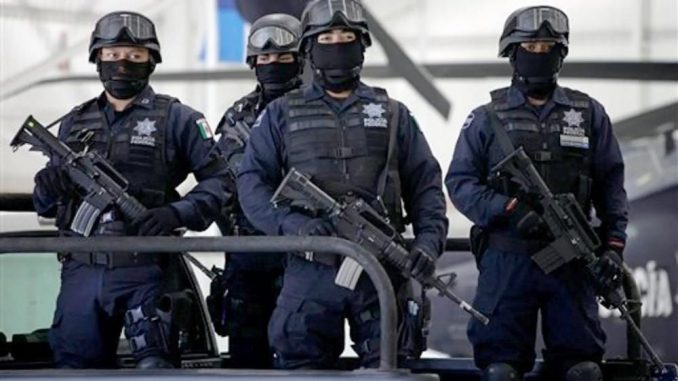
Speaking of predatory police, it's not uncommon to see the Federal police (“Federales”), the Guardia Nacional and the military cruising around in the back of trucks, assault weapons at the ready, driving through shopping precincts intimidating shoppers while ignoring the cartels that are paying them off.
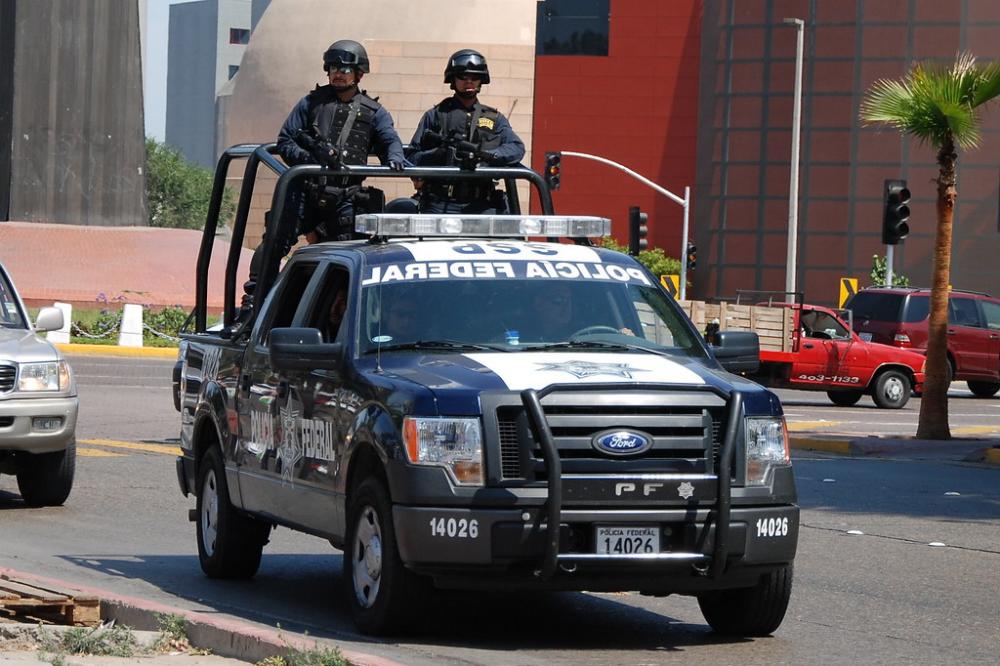
Because of the high crime rate and rampant corruption, private security is a huge growth industry in Mexico. Most of these companies are unregulated, and even registered companies have little incentive to follow rules because the government rarely punishes those that commit abuses or lose track of firearms, which can end up in the hands of criminals. Not surprisingly, a report by Washington-based think tank Inter-American Dialogue found the industry's rapid growth in Mexico has contributed to corruption, human rights abuses and excessive use of force.
So is there more freedom in Mexico, as certain Telegram and 'Plan B' types insist? Well, they're free to start unregulated security companies and give assault weapons to people with no training, free to make lots of noise all day and well into the night, free to ride motorbikes without a helmet while roaring the wrong way down a one-way street, evidently free to attack women largely without consequence, and the cops are free to shakedown and rape tourists and locals alike with impunity ... but everyone’s terrified of a re-badged flu and almost everyone wears a mask outdoors.
Not my cup of tea, folks. Not by a long shot.
If there was an even an ounce of doubt remaining in my mind as to whether Mexico was a worst-of-both-worlds deal, it was obliterated after I read about the maddening plight of civil society leader and former Mexican Congressman, Rodrigo Iván Cortés. Before I recount what happened to the poor guy, it's bears reiterating that, despite supposedly being a Catholic country, Mexico has embraced the woke transgender agenda in a manner that would make Dan Andrews proud.
Last month, Cortés was again convicted of “gender-based political violence,” including "digital violence", for social media posts on Twitter and Facebook referring to transgender Mexican Congressional representative, Salma Luévano, as a “man who self-ascribes as a woman”.
Excuse me, but isn't that the actual definition of a transgender person? A person who self-ascribes (identifies) as the opposite sex?
Cortés, head of pro-family advocacy group Frente Nacional por la Familia (FNF), was first convicted by a lower court. His case parallels that of sitting Mexican Congressman Gabriel Quadri, who was similarly charged and convicted of “gender-based political violence” for Twitter posts, as a result of a complaint also filed by Luévano. Quadri's 'crime' was to write that "trans women are men who pretend to be women." A tribunal ordered Quadri to take a course on "political violence against women based on gender" and another on "violence against members of the LGTB+ collective". He is pursuing justice at the Inter-American Commission on Human Rights and is awaiting a decision on admissibility there.
Luévano, and fellow transgender representative María Clemente, are members of the MORENA party, which has promoted constitutional amendments to enshrine “sexual rights” without age distinctions (including minors) - a proposal that the FNF criticized in one of the social media posts.
That's the reality of Mexico. In a country where physical violence and sexual assault against women are running rampant, the legal system considers "gender violence" to be social media posts that state a man who self-ascribes as a woman is a man who self-ascribes as a woman.
Here in Australia, we're facing down Orwellian laws that will herald the end of free speech. In Mexico, they've already weaponized the legal system against public figures who make factual remarks about their transgender colleagues. As for journalists who get a little too close to the truth, Mexico has long since come up with a more final solution:
Murder.
Last year, Mexico once again claimed the dubious honour of being the world's most dangerous country for journalists. Eleven of the world's 57 slain media professionals were killed in Mexico. I'll leave readers to ponder why the government has done so little about this longstanding problem.
Like I said, there was nothing about Mexico that grabbed me, and plenty that pushed me away.
It's a no from me, folks.
Leave a Reply