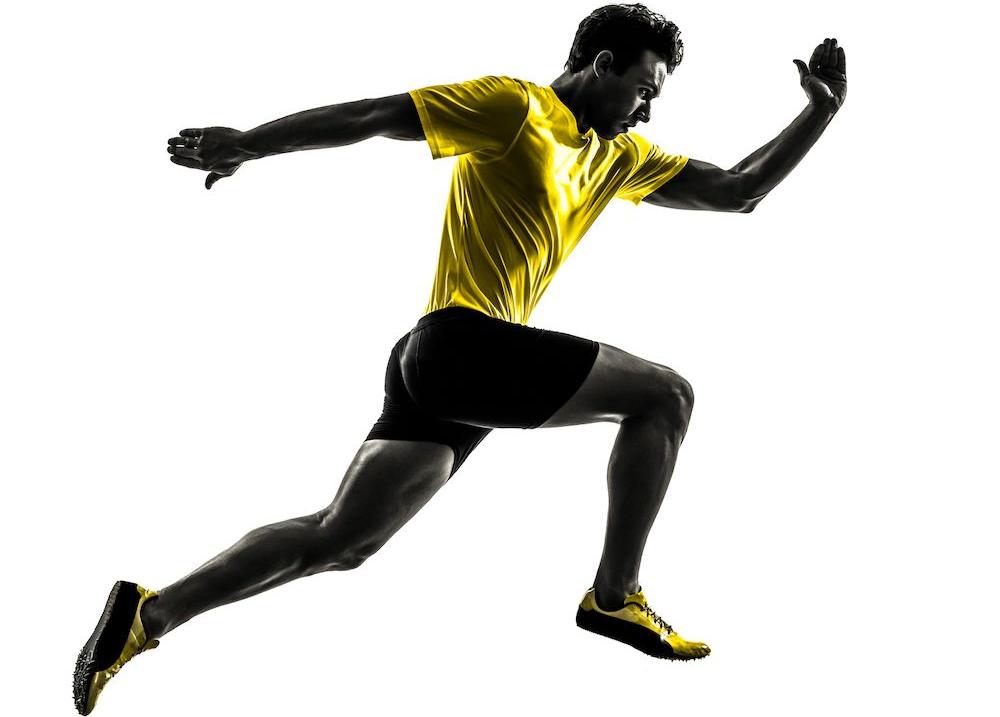
Eleven years ago, I wrote a popular article which addressed the often outrageous fat loss claims being made for high-intensity interval training (HIIT). This style of training typically involves brief and intense bouts of effort (for example, all-out 30-second sprints on a stationary bike), interspersed with passive or active ‘rest’ periods (e.g., pedaling at an easy to moderate pace for 30 seconds to 4 minutes between sprints).
Eleven years ago, HIIT was still a highly novel concept. This might seem strange to some of you young whippersnappers who've grown up during the "functional training" era, but not so long ago in history, cardio training in the gym inevitably meant one of two things:
1) Plodding along on a treadmill or stationary bike for 30-45 minutes while you daydreamed about other stuff, or;
2) Jumping around in lycra for almost an hour while an "aerobics instructor" yelled at the top of her lungs, instead of just turning down the technofied Bee Gees music neighbours could hear two blocks away:
"Now who got a fever for the flavor [PUSH! PUSH THAT TUSH! THAT’S IT LADIES!!] Ah, ha, ha, ha stayin' alive.”
Yep, it was the best of times, it was the worst of times.
Then along came HIIT, which removed the need for over-the-top aerobics instructors and where 20 minutes was considered a lengthy workout.
Almost as soon as HIIT took off, the charlatanistic diet and fitness arena lit up with claims that only a few minutes of exercise, a few times a week, would transform your body into a fat-burning "furnace".
I value my time as much as anyone else, and can understand why the promise of getting great results in less time would appeal to people. But wishful thinking does not equate to scientific reality. In 2012, the reality was that very little research existed on the fat loss effects of HIIT - most trials at that point had concerned themselves with the cardiorespiratory (fitness) effects of intense interval training.
Of the three trials that had looked at body composition changes at that point, none were particularly inspiring. One saw little change in overall weight and the fat loss results were marred by discrepancies in the skinfold readings. The other two HIIT trials produced 2.0 - 2.5 kg fat losses over 12-15 weeks, but did not include a comparison group performing traditional, or steady state, cardio.
Hardly a sound platform from which to launch hyperbolic claims about the fat loss effects of HIIT.
Fast Forward to the Present
Thanks to intense interest by researchers in HIIT, the past eleven years has seen a marked proliferation of RCTs comparing the fat loss effects of HIIT with steady state cardio, or "moderate intensity continuous training" (MICT).
So where does the science stand now regarding the effects of HIIT and fat loss?
The content below was originally paywalled.
Two recent meta-analyses have addressed this very topic. One looked at trials comparing HIIT and MICT in adults, the other concerned itself exclusively with trials involving overweight/obese children and teens.
HIIT in Young and Middle-Aged Adults
In a review and meta-analysis published in March, Guo et al from the School of Physical Education, Hunan University of Science and Technology, Xiangtan, China analyzed relevant trials involving adults aged 18–60.
After scouring the literature, they retrieved 29 trials collectively comprised of 807 participants (404 HIIT participants, 403 MICT participants).
Mean age of the participants was 33.8 years. Four studies did not report gender ratio; the male:female ratio of the remaining studies was 2:3.
Most of the trials used stationary cycling as the exercise intervention. Six used running, two studies used home-based HIIT and running for MICT, and one study used boxing for HIIT and walking for MICT.
Among the HIIT groups, workout duration ranged from 9 to 44 minutes, while the MICT workouts ranged from 20 to 60 minutes in length. Interestingly, given HIIT's time-efficient hook, in three studies the HIIT groups spent more time training, while in four studies the HIIT and MICT groups performed workouts of identical length.
There are countless variations of HIIT, with the sprint:rest ratio limited only by one's imagination. In the analyzed studies, the duration of the high intensity intervals ranged from 10 seconds to 4 minutes, while the duration of the rest intervals ranged from 30 seconds to 7 minutes.
Longer duration ‘sprints’, obviously, necessitated lower intensity levels. You simply can’t sprint all out for four minutes.
The most common combination was a 30-second sprint interval and 4 minute rest interval, used in five studies. Another three studies employed 30-second sprints with rest intervals ranging from 30-120 seconds, while another employed 30-45-second sprints with 2-3-minute rest intervals.
In some studies the rest was passive (no exercise), in others it was active (continuing the activity, but at a greatly reduced intensity).
Duration of the studies ranged from 2 weeks to 6 months.
So ... what did Guo et al's systematic review and meta-analysis of all these studies actually find?
Mean weight losses were 2 kg for HIIT and 2.19 kg for MICT.
BMI declined by 0.9 kg/m2 for HIIT and 0.92 kg/m2 for MICT.
Waist circumference decreased 4.41 cm for HIIT and 2.96 cm for MICT.
Percent fat mass dropped 2.03% for HIIT and 1.89% for MICT
Fat mass dropped by 1.79 kg in HIIT and 2.33 kg for MICT.
Little change was seen in fat-free mass (−0.36 kg for HIIT and −0.38 kg for MICT).
As you can see, there was little-to-no difference between the two groups. Only the differences in waist circumference and percent fat mass reached statistical significance, but they were miniscule and of doubtful real world significance. As the researchers concluded, "compared to MICT, our study indicated that the advantages HIIT brings to the young and middle-aged on fat loss and CRF are limited, yet these benefits can be provoked in a more time-saving manner."
Which is where HIIT shines. While it may not produce superior fat loss results, in most of the studies similar results were obtained in less time.
Another area where HIIT continued to shine is cardiorespiratory fitness. While traditional cardio is no slouch for improving cardiovascular health, HIIT established an ability early on to further improve VO2max even in advanced athletes.
Of the 29 studies analyzed by Guo et al, 27 reported on VO2peak (not to be confused with VO2max, which is where actual oxygen intake during exercise reaches a maximum beyond which no increase in effort can raise it. Asking sedentary or unfit adults to chase their VO2max carries inherent risks, so researchers often examine VO2peak instead, which is the the highest value of VO2 attained on a particular test. As Whipp notes, "while it defines the highest V’O2 that was attained during the test it does not necessarily define the highest value attainable by the subject").
Among those 27 studies, VO2peak increased 0.83 for HIIT and 0.6 for MICT, a statistically significant difference.
HIIT in Overweight Kids and Teens
According to a 2017 paper, an estimated 107.7 million children were obese worldwide in 2015. This gave an overall global prevalence of obesity of 5% among children compared to 12% among adults.
In a 2021 meta-analysis, Cao et al from Shenzhen and Zhejiang Universities analyzed 12 trials comparing HIIT with steady state cardio in overweight and obese children and adolescents.
The trials were published between 2012 and 2020, and again employed varying training protocols. Six of the 12 studies used treadmill running as the training modality for both HIIT and MICT groups, while three used stationary cycling for both groups. One study used stationary cycling for the HIIT group and treadmill running for the MICT subjects, another used a mix of upper and lower limb exercises and boxing. The remaining study used outdoor running for HIIT, and football training/games in the MICT group.
Again, in some of the studies the HIIT took as long or longer than the MICT training (30 minutes for both groups in two studies, in another the HIIT routine took 48 minutes compared to 45 minutes for steady-state).
Excluding the study with 48-minute HIIT, training duration of the remaining HIIT groups ranged from 10 to 34 minutes, compared to 30-60 minutes for the steady-state groups.
The Cao et al meta-analysis found no difference between HIIT and steady-state training for body weight, BMI, body fat percentage, fat free mass and abdominal fat.
Eight of the studies reported on VO2max, and found HIIT produced superior improvements maximal oxygen uptake compared to steady state training.
No differences in blood glucose, insulin or insulin resistance were seen between the two training modalities.
The Bottom Line: It's All About Calories
HIIT takes less time, but produces similar weight and fat loss results as MICT.
Why?
Because strenuous activity burns more calories than less strenuous activities. In many studies, the researchers explicitly designed the HIIT and MICT regimens to produce a similar caloric requirement.
That said, the body composition changes in both the HIIT and MICT groups seen in the RCTs aren't exactly awe-inspiring. A fat loss of 2-2.5 kg over three months is better than nothing, but most motivated folks should be able to achieve that in three weeks on a sensible weight loss regimen.
You'll note I said motivated. Before we get the usual pack of living brain donors proclaiming "exercise is useless for fat loss!", negligible weight losses are par for the course in free-living weight loss intervention studies. I've lost count of the number of dietary intervention studies I've read where subjects were randomized, given careful dietary instructions, regularly followed-up and counseled by researchers - only to register paltry weight losses of a few kilograms at six months, most of which was gained back by 12 months.
It's not politically correct to say this, but most people have low motivation and discipline when it comes to keeping in shape. Such is the self-entitlement of Westerners, that many people believe 'effortless' weight loss - involving little restraint and no exercise - is their birthright. Because the weight was easy to gain, they believe it should be easy to lose. The easy-come, easy-go principle might be correct when it comes to money or fair-weather friends, but it's unrealistic when it comes to weight loss. When you tell people this, they often become indignant and even angry (the flabulously deluded low-carb/keto crowd is a classic case in point).
Then they reach for the Ozempic and get sick.
All issues of motivation aside, the calorie burn from short HIIT sessions is small - often in the order of 300 calories or less. As for the muy grande calorie-burning EPOC (excess post-exercise oxygen consumption) HIIT allegedly produces, it's simply not that grande.
If you're eating right at calorie maintenance levels, and don't use exercise as an excuse to increase your food intake, you'll likely see more impressive fat loss results than what was noted in the studies, especially if you combine your HIIT with thrice-weekly weight training sessions (a great starting point for the time-challenged).
If you're carrying ample flab but want to look like an athlete, then ... you're going to have to get your athlete on. No, you don't have to join a track and field club and start training for the state title, but you'll need to get some volume happening in your cardio training.
As the authors of a 2019 review of low-volume HIIT studies noted:
"Although factors such as excess post-exercise oxygen consumption (EPOC), appetite suppression and hormonal responses may differ between HIIT and MICT, and could conceivably differentially benefit fat oxidation with HIIT, the evidence suggests that this may not necessarily lead to a meaningful effect on body fat loss when low-volume approaches are used. In contrast, as reflected in current recommendations for weight management, there is strong evidence that high volumes of MICT, which is characterised by prolonged bouts of continuous steady-state exercise at a moderate intensity, can result in significant weight loss, which affirms the argument that large increases in caloric expenditure leading to a negative energy balance are needed for exercise-induced adiposity reduction."
I get that hours upon hours of an activity you don't particularly enjoy is a drag. So pick something you enjoy. For me (and many others), that's cycling. While I love road cycling, here in Australia - where the car drivers often exhibit a wide array of mental disturbances - I much prefer off-road cycling. No matter how many times it happens, I still maintain a sense of awe every time I see a bunch of kangaroos hopping alongside the trail and I can't help but smile when emus see me coming and start doing that funny trot in the other direction.
Snakes, not so much, but you take the good with the bad.
For others, it might be boxing or MMA-style training, rock climbing, or hiking in the great outdoors.
If the weekend is the only time you can engage in such activities, then do just that: Time-efficient HIIT during the week, more prolonged cardio on the weekends.
If you're new to vigorous training, then don't jump into all-out sprints right away. Build up the intensity level over time in a graduated fashion.
Be wary of instructors who yell and scream at you like drill sergeants every workout. A good trainer should come off more like a methodical coach than someone having a nervous breakdown, and should have you progressing gradually and periodizing your efforts. Flogging you like a race horse every session might seem ‘hardcore’, but it's the no-brains approach to training.
Anthony's new book, Not So Fast: The Truth About Intermittent Fasting & Time-Restricted Eating is now available at at Amazon and Lulu.
Leave a Reply