An update on the wonder-food that never was.
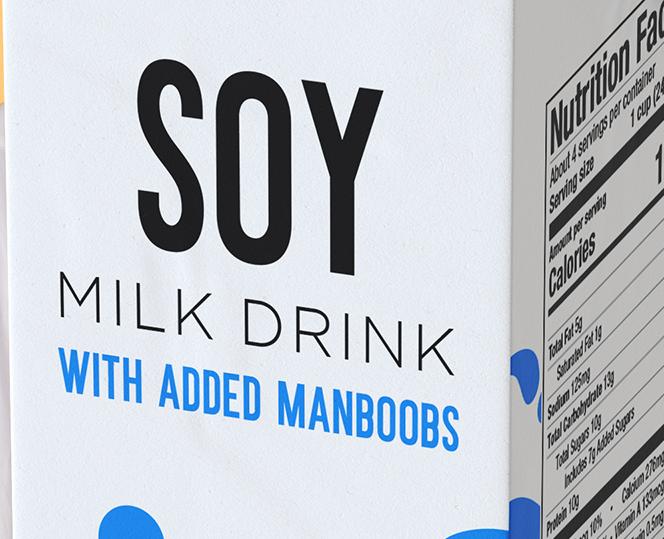
The official party line spouted by soy industry-sponsored researchers, like the prolific Mark Messina, is that soy ingestion “does not have feminizing effects on men.”
Of course, he would say that.
Mark Messina, we learn in the small print of one of his many pro-soy commentary papers, "regularly consults for companies that manufacture and/or sell soyfoods and/or isoflavone supplements, and he is the executive director of the Soy Nutrition Institute, a science-based organization that is funded in part by the soy industry and the United Soybean Board."
The Soy Nutrition Institute is an industry-created and funded group whose purpose is to shill the alleged benefits of soy products. It was founded in 2004 by the United Soybean Board.
Far be it from me to ever suggest that researchers who receive substantial sums of money from the industry they are defending would ever be anything less than 100% impartial and scientifically accurate in their conclusions.
The pro-vegetarian Messina is also an adjunct professor at Loma Linda University, owned and run by the pro-vegetarian religion known as Seventh-day Adventism. He has co-authored the pro-soy, pro-vegetarian books The Simple Soybean and Your Health, The Vegetarian Way, The Dietitian's Guide to Vegetarian Diets, and is editor of a peer-reviewed journal on vegetarian nutrition entitled Vegetarian Nutrition: An International Journal.
Far be it from me to ever suggest that researchers who are part of the intensely dogmatic world of vegetarianism would ever be intensely dogmatic about something like soy, which has become a staple protein-replacement source for vegetarians and vegans around the world.
Nevertheless, a lot of folks remained unconvinced. For over two decades, despite intense industry-funded propaganda, soy has established a reputation as a feminizing food. The term “soy boy” even entered the common vernacular, a derogatory term used to portray the male target as weak or feminine.
The content below was originally paywalled.
In 2004, Sally Squire of the Washington Post attempted to rescue soy’s sagging reputation among red-blooded men who had no desire to turn their plums into raisins with an infomercial-like piece titled “Eat Your Soy, Boy”.
Somehow, men were supposed to be comforted by the findings of Steven Zeisel and his colleagues at the University of North Carolina who fed “megadoses” of soy to men and observed nipple discharge, breast enlargement (gynecomastia) and slight decreases in testosterone.
According to Zeisel, “we still couldn’t find anything that was serious, and we went up to doses that are probably 30 times what you could get from normal foods ... I don’t think that there are a lot of estrogenic worries. Your testicles will not shrink and you won’t have massive breast enlargement.”
What an utter relief. You might get man boobs and nipple discharge, but at least your bean bags won’t shrink, fellas. And your breast growth won’t be “massive,” so no need to go shopping for a D-cup.
Curiously, despite its 'reassuring' results, the Zeisel study was never published, so we can’t determine exactly what constituted a “megadose.”
Follow the Science, Not Industry-Funded Ideologues
While industry-funded researchers and compliant journalists unrelentingly portray soy as hormonally harmless, numerous case studies have been published showing that soy can indeed exert feminizing effects.
In 2008, Martinez and Lewi reported on a 60-year-old man who was referred to the endocrinology clinic at Brooke Army Medical Center, Fort Sam Houston, Texas for evaluation of gynecomastia that had persisted for some 6 months. Along with gyno, the man reported erectile dysfunction and decreased libido.
Upon being questioned, he reported no changes in testicular size, no history of testicular trauma, no sexually transmitted diseases, and no change in muscle mass or strength.
Blood work showed his estrone and estradiol concentrations to be four times higher than the upper limit of the reference range.
Despite having estrogen levels that would impress a lactating cow, all other examinations were normal so the patient was interviewed again. It was at this point he fessed up to drinking almost 3 litres of soy milk daily.
After he discontinued drinking soy milk, his breast tenderness resolved and his estradiol concentration slowly returned to normal.
In a 2011 issue of Nutrition, Harvard researchers reported on a 19 year old Type 1 Diabetic lad who'd experienced a sudden onset of libido loss and erectile dysfunction 12 months previously.
The patient had previously been sexually active with normal libido, no STDs, no psychiatric issues, and no trauma to the family jewels. He denied taking anabolic or recreational drugs. Despite being otherwise healthy, the subject had been prescribed the useless and toxic statin Lipitor along with his anti-diabetic meds to “minimize cardiovascular risk factors.”
His initial blood results showed low free and total testosterone levels with elevated levels of dehydroepiandrosterone (DHEA). The percentage of free testosterone compared with total testosterone was 0.95% (normal range 1 to 2.7).
The patient was interviewed regarding his dietary habits, which revealed he had started a vegan diet shortly before the symptoms began. This diet included a large amount of soy products equaling 360 mg of isoflavones per day.
This included soy milk, soy cookies (soy crisps), tofu, soy sauce, soy nuts, and soybeans (edamame).
Before he started the vegan diet, he had been on a standard 2000-calorie-per-day American Diabetes Association diet.
Within 12 months of discontinuing the vegan diet and eliminating the intake of soy products, the patient noted gradual improvement in symptoms and normalization of sexual function. This beneficial turn of events was paralleled by a gradual normalization of testosterone and DHEA levels.
Gynecomastia, notes Sea et al in a 2020 case report, is a rare condition in prepubescent boys. They go on to describe an 8-year-old male who developed gynecomastia of the left breast.
Physical examination with a pediatric endocrinologist revealed no other abnormal findings. His serum estradiol, prolactin, chorionic gonadotropin and luteinizing hormone (LH) concentrations were all within normal ranges. His serum testosterone was borderline, siting right at the lower end of normal range at 2 ng/dL (reference range 2–8 ng/dL).
The patient had no recent exposure to estrogen creams, a common source of prolonged accidental estrogen exposure. The patient also reported no recent exposure to lavender or tea tree oil–containing products, which had been previously reported as a potential cause of prepubescent gynecomastia.
The boy’s mother reported he had a daily intake of various soy-containing products, consisting of:
imitation chicken soy nuggets (10–12 per day on 4 days each week);
imitation ground beef soy crumbles (2 days per week);
vegetarian soy chili (1–2 cans on 2 days each week).
His diet was estimated to provide 273–440 mg of phytoestrogens weekly.
The boy was counseled to discontinue dietary products containing soy, which he did within a week.
Upon follow-up five months later, the unilateral gynecomastia had notably regressed. At 10 months after the initial patient visit, the boy's mother reported complete regression of the gynecomastia.
In 2022, researchers from Showa University Fujigaoka Hospital, Japan, reported on yet another case of soy-induced erectile dysfunction and gynecomastia. The Japanese are incessantly held up as proof that soy is awesome, but the shady extrapolation involved in these claims didn't help the 54-year old chap who presented to the hospital.
Three years earlier, the man had started restricting his carbohydrate intake and drinking approximately 1.2 L of soy milk per day - a veritable double-whammy of misguided dietary faddism.
The man's soy milk consumption equated to approximately 310 mg of isoflavones per day. The average soy isoflavone supplement contains around 60 mg per serving.
After making the aforementioned dietary changes, the man subsequently noticed erectile dysfunction, and around a year later became aware of gynecomastia. When he further experienced malaise and muscle weakness, he visited a local physician who found low serum LH and free testosterone. The man was referred to the hospital, where tests showed low levels of LH, follicle-stimulating hormone (FSH), testosterone, and free testosterone.
The patient stopped drinking soy milk and restricting his carbohydrate intake the following month. Blood tests two months after that showed improved gonadal function.
"In men," wrote the non-soy industry-funded researchers, "an excessive intake of isoflavones may cause feminization and secondary hypogonadism."
In Summary
When a food item such as soy is vigorously hyped as healthy, some folks will inevitably adopt a more-is-better approach and consume large amounts of that item. When industry-funded researchers and media sources fail to report on the negative aspects of soy, these more-is-better types have little incentive to exercise restraint or, even better, avoidance.
In their case report of the 8 year old boy, whose consumption of soy products was entirely consistent with weekly ingestion of a staple food item, Sea et al concluded:
"While soybeans and soy-derived products can be an important source of nutrition for some, those with abnormal sensitivity to phytoestrogens may benefit from limiting dietary soy consumption to avoid potential adverse effects, including gynecomastia."
The obvious question is just how can anyone tell they have "abnormal sensitivity" to soy products, until it's too late?
It's not like you can take a quiz.
Some researchers propose that response to soy products may be influenced by an individual's ability to convert the isoflavone daidzein into equol in the intestine. Equol is the isoflavone-derived metabolite with the greatest estrogenic activity, and has been endorsed as having many beneficial effects on human health.
You know, like man boobs, erectile dysfunction and lowered testosterone.
Between one-third and one-half of human subjects (depending on the population) are able to produce equol, ostensibly those that harbor equol-producing microbes.
Interestingly, when challenged with soy milk, vegetarians were significantly more likely to be equol producers than non-vegetarians (59% versus 25%), suggesting that diet can also influence equol production in humans. Men were three times more likely to be equol producers than women.
Studies from Japan have shown 55–60% of Japanese adults typically produce equol when consuming soy foods. Interestingly, the frequency of equol producers in young Japanese adults is much lower than in older Japanese adults and similar to that of Westerners. The most plausible explanation is the change in the Japanese diet.
In 2007, researchers published the results of an experiment in which thirteen men, aged 25-47, were asked to consume two scoops (56 g) of pure soy protein powder (Puritan’s Pride) daily for 28 days. Serum testosterone and LH levels were collected before starting supplementation with soy protein powder and on days 14 and 28 of the study. An additional collection was taken on day 42 (14 days after the completion of the soy protein intervention).
At day 28, nine subjects had experienced small to large declines in their testosterone levels.
One person experienced no change, while three other subjects experienced increases.
At 42 days, two weeks after soy protein ingestion was ceased, all but three of the subjects experienced increases in testosterone. One subject who had experienced an increase at day 28 experienced a large drop by 42; another subject who had experienced a large drop at day 28 experienced a further drop at day 42.
This study shows that, when men are instructed to take the same soy protein product over 28 days, variation in the testosterone response will be observed. Most men will experience a decline, some no change, and others an increase.
Fretting over whether or not you will respond negatively to soy, or whether you are an "equol producer" and what role this may play, all seems rather redundant when far higher quality and less problematic sources of protein are readily available.
Those with dairy allergies or sensitivities may wish to investigate the use of branched chain amino acid (BCAA) supplements for pre- and post-workout use.
Leave a Reply