Miracle supplement? Dangerous poison? Or just another marketing fad?
One of the recent hot health trends on the Internet is a drug called methylthioninium chloride, more commonly known as methylene blue.
It’s being pimped as a cognition-enhancing nootropic with antidepressant properties, an energy-boosting supplement that will turbocharge your mitochondria, and even as an anti-aging therapy.
Methylene blue (MB) was first extracted in 1876 by German chemist Heinrich Caro. For a drug that was discovered almost 150 years ago, you’d think by now there would be a mountain of clinical trial evidence with human subjects.
You’d be mistaken.
The first thing that struck me when I began looking into this compound was the dearth of meaningful human research.
My skepticism shifted up yet another gear when I observed some of the characters linked to MB, and the lavish claims they were making. For example, ‘biohacker’ Dave Asprey, whose books and websites are a compendium of untenable pseudoscience, is promoting methylene blue.
In February, the suckernet was “buzzing” after the hopelessly hypocritical Robert F. Kennedy Jr. was filmed adding “mysterious blue droplets” to his glass mid-flight. Curiously, he wasn’t seen drinking it, but the clip quickly went viral, garnering over 21 million views.

Bobby Jr wouldn’t respond to media queries, but Gary Brecka, another spruiker belonging to the ‘biohacker’ fraternity (i.e. a bunch of marketing entrepreneurs claiming to know the ‘secrets’ to longevity), wrote on X:
“Looks like RFK Jr. is in on one of the best-kept secrets in biohacking—Methylene Blue.”
Brecka is perhaps best known for appearing in a video alongside bombastic UFC promoter Dana White, making some especially ridiculous claims for the former’s “10x Health System”.
When I witnessed the quality of evidence these shills were using to support their gushing appraisals of MB, my skepticism didn’t just shift up another gear - it went into overdrive.
The content below was originally paywalled.
This article by an American doctor, describing the alleged “Remarkable Health-Boosting Benefits” of MB, is typical of the exuberant claims being made.
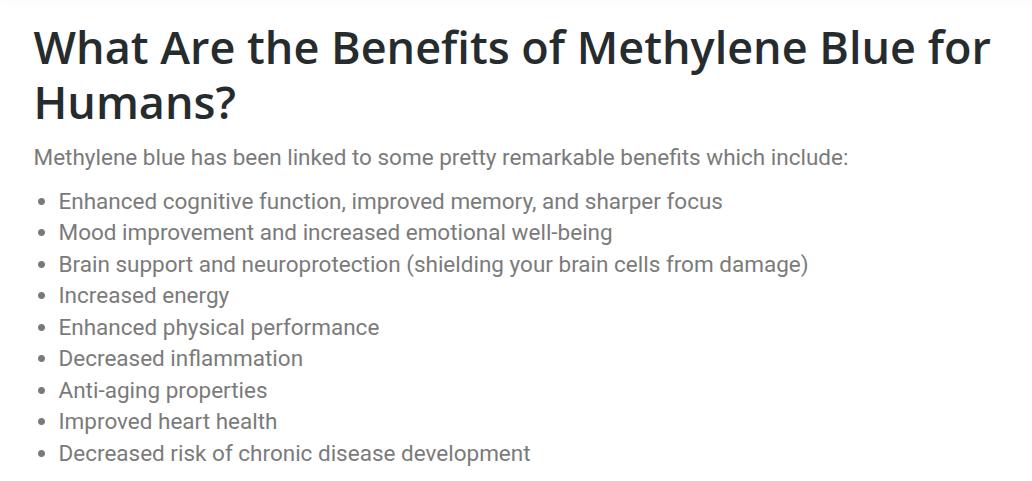
In support of these alleged benefits, the author - who is an affiliate marketer for the Troscriptions brand of MB - cites 9 references, three of which were Internet articles.
Of the six remaining citations that were actually published journal articles, not a single one was a report of a clinical trial involving human beings.
One was an overview about the “potential” of MB, co-authored by Kan Cao, founder of a company called Mblue Labs that markets cosmetic products containing MB.
Another was an animal study in which researchers surgically obstructed the carotid arteries of unfortunate rats, who were then injected daily with MB or saline solution. The MB-treated rats showed greater improvements in a visual water maze task, but the relevance of this finding to your average Homo sapien is highly questionable, especially given no differences were noted between another group of rats given MB or saline that did not have their arteries occluded.
The remaining citations (Oz 2012, Ginimuge 2010, Alda 2019, Gonzalez-Lima 2015) were discussion papers addressing either the specific medical/surgical/diagnostic uses of intravenous MB (of little relevance to the average consumer interested in health and longevity), or its “promise”, “potential” and purported mechanisms of action.
None of which even begins to support claims that taking oral MB supplements will make you smarter, sharper, more energetic, improve your heart health, enhance your physical performance, or slow down aging and make you live longer. To make any of those claims, especially in such a bold definitive manner, based on the current available evidence is pure quackery.
So is there any reason, aside from affiliate marketing income, to get excited about MB?
MB and its Legitimate Uses
Injectable MB is included in the World Health Organization’s list of essential medicines under the category “ANTIDOTES AND OTHER SUBSTANCES USED IN POISONINGS”.
The primary clinical use of MB is for a condition known as methemoglobinemia, which can arise from ingestion of certain pharmaceuticals and toxins, or broad beans in individuals with G6PD deficiency (who, ironically, must avoid MB).
Methemoglobin contains the insoluble ferric form of iron, so unlike regular hemoglobin (which contains ferrous iron) it cannot bind with oxygen.
Normal methemoglobin levels are less than 2% of the total hemoglobin count. Moderate symptoms generally kick in when methemoglobin levels reach 20-30%, while higher levels can result in seizure, coma, arrhythmia and death.
Methylene blue, when injected intravenously, triggers the conversion of methemoglobin to hemoglobin. Methylene blue can reduce the half life of methemoglobin from hours to minutes, which can literally mean the difference between survival or certain death.
An illustrative case was a 23-year-old female who presented to the emergency department after an intentional ingestion of sodium nitrate she obtained online. On arrival, her blood pressure was 89/42, oxygen saturation was 74% (normal is 95% to 100%), and her methemoglobin level was 92.7%, “which is among the highest recorded MetHb levels.” The patient received two doses of 1 mg/kg MB which not only halted her rapidly declining condition, but produced “dramatic clinical improvement and subsequent successful extubation.”
MB has also been used to treat encephalopathy induced by the cancer drug ifosfamide.
A number of studies have reported mortality reductions among vasoplegic patients undergoing cardiac surgery and administered MB.
MB has also seen use as a bacteriologic stain, an indicator dye, and for surgical and medical marking.
MB has been used in photodynamic therapy, which combines directed light and a photosensitizing chemical to elicit death in targeted cells. MB has been used as a photosensitizer for dermatologic conditions. MB is applied topically when used for this purpose.
MB was used in the past as an antidote for cyanide poisoning, but is no longer recommended for this purpose.
MB was also used in the past as a mild urinary antiseptic and stimulant to mucous surfaces in the treatment of cystitis and urethritis, but it is no longer recommended.
It has also been used for management of chronic urolithiasis. Drugs.com reports it may inhibit formation of calcium oxalate and calcium phosphate crystals, but is not currently recommended for this use and is ineffective in dissolving previously formed stones.
Because of its blue color, MB is also used as an industrial dye. Online articles pimping MB frequently claim it is the dye that gives denim jeans their blue color, which is incorrect. Blue denim gets its color from indigo dye.
All of which makes a 2018 report from researchers at the University of Leeds somewhat ironic. Especially so considering some MB shills are claiming the drug has anti-cancer potential.
After obtaining consent from patients undergoing routine endoscopic examination, they took biopsy samples from the same area of the colon before and after the application of identical amounts of methylene blue or indigo carmine dye (produced from indigo) onto the colonic mucosa.
Patients in the methylene blue group, but not those in the indigo carmine group, had significantly greater DNA damage in biopsy samples after dye spraying than before.
“Our study highlights the potential for the induction of DNA damage by methylene blue when used as a dye during colonoscopy,” wrote the researchers. “It is reasonable to suggest that any iatrogenic DNA damage induced in colonocytes by dye spraying should be avoided where possible, particularly in high-risk groups such as patients with ulcerative colitis. The efficacy of methylene blue versus indigo carmine during chromoendoscopy has not been formally compared, but if assumed to be equal, indigo carmine rather than methylene blue should be considered for use.”
What About the Alleged Cognitive, Mood, Energy, Anti-Aging, Etc Etc Etc Benefits?
Psychiatric Effects
Another of the doctors recommending MB online (and who also happens to be the COO of Troscriptions) says “Low dose MB also has antidepressant effects, functioning as a monoamine oxidase (MAO) inhibitor. Inhibiting MAO prevents monoamine neurotransmitter breakdown (dopamine, melatonin, and serotonin) which leads directly to increases in these neurotransmitters.”
Take a close look at what he did there.
He linked to a study that found MB, methylene green and acriflavine “were potent inhibitors of especially MAO-A” in rat brains - a truly yawn-worthy revelation that tells us absolutely nothing about the effect of MB on mood state in humans. MB and MG also reportedly “enhanced serotonergic behaviour” in the rats’ brains, which warrants another massive “who cares?” given that no-one has ever demonstrated a cause-and-effect relationship between serotonin levels in the brain and depression, anxiety or any other mood disorder.
What we need are randomized, double-blind, placebo-controlled trials that examined the effect of MB in depressed patients. A truly blind placebo condition is especially important in such trials, because unlike blood markers or hard outcomes like death, mood state is highly subjective and heavily influenced by suggestion. Antidepressant trials use psychiatric scales like the Hamilton Rating Scale for Depression (HAM-D) to measure outcomes, and improvements of a mere few points - while of doubtful clinical significance - are eagerly seized upon by researchers as confirmation of a drug’s ‘efficacy’. So again, it is crucial that trials of antidepressant and anxiety drugs are free of potential confounders that could induce a placebo effect.
Good luck removing those important confounders in any trial involving MB, because its use results in bluish-green urine, making it near impossible to achieve double-blind conditions. As soon as the MB subjects take their first blue-colored pees, they’ll know exactly which treatment group they are in. As a result, there is a very real possibility any claimed improvement in a subjective endpoint like mood is simply due to placebo effect. A subject may have simply had a good night’s sleep or a random string of better-than-usual days in a row, but knowing they are in the treatment group they may tell themselves - and the researchers - that their condition is improving.
Which casts a long shadow of doubt over the handful of small studies claiming improvements in patients with mental health conditions.
In years gone by, doctors would reportedly tell patients considered hypochondriacs, or to have psychologically-based symptoms, that their condition was caused by a benign tumor, and that MB would entirely dissolve the tumor. The patients were told they would know the treatment had worked when their urine turned blue. The purpose of this was to convince the patient their imagined ailment was treated, that they would take comfort from this, and hopefully their symptoms would resolve.
In an attempt to overcome the unblinding effect of MB, in the 1980s Scottish researchers conducted a double-blind crossover trial with 31 bipolar manic-depressive subjects already being treated with lithium.
The subjects began the trial with either a low 15 mg or therapeutic 300 mg dose of MB. The assumption was the lower dose would have no therapeutic benefit, while helping to ensure everyone in the study was peeing blue and therefore unable to tell which phase of the trial they were in.
We’ll discuss whether this was a valid assumption in a moment.
After a year, the subjects were crossed over to the other dose. If they took the 300 mg dose during the first year, they were switched to the 15 mg dose for the second year, and vice versa.
Only 17 of the 31 starters completed the two-year trial. All fourteen subjects who dropped out did so during the first year, with an equal number of dropouts in the low- and high-dose groups.
Of those who completed the trial, both medical and self-rating reported a significant reduction in the number of weeks “ill” and the number of weeks “depressed”. Medical rating also found improvement in a combined measure of severity and duration of illness.
Two decades later, Canadian researchers employed a similar design. Bipolar patients partially stabilized on lamotrigine (an anticonvulsant drug used for epilepsy and bipolar disorder) were randomized, in crossover fashion, to 15 mg and 195 mg doses of MB. The subjects spent 3 months on each dose, in random order.
Twenty-seven of the original 37 subjects completed the study.
The researchers reported they “found a significant effect of treatment” in favor of the therapeutic MB dose, as determined by a number of widely-used depression and anxiety rating scales.
Neither the active dose nor the placebo dose of methylene blue had any effect on mania.
In contrast to claims of MB being an effective nootropic, there were no differences between the low and standard doses of methylene blue on any of the cognitive tests administered.
In both the above studies, the researchers concluded that MB was a useful addition to treatment for bipolar depression.
But was that a tenable conclusion?
In addition to being marred by small patient samples and high dropout rates, there remains another key concern with both studies: The participants may not have been truly blinded. The researchers operated on the unverified assumption that the participants could not tell whether they were on the low or high dose of MB.
Unlike other researchers have done, the researchers did not ask the subjects during or after the study to guess which treatments they were given during the first and second phases. If they did, they never reported the results in their papers.
Given that “higher doses of methylene blue generally lead to more intense blue or green urine coloration” and a higher risk of side effects, it is not a safe assumption that low doses of MB will effectively blind participants to a higher dose.
Side effect rates would help reveal to the subjects which phase they were in, but the Scottish researchers did not report this. The Canadian researchers did, and the results are revealing.
In the group that began with the low dose, there were 4 dropouts; 3 due to withdrawn consent, 1 due to side effects.
In the group that began with the high dose, there were 6 dropouts; 2 due to side-effects, 2 because of clinical worsening (1 of these occurred after cross-over to the low dose), 2 due to “unrelated” physical illness.
So we had 5 people dropping from the high-dose group due to ill effects, versus only 1 in the low-dose group.
The proportion of participants who reported any side-effects in the low dose-first group changed from 13% at trial onset to 20% at crossover, and to 0% at the end of treatment with the high dose.
In the active-dose-first group, the proportion of those with side-effects changed from 57% at trial onset to 29% at crossover, and to 0% at the end of treatment with the active dose.
These figures don’t make sense. Despite what the dropout data suggest, the researchers are claiming side effects increased during the first low-dose phase, but decreased during the initial high-dose phase. The exact opposite would be expected to occur.
Side effect rates were far higher at commencement of the initial high-dose phase; if this wasn’t due to MB, then it would suggest important baseline differences between the two groups (separate baseline data for the low dose-first and the high-dose first groups was not presented).
The differences in the depression and anxiety scores reported by the Canadian researchers, while statistically significant, were of doubtful clinical significance. For example, on the widely-used HAM-D scale, the group that received the high dose first had a score that meandered between around 4 and 8 points over the 3 months.
Meanwhile, the group that received the high dose during the second phase experienced almost no change, their mean score meandering around the 10-point mark over the 3 months.
To place these results in context, a HAM-D score of 0–7 indicates “Not depressed” while a score of 8–13 indicates possible or mild depression. The subjects were not people who were snatched from the arms of suicide and safely delivered to a state of peace and serenity by MB; they were subjects who experienced very little, if any, ‘real world’ improvement in their mood state.
The bottom line is that the evidence for MB as an antidepressant is very weak.
Energy and Performance Enhancement
Those who sell MB like to say seemingly impressive, sciencey-sounding things about MB’s ability to donate electrons in “the process that powers ATP production. This donation boosts oxygen consumption and significantly increases ATP, giving your cells the energy they need to function optimally.”
and
“By accepting electrons, MB helps recycle NADH into NAD+, a crucial molecule for energy metabolism. Elevated NAD+ levels support efficient mitochondrial respiration and enhance cellular oxygen utilization.”
Again, we see the favored and shady method of extrapolation employed by agenda-driven commentators. In this case, they take findings from studies involving mitochondria suspended in buffer solution in glass receptacles, but don’t mention they were obtained from studies involving mitochondria suspended in buffer solution in glass receptacles. Instead, they write as if these findings were observed in studies where MB was given to real live human beings, and that these imaginary studies found those imaginary human beings enjoyed an increase in energy levels and physical performance.
That might work on the average Dave Asprey fan, but it doesn’t even begin to wash with yours truly. So I went looking for peer-reviewed RCTs on PubMed, and unpublished studies with results on ClinicalTrials.gov, examining the effect of methylene blue ingestion on energy levels, exercise performance and/or cardiovascular disease outcomes.
In. Humans.
I couldn’t find any. Which I’m guessing is the reason why the pro-MB crowd never cite any such RCTs.
Some MB marketers go beyond simply making misleading extrapolations from in vitro experiments, and venture into outright lying. In an article titled “Improving Sports Performance with Methylene Blue”, one such marketer claims:
“incorporating methylene blue into your training regimen can amplify your sports performance like never before.”
“With its established ability to enhance physical performance, improving focus and mental performance with methylene blue becomes an exciting next step for athletes striving for excellence in their chosen sport.”
“Methylene blue has been shown to have a profound impact on enhanced athletic performance and increased power output.”
“Its ability to enhance athletic performance and increase power output is unmatched by any other supplement on the market.”
“Methylene blue works by improving oxygen utilisation in the body, allowing for increased energy production during high-intensity activities.”
“This means that you’ll experience enhanced endurance and stamina, enabling you to push through even the most challenging workouts or competitions.”
“Additionally, methylene blue has been shown to improve muscle function and reduce fatigue, giving you an extra edge when it matters most.”
“Not only does methylene blue enhance physical performance, but it also boosts mental focus and cognitive function.”
“It stimulates brain activity, improving concentration and reaction time – crucial elements for success in any sport.”
These statements are all unequivocally false. MB does not have an “established” ability to enhance physical performance. The only thing MB has proven outside of its limited array of legitimate medical uses is the ability to inspire Internet marketers to concoct egregious nonsense in pursuit of supplement sales.
Again, the author fails to cite even a single study, let alone a blinded RCT, that shows MB can do any of the things he claims. When quoting him above, I have left the original hyperlinks intact. Click on them, and you’ll see they lead to articles that have nothing to do with MB.
On a personal note, I’ve been involved in the fitness and strength arena for four decades. In that time, I’ve read of and personally observed athletes and even recreational exercisers trying all manner of substances in an attempt to boost their performance and strength, or add some extra muscle. I’ve read countless exposes on doping, and I’ve marveled at the extremes competitive bodybuilders will go to in their pursuit of a trophy. If you could convince some of these folks that eating a mixture of sawdust and organic possum shit conferred a performance-enhancing effect, they would probably try it.
So if MB - a readily available substance discovered nearly 150 years ago - was effective in enhancing strength, endurance and reaction time, you can bet your last dollar elite athletes would have been all over it a long time ago. Yet I’ve never heard or seen MB being touted as a performance enhancer until recently.
That in itself speaks volumes.
Safety and Toxicity of MB
DNA Damage and Carcinogenicity
Studies examining the potential for MB to induce DNA damage have returned mixed results. I discussed above a study that found MB, but not indigo carmine, increased DNA damage when applied directly to the colon.
However, when Italian researchers added an oral dose of 200mg MB to the bowel prep of 10 patients undergoing colonoscopy, they reported no before and after difference in γH2AX, a biomarker of double-stranded DNA breaks.
This, of course, tells us little about the long-term safety of MB.
In his article at the Dave Asprey website, Dr Scott Sherr defines a low MB dose as 0.5 to 4 mg/kg. In an article at his Troscriptions site, he cites a “moderate dose” as 4 to 10 mg/kg.
In April 2008, the US DHHS National Toxicology Program reported on a series of MB toxicology studies performed in rats and mice.
Rats were tube fed MB at doses of 0, 5, 25, or 50 mg/kg, 5 days per week for 2 years. Additional groups of rats were administered the same doses for up to 18 months and evaluated at 2 weeks and 3, 12, and 18 months for hematology. Survival of all dosed groups of rats was similar to that of the vehicle controls.
Dosed male and female rats developed methemoglobinemia (at higher doses, MB paradoxically causes methoglobinemia), and females developed a regenerative Heinz body anemia (a type of anemia caused by the breakdown of red blood cells that contain Heinz bodies, which are clumps of damaged hemoglobin).
The incidences of pancreatic islet cell adenoma and adenoma or carcinoma (combined) were increased in all dosed groups of males, were significantly increased in 25 mg/kg males. The incidence of pancreatic islet cell hyperplasia was significantly increased in the 50 mg/kg males.
The incidences of capsular fibrosis (a condition leading to blurred vision) were significantly increased in all dosed groups of males and in 5 and 50 mg/kg females.
A similar series of experiments were performed in mice, who were tube fed MB at doses of 0, 2.5, 12.5, or 25 mg/kg, 5 days per week.
Survival of dosed male and female groups exceeded that of controls in a generally dose-related manner.
Dosed mice developed methemoglobinemia and a regenerative Heinz body anemia.
The incidences of carcinoma and of adenoma or carcinoma (combined) of the small intestine occurred with a positive trend in males. The incidences of malignant lymphoma occurred with a positive trend in females, and the incidence in 25 mg/kg males exceeded the historical control range.
Given that domesticated rats live an average 2-4 years, the human equivalent of these studies would see MB administered daily for several decades. Despite claims that MB shows “promise” as an anti-aging treatment, no such studies have been performed with humans.
Breast Milk Contamination
MB administration during breast feeding is discouraged since MB easily crosses the blood-milk barrier. After administration of 10 mg/kg MB via injection to lactating cows and goats, drug concentrations in milk 4-36 hours later were higher than those in blood. Unless necessitated by a medical emergency such as methemoglobinemia, pregnant and nursing women would be best advised to avoid MB until more is known about its safety.
Serotonin Syndrome
One clear contraindication for MB use is concomitant use of SSRI, SNRI and similar antidepressants, an already dubious and toxic class of drugs. Because MB is an inhibitor of MAO-A, administration of the drug to antidepressant users can lead to life-threatening serotonin syndrome, whose symptoms include disorientation, dizziness, headache, tremors, seizures, and mental confusion.
This phenomenon has been widely reported in subjects undergoing parathyroid surgery, where intravenous administration of MB is a common practice. For examples, see Khavandi 2008, Honore 2017.
As Top et al reported in 2014, the combination of antidepressant use and MB administration during thyroid procedures can prove fatal. They reported on the case of a 70-year-old female who used venlafaxine 75 mg twice daily, who was administered 9 mg/kg of MB intravenously prior to parathyroid surgery.
After surgery, in the recovery room, the patient suddenly became agitated. She evinced further neurological deterioration with profuse sweating and hypersalivation, and was transferred to the intensive care unit, where her temperature rose to 43.1°C. Although the temperature decreased after dantrolene administration, the patient died from circulatory collapse not responding to resuscitation, inotropes and vasopressors (drugs used in the hope of strengthening heart muscle contractions). A terribly sad and traumatic end to what should have been a routine procedure.
The administration of less than 5 mg/kg of MB in SRI-using patients was once considered “probably sufficient precaution.” Until 2009, when doctors reported on a definite case of serotonin toxicity precipitated by only 1 mg/kg of MB, given to a young paroxetine-using female patient during surgery for a pelvic malignancy.
Antidepressants are a highly problematic class of drugs. If you are currently taking them, I would advise not pushing the envelope further with concomitant MB use.
G6PD Deficiency
Glucose-6-phosphate dehydrogenase (G6PD) deficiency is another strong contraindication for MB use. A deficiency in this enzyme can lead to the breakdown of red blood cells, causing conditions like hemolytic anemia. MB can worsen the condition of the patient by increasing red blood cell breakdown.
Not everyone who has G6PD deficiency is aware of it, so testing is necessary before MB administration.
Conclusion
I’d love to tell you MB has a wealth of supportive research behind it, and would be a beneficial addition to your supplement arsenal, but that would be a big blue lie.
The current MB mania relies entirely on unverifiable anecdote, speculation, dubious extrapolation from in vitro lab experiments, and outright lies. Almost all the websites I came upon that were effusively praising MB were also selling MB, either directly or on an affiliate marketing basis.
Until such time science can confirm non-medical MB ingestion is a safe and effective endeavor for real live human beings, I’d recommend diverting your supplement budget to items with a far more solid research base.
Leave a Reply