Run and ride faster, and play harder, with the world's most popular drug.
Caffeine has been used for hundreds and possibly thousands of years for its stimulant effects. However, it wasn’t until 1978 that compelling evidence of caffeine’s performance-enhancing effects finally appeared in the peer-reviewed literature.
That was the year pioneering exercise scientist David Costill and his colleagues reported that caffeine significantly enhanced cycling performance. They had performed a crossover-style trial in which nine competitive cyclists (7 males, 2 females) were given decaffeinated coffee 60 minutes before performing time-to-exhaustion tests. Prior to one of those tests, in random fashion, the researchers added 330 mg of caffeine to the decaf brew.
After the researchers snuck the caffeine into the pre-test drink, the subjects were able to pedal at 80% VO2max for 19.5% longer. After consuming the decaf-only beverage, the subjects lasted an average 75.5 minutes before reaching exhaustion. However, after consuming the caffeinated beverage, they were able to pedal a mean 90.2 minutes before running out of gas.
Since then, a significant volume of research has confirmed that caffeine is highly efficacious for extending time-to-exhaustion.
While an increase in time-to-exhaustion clearly reflects an increase in endurance capability, it is not a marker of relevance to most athletes or serious exercisers. I’m not aware of any sanctioned athletic event in which contestants are simply told to run, cycle or swim at a set pace for as long as they can, with the winner being the person who lasts the longest before collapsing (or drowning).
Most such events are conducted over a predetermined distance, with the winner being the person first across the finish line. This is what we all know as a race.
A time trial is similar, in that you also need to complete the set course in the fastest time, but you are racing against the clock rather than alongside other competitors.
Some events, such as the cycling one-hour record, deem the victor the person who completes the greatest distance within a set time.
Even as a serious exerciser, chances are you set off on a run or ride with a predetermined course and distance in mind. I doubt any of you head off with the express purpose of running or riding until you drop, then having to make the call of shame to your significant other:
“Honey, can you come pick me up?”
“Not again, where are you this time?”
“Um … halfway between Melbourne and Sydney …”
Caffeine’s Effects on Time Trial Performance
The content below was originally paywalled.
So in order to determine caffeine’s effects on more relevant endurance scenarios, Ganio et al 2009 sought out studies involving time trial formats rather than time-to- exhaustion tests. Their literature search revealed 21 eligible studies containing 33 trials* in which the TT lasted 5 minutes or more.
Thirty of those trials showed positive improvements in performance with caffeine. Only 15 were statistically significant (p 0.05 or less), which may have something to do with the fact these trials had small sample sizes (the bane of sports science research).
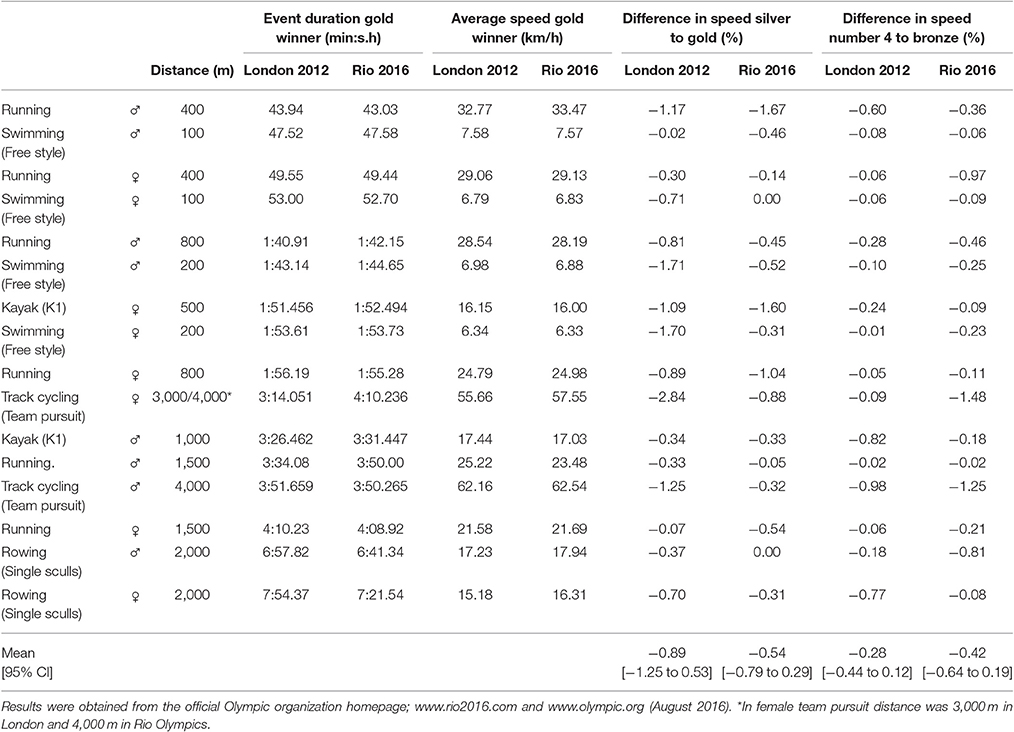
The mean improvement in performance with caffeine ingestion was 3.2%. That might not sound like much, but in highly competitive events such a margin can mean the difference between a gold medal and heartbreak. For instance, at the 2016 Rio Olympics, the gold and silver medalists in the female 4,000 m team pursuit track cycling event were separated by just 0.88% in average speed. In the men’s event, the difference was a mere 0.32%.
Unfortunately, sipping a couple of double-shots or popping some No-Doz before a big run or ride doesn’t guarantee a fixed amount of improvement in your time. The improvements detected in the Gaino review were highly variable between the examined studies (-0.3 to +17.3%). The largest mean improvement (4.4%) was observed in studies involving stationary cycling, which may have been due to the much larger number of studies employing this mode of exercise as compared to running, rowing, skiing and swimming (we’ll take a closer look at why caffeine studies have returned such heterogeneous results later).
More recently, Chen et al 2024 hunted down crossover, placebo-controlled studies examining the effects of caffeine ingestion on cycling TT performance. Completion time and mean power output were used as performance measures. They found 15 relevant papers reporting 35 trials.
Most of the studies administered caffeine supplementation 60 minutes prior to exercise, while one study provided the caffeine dose 90 minutes prior. One study initiated exercise following individual peak serum caffeine concentrations. None of the studies reported commercial sponsorship.
There was a significant effect of caffeine ingestion on time compared to placebo. Time reductions in most of the caffeine treatments ranged between 1.0%-4.5%, with two trials recording 0.5% and 15.9% time reductions.
There was also a significant effect of caffeine ingestion on mean power output compared to placebo. Changes in MPO ranged from a 0.7% reduction to a 9.3% increase.
The studies in the Chen analysis featured caffeine doses ranging from 1–6 mg/kg. As I touched upon in the previous installment, and will discuss further, the consensus range for caffeine efficacy is 3-6 mg/kg. Chen et al reported that when analyzed separately, only the improvements seen with 4–6 mg/kg doses were significant; the changes seen with 1-3 mg/kg did not attain significance.
However, it should be noted that only one study in their review directly compared different caffeine doses with each other. That study found 2 mg/kg produced a higher % increase in MPO than 1 or 3 mg/kg doses; time improvements were not reported. Again, small sample size may explain the failure of the 3 mg/kg dose to produce a significant improvement.
Not all the studies in the Chen analysis reported on subjects’ habitual caffeine consumption; among those that did, there was a wide array of reported daily intakes. One study reported a mean caffeine intake of only 59 mg/day, while another found individual intakes ranging from 253-620 mg/day. Habitual caffeine intake has long been posited as a factor that may affect the ergogenic response of caffeine, but there was no clear relationship between this variable and subsequent performance improvements.
Almost all the studies analyzed by Chen featured a withdrawal (coffee abstinence) period of 24-48 hours. One study had the subjects abstain for only 12 hours prior to testing, and still found improvements in both time and MPO after ingestion of 5 mg/kg caffeine prior to a simulated 20 km TT. That study screened for and excluded subjects who consumed less than 1 cup or more than 4 cups of coffee daily.
Again, there was no discernible relationship between the period of abstinence and subsequent test improvements, although the small sample sizes and disparate testing procedures (different distances/intensities) forbid us from reading too deeply into the results and making any firm conclusions. However, habituation and abstinence are variables that still feature regularly in discussions about caffeine’s performance-enhancing effects, so we’ll look at them in more depth later.
To recap, caffeine often produces mean improvements in simulated time trial performance, the effect most consistently observed with cyclists on ergometers (stationary bikes). The improvements are not generally as large as those seen in time-to-exhaustion tests, but enough to make a very deal difference in a competitive scenario.
Team Sports
Some of you may participate in team sports, rather than solo endeavors like cycling or running. Unlike endurance activities performed over prescribed distances, team sports tend to take place on a field or court and are characterized by frequent changes in direction and intermittent bursts of activity.
Salinero et al 2018 reviewed thirty-four crossover-design, placebo-controlled studies published between 2001 and 2018 that examined performance on variables related to team sports. Inclusion criteria were caffeine doses greater than 2 mg/kg and washout periods of at least 24 hours.
Their meta-analysis revealed caffeine increased single and repeated jump height, single and repeated sprint velocity, and reduced the time to complete agility tests. During team sport matches, caffeine increased total running distance, running distance covered at sprint velocity and the number of sprints. “The acute ingestion of a moderate dose of caffeine,” concluded the authors, “had a small but significant positive effect on several aspects related to physical performance in team sports.”
Gomez-Bruton et al 2021 reviewed the effect of caffeine supplementation on physical performance in adult female team sport athletes. They found eighteen crossover-design, placebo-controlled studies employing caffeine doses between 1.3 and 6 mg/kg.
Their meta-analysis results found caffeine increased performance in specific team-sport skills, countermovement jump, total body impacts (a proxy for the players’ match intensity) and handgrip strength. No effects were found on the ratings of perceived exertion, squat jumps, agility, repeated sprint ability or agility tests performed after fatigue. “The results of the meta-analysis,” concluded the researchers, “revealed that acute caffeine intake was effective in increasing some aspects of team-sports performance in women athletes. Hence, caffeine could be considered as a supplementation strategy for female athletes competing in team sports.”
Football (soccer) is the world’s most popular team sport. Mielgo-Ayuso et al 2019 reviewed the research on caffeine and soccer players and reported that 5 studies (100% of the number of investigations on this topic) found ergogenic effects of caffeine on jump performance, 4 (100%) on repeated sprint ability and 2 (100%) on running distance during a simulated soccer game.
In contrast, a meta-analysis by Ferreira et al 2021 found no differences from caffeine for vertical jump, repeated sprint tests or reaction time agility test in soccer players.
Haddon 2022 reviewed ten studies involving male and female footballers utilizing caffeine doses between 3-6 mg/kg. He found nine of the 10 studies showed a beneficial effect of caffeine on at least one performance variable.
Chen et al 2025 recently reviewed the research on caffeine and volleyball performance. Most of the studies included in their analysis used dosages of 3-6 mg/kg. They found caffeine supplementation improved volleyball-specific outcomes, including attack and serve accuracy, and increased the frequency of positive game actions during simulated volleyball matches. Regarding nonspecific outcomes, caffeine increased single-jump performance, repeated-jump performance, and handgrip strength, while decreasing agility test completion time.
Summary
Caffeine has a solid track record for improving endurance outcomes in time-to-exhaustion and time-trial tests. Improvements in team sport performance are harder to measure, as they cannot be quantified by simple time, distance or mean power output measures. However, most studies report caffeine doses of 3-6 mg/kg taken 60 minutes prior to testing or simulated matches to have a beneficial effect on at least one variable associated with performance in team sport activities.
In the next installment, we’ll look at caffeine’s effect on in-the-gym activities, such as strength training and HIIT-style sprints.
We’ll also take a closer look at some of the factors posited to impact upon individual response to caffeine intake, such as habituation, training experience and genetics.
*Please note: In this case, the number 33 is not a Masonic reference, it is genuinely the number of caffeine trials the authors found within the 21 relevant papers they retrieved. This is not a “PSYOP” to distract you from other effective ergogenic drugs. I have not been co-opted by the Caffinati or Freemacchiatos to suppress awareness of modafinil or creatine. My cabinet has not been penetrated by the World Cuppa Joe Forum. No self-respecting lover of percolated black coffee, American Staffies and the Ramones would ever have anything to do with those dastardly sods.
Leave a Reply