Does the change in routine trigger new size and strength gains?

The phrase "a change is as good as a holiday" suggests that making a change in your routine or environment can provide similar benefits to taking a vacation, such as refreshing your perspective and boosting your mood.
In the world of resistance training, a change in routine can also perk up your motivation and interest when things start getting a bit stale. Variation in the volume and intensity of training are also key facets of periodization, a strategy used by most leading coaches.
Traditional gym lore also holds that multiple work sets of the same exercise are superior to a single set. While an increasing volume of research disputes this contention, most people still perform multiple-set routines. Which means that, when researchers recruit previously-trained subjects to participate in 1-set versus multiple-set studies, most of those subjects will be coming from a background of multiple-set training.
Today, we’ll look at a study in which the exact opposite occurred: the researchers recruited people who had been training for at least one year on a single-set routine. These subjects were then divided into two groups, one of which began performing 3 sets per exercise for 13 weeks, while the other group continued with their single-set approach. Aside from the number of sets, their workout routines were identical.
So did the ‘novel’ stimulus of an increased set volume result in accelerated muscle and strength gains?
Let’s find out.
The content below was originally paywalled.
Forty-nine subjects were recruited for the study by Hass et al (2000)1, and randomly stratified into one of 2 training groups based on sex, age, leg extension strength, and amount of endurance training.
All subjects were between 20 and 50 years and active members of a Gainesville, Florida fitness center. All were recreational weight lifters whose training goals were “improved health and muscular fitness”.
During the 13-week intervention, both groups trained three days per week. The groups completed either one set or 3 sets, in circuit fashion, of the following exercises: leg extension, leg curl, pullover, arm cross, chest press, lateral raise, overhead press, biceps curl, and triceps extension using MedX machines.
Each set was performed for 8–12 repetitions to volitional fatigue. Initial load was set at 70-75% of initial 1RM strength depending on the exercise. Training load for a particular exercise was increased by 5–10% for the next workout when subjects were able to perform 12 reps or more for that exercise.
Subjects were instructed to perform each repetition with a standardized tempo using strict form. Subjects were allowed to rest up to one minute between exercises; the 3-set group was allowed to rest 3–5 minutes between circuits.
Each training session was conducted and monitored by the researchers, and subjects were encouraged to exert maximal effort on all sets.
The Results
Forty-two of the original 49 subjects completed the study (12 men, 30 females, mean age ~40). They had an average of 6.2 ± 4.6 years of resistance training experience, and had been performing one set of a 9-exercise circuit for an average of 2.7 times a week for at least 1 year.
All seven subjects who did not complete the study were from the 3-set group. Five were removed by the researchers for failing to complete a minimum 85% of the training sessions. Two subjects experienced tendinitis in their shoulder and knee joints and, after medical evaluation and physician clearance, both chose to withdraw from the study.
According to the researchers, results were similar for male and female respondents and so were presented collectively.
No significant differences were observed between groups in circumference measurements. The 3-set group did experience a significant increase in both their chest and flexed biceps circumferences following the 13-week intervention.
Skinfold measurements indicated the 1-set group experienced a significant reduction in their anterior thigh skinfold and a significant increase in lean body mass.
The 3-set group experienced a significant reduction in the sum of seven skinfold values, percent body fat, and a significant increase in the amount of lean body mass. No statistically significant differences were found between groups.
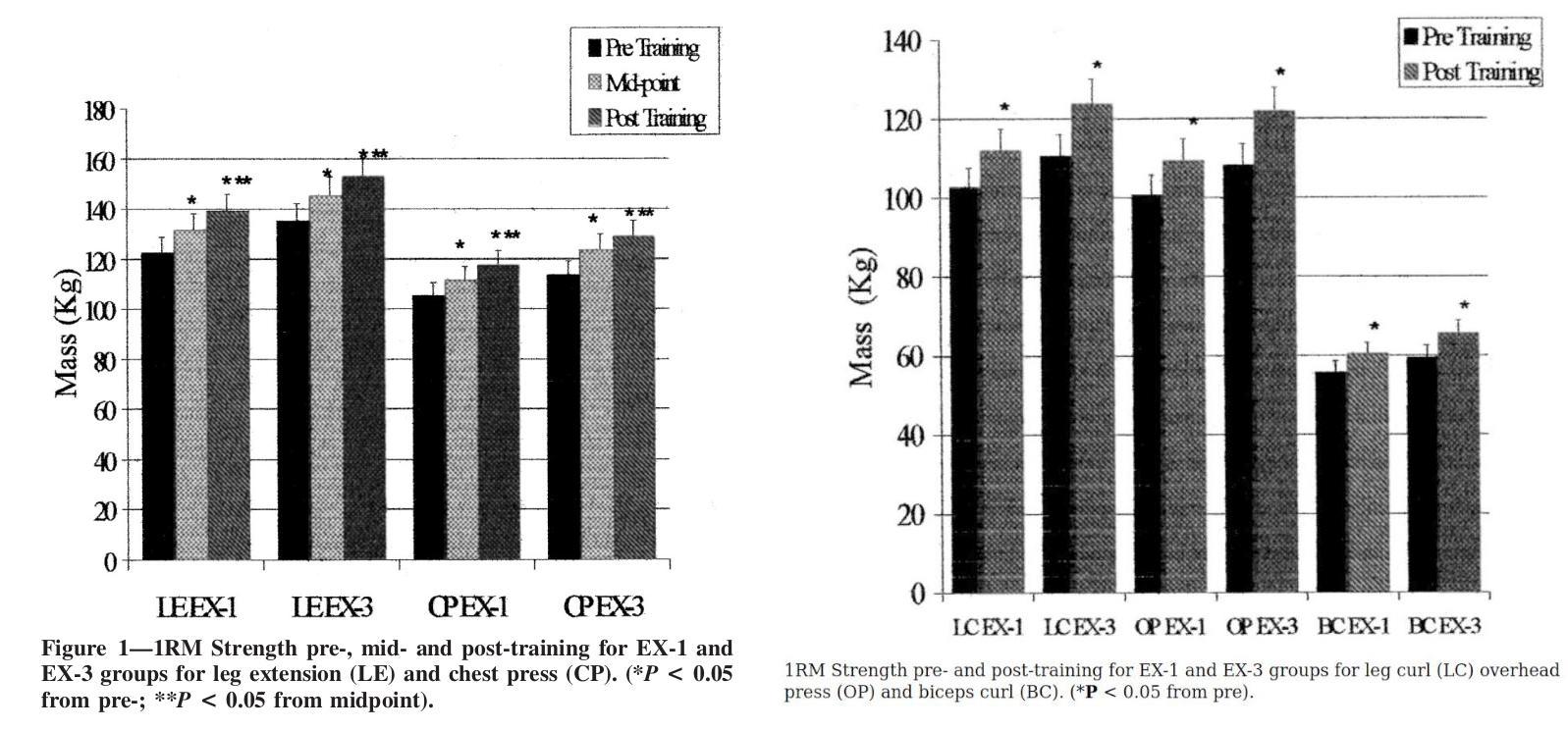
1RM was tested on the leg extension, chest press, leg curl, overhead press and biceps curl exercises. As the charts below demonstrate, no differences were seen between groups.
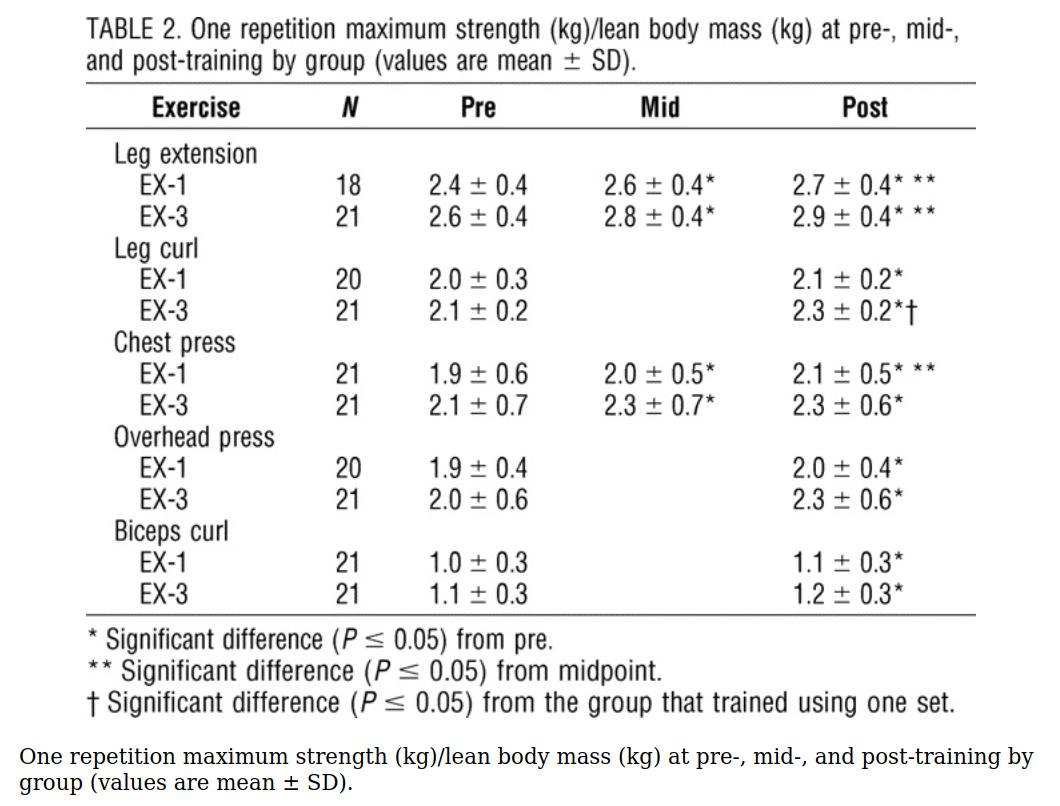
When 1RM was expressed in terms of kg lifted per kg of body mass, results were again near-identical:
Muscle endurance was determined by having the subjects perform as many reps as possible with 75% of their pre-intervention 1-RM. The 1-set group increased endurance for chest press and leg extension by 48.15% and 49.5%, respectively. The EX-3 group increased endurance by 58.4% and 66.7% for chest press and leg extension, respectively. There were no significant differences between groups
Discussion
In this study, switching to a multiple-set routine for thirteen did not produce any significant additional benefits in subjects previously performing one-set routines.
The only standout difference was poorer adherence and a far higher dropout rate in those assigned to the 3-set routine.
The 3-set group experienced more favorable skinfold results. The differences were not statistically significant, but this may have been due to the small sample size. Further, given the higher calorie expenditure necessitated by the multiple-set routine, it is not unthinkable that it may have lead to greater loss of body fat. However, given the lack of difference in 1RM outcomes, I’d suggest those seeking fat loss would be better served spending the extra time on cardiovascular work, perhaps in the form of high-intensity interval training (HIIT).
The study had its limitations. No mention is made as to why 28 subjects were initially assigned to the 3-set group, and only 21 to the 1-set group.
Body composition was determined by rudimentary methods (circumference and skinfold measurements). On the flip side, these methods are more likely to be employed in a real world gym setting than more advanced measures such as underwater weighing or DEXA.
The researchers did ensure only one highly trained investigator performed these before and after measurements, and female participants were not tested during or within 3 days of their menstrual cycle. Subjects were instructed to refrain from strenuous exercise for 24 hours before testing, from eating for 2 hours before testing, and from using caffeinated beverages, tobacco, or alcohol for 4 hours before testing.
Taking Less Time to Get Similar Results
Hass et al noted subjects in the 3-set group took approximately 1 hour to complete their workouts, compared to 25 minutes for the 1-set group.
As I’ve discussed previously, many comparisons of 1-set vs multiple-set training have shown little difference between groups; the studies that do typically feature anomalies that demand further explanation, such as substantial differences in mean baseline characteristics of groups.
When comparing 1-set and multiple-set routines, however, one thing remains indisputable: A three-fold increase in the volume of work, and a 2.4-fold increase in weight room time (or more), simply does not lead to a 2.4-3-fold increase in results.
Single-set training is not only a valid and viable method for improving strength and lean mass, but is by far the most time-efficient method of doing so. Currently, it does not get anywhere near the respect it deserves.
Hass, C. J., Garzarella, L., De Hoyos, D., & Pollock, M. L. (2000). Single versus multiple sets in long-term recreational weightlifters. Medicine & Science in Sports & Exercise, 32(1), 235.
Leave a Reply