When I'm about to put someone through a workout for the first time, be they a beginner or someone with previous training experience, I'll often ask, "What do you think is the most important consideration when training?"
The question tends to stump them, even if they've had previous training experience. It's not a question they were expecting, and there are countless possible answers.
If you were to walk into a gym and begin asking people the same question, and give them time to think about it, you might get answers like "training hard," "feeling the muscle that you're working," "eating plenty of protein," and "don't eat beans before a squat session."
All worthy answers - but all wrong.
The most important consideration by far when training is safety.
Because it's hard to make progress when you're sidelined by injury.
One of the most dreaded injuries is the distal biceps tendon rupture. This is when the biceps tendon crossing your elbow joint tears, and your biceps roll up your arm like a shutter. It's a nasty injury that requires surgical reattachment and around 4-5 months of healing time.
Often, the muscle will never look the same as it did before the injury, and your upper arms will be somewhat asymmetrical.
Obviously, it's a scenario you want to avoid at all costs.
Today I'm going to discuss some popular exercises that greatly increase your risk of a biceps tear. All involve subjecting the biceps to inordinate strain when it is in the supinated (palms up) position. It's a position that doesn't play well with excessive weight or sudden jolts.
The content below was originally paywalled.
Mixed-Grip Deadlift
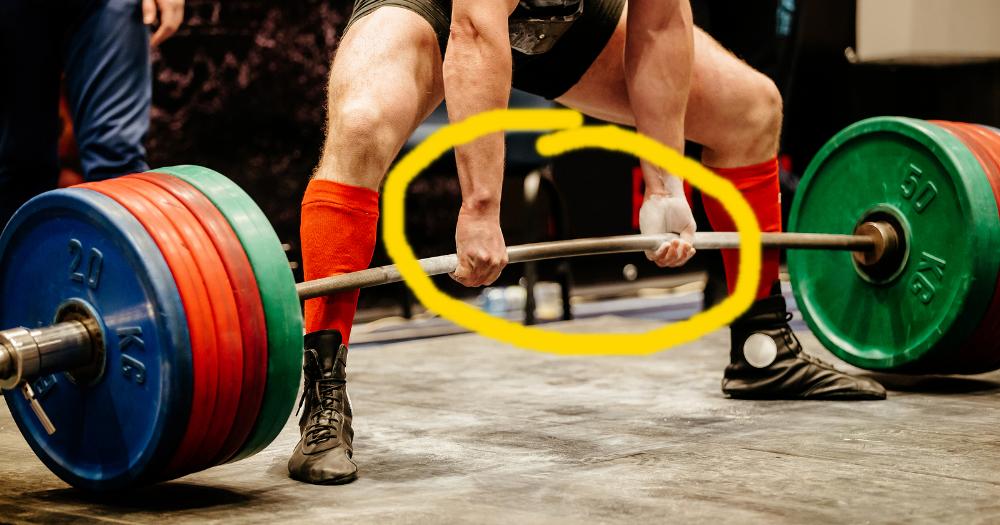
I love the deadlift. Not only is there something raw and primal about pulling a shite ton of weight from the floor, but it's a terrific posterior chain exercise. That said, the deadlift has sent a lot of folks to the operating theater for biceps reattachment surgery. The culprit is the mixed grip, where one hand is in the supinated position. After decades of torn biceps, I'm not sure why anyone is still teaching this version of the deadlift.
In 2021, a group of Turkish orthopedists published the results of an online investigation they'd conducted into strength sport-related biceps tears. They searched YouTube using the terms “distal biceps tendon rupture” and “distal biceps tendon injury” combined with “competition,” “deadlift,” and “powerlifting”.
Some 600 videos were reviewed, and among them, 35 featured injuries which met their inclusion criteria. All the participants in the videos were male. The majority of the injuries were observed during the deadlift: 71% (25) of ruptures occurred during a deadlift, 14% (5) occurred during a biceps curl, 6% (2) occurred during truck tire lifting, 3% (1) occurred during arm wrestling, 3% (1) during a stone lifting competition, and 3% (1) of ruptures occurred in the Bakasana pose during yoga.
The significant finding of this study was that all the deadlift-induced distal biceps tears occurred on supinated arms. One tear resulted from using a double-underhand grip where both hands were supinated; I cringe just thinking about deadlifting in this manner.
The remaining twenty-four deadlift-induced biceps ruptures occurred on the supinated side during the mixed grip version. No injuries were observed in pronated arms. Moreover, 75% of ruptures were observed on the left arm.
Again, I don't understand why anyone is still doing the mixed-grip deadlift, when there is a superior alternative available. I'm talking about the hook grip, in which both hands are pronated, and your index and middle fingers reach around the bar and 'hook' onto your thumb.
If you've never used the hook grip before, it does take some getting used to. Be warned: For the first few weeks, it will probably hurt like a beeyatch. After several weeks, however, you will get used to it and eventually it will become second nature. I've successfully taught small females to use the hook grip, so man up and embrace the brief period of discomfort. Somewhere in the world right now, a 5'5" girl weighing 58 kg is deadlifting like a machine, and she's doing it with a hook grip.
It's much more tolerable than a biceps tear.
Olympic lifters have actually been using the hook grip for years, however it is still something of a rarity in powerlifting.
If you're thinking that's because you can't possibly pull super heavy weights with a pronated grip, then you need to check the video below. It features current raw deadlift world record holder Dan Grigsby pulling an insane 487.5 kg (1074 lbs) using a hook grip, with not a wrist strap in sight!
I haven't used a mixed grip on the deadlift for almost a decade, and I don't plan on ever using it again.
I've found the hook grip doesn't lend well to constant repetitions; you'll probably need to quickly reset your grip at the bottom position of the deadlift while the bar is on the floor. Some of you may be already training your deadlifts in this style.
If you're doing high-rep sets, use lifting straps in order to maintain a fully pronated grip.
A video tutorial on deadlifting with the hook-grip can be found here.
Another alternative is the trap bar deadlift, an underappreciated and underrated version of deads that uses a neutral grip. Here's a good explanation of how to do it:
Whatever version of the deadlift you use, make sure that your arms are straight at the beginning of the movement. A common mistake I see is people beginning with slightly bent elbows, then snapping them straight as they go to pull the bar from the floor. Keep your arms straight from the outset.
Preacher Curls
"Preacher curls?!" I can hear some of you protesting, "what's wrong with preacher curls?!"
A lot.
In the fully extended position of biceps exercises such as standing dumbbell or barbell curls, the arms are in line with gravity. There is no undue strain on the biceps in that position.
Contrast this with the preacher curl, where in the fully extended position your arms are angled out in front of you while the weight is still bearing downwards. This means your biceps are being disproportionately loaded in their most vulnerable position - which can lead to disastrous outcomes like these (warning: graphic clips):
Ouch.
If you're doing preacher curls, and would prefer not to hear that nasty ripping or popping sound, kick their sorry butt out of your life. There are plenty of other far less perilous biceps exercises to choose from.
Underhand Grip Rows
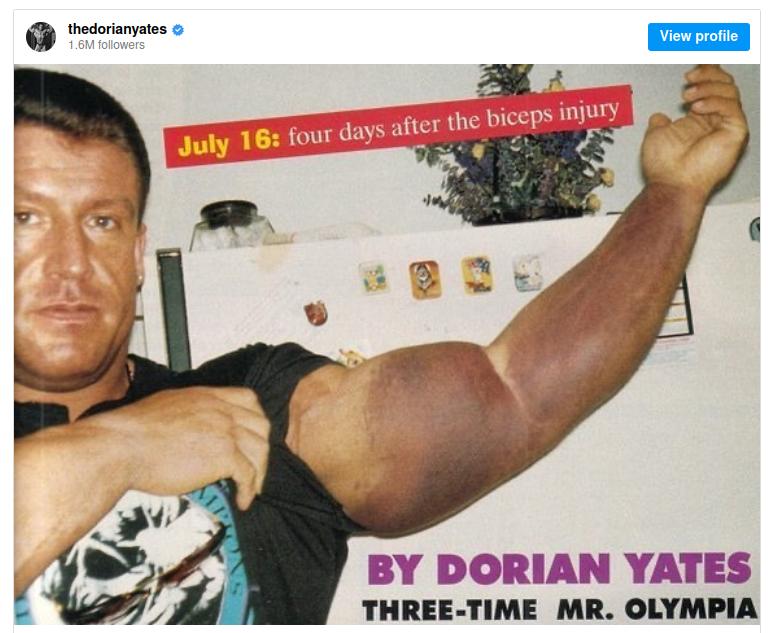
I like Dorian Yates, the former Mr Olympia who dominated pro bodybuilding during the 1990s. Unlike most pro bodybuilders, he always came across as down to earth and quite intelligent. Despite this, he for some reason embraced the perilous practice of performing underhand (supinated) barbell rows.
Yates was hell strong, which meant his rows were combining the worst of both worlds: Supinated hands and heavy weights.
The eventual result was a biceps tear, six weeks out from the Mr Olympia, which could have derailed his career. Thankfully, it was not a complete rupture and he was still able to compete and take his third Olympia title.
But the lesson was learned; Yates switched to an overhand grip and that's the style he now demonstrates in his seminars.
Dorian had been doing underhand rows for ten years prior with no issues, so just because you've been doing a questionable exercise for eons with no issues is no guarantee things will always be that way.
Other lessons Yates now imparts his trainees is not to train with crazy high-intensity during pre-contest (cutting) phases. You're not going to gain muscular size when consuming a calorie deficit; the goal is to maintain muscle and strip away body fat. Training with intensity techniques, aimed at stimulating muscle growth, during this depleted state is not just pointless but also raises the risk of injury.
The Tire Flip and Stone Lift
If you've ever watched "The World's Strongest Man", you've almost certainly seen these exercises. If you haven't, then here's a clip of the tire flip event from the 2017 contest:
The increasing popularity of strongman training has seen this exercise crossover into the mainstream fitness arena and become a staple of the 'functional' training crowd. Which is ironic, because this exercise provides little functional benefit for the average person or even most athletes.
What it does do is increase the risk of biceps tears.
In the start position, where you begin to lift one end of a tire weighing hundreds of pounds from the ground, your hands are supinated. It's pretty much a double-underhand deadlift, with a curling motion thrown in as the tire rises from the ground - an exercise no-one in their right mind would attempt in the gym with a barbell!
The stone lift is not as nearly popular outside of the strongman world, probably due to its inherently awkward and difficult nature. Not to mention the impracticality and potential hazards of heavy round concrete balls in a commercial training facility. Like the tire flip, successfully grasping heavy stones requires the hands and forearms to be at least partially supinated.
In a survey of 213 strongman competitors from 19 countries, the tire flip, yoke walk, and stone lift were ranked as the 3 most dangerous exercises. Of the 174 respondents who reported injuries, 18 sustained biceps injuries from the tire flip and stone work.
These competitors performed a mix of traditional weight training movements and strongman-style training. While 31% of their training involved the use of strongman implements, this style of training accounted for 66% of total injuries. In other words, strongman athletes were almost twice as likely to sustain injury when performing strongman implement training compared with traditional training.
In a 2022 case report, physical therapist Daniel Lorenz described a 39-year-old strongman competitor who suffered a distal biceps rupture while performing a tire flip during training. Despite a successful surgery and uncomplicated post-operative recovery, it took six months before symmetrical isokinetic strength of the elbow flexors was restored.
If you have your heart set on competing in strongman events, then you're going to have to do tire flips and stone lifts. For the rest of us, these exercises combine little practical benefit with a disproportionate injury risk. That's not an acceptable trade-off.
If you want an exercise that incorporates lifting something from the ground and an explosive hip thrust to get the weight to shoulder level, then power cleans are a much better choice - but only if you let go of the bar at the completion of each rep and let the weight fall to the platform. Attempting to catch the weight in the hang position - be it after a full or hang clean - is to invite a biceps or rotator cuff injury. Asking these small muscles to do what a lifting platform should be doing (stopping a heavy weight in free fall) is not a reasonable ask and will inevitably lead to problems. There's a reason why Olympic lifters dump the weight after a clean and jerk or snatch...
If you train in a facility that doesn't have a lifting platform or rubber-coated bumper plates, or where it's otherwise not possible to drop the weight Oly-style, then stick to hook-grip deadlifts.
Other Risk Factors for Distal Biceps Tears
The majority of patients with distal bicep tendon ruptures are males in their thirties and forties. Other common risk factors include increased body mass index (BMI), use of anabolic steroids and smoking.
Steroids are posited to increase the risk of tendon ruptures by two primary mechanisms: causing muscles to grow faster than tendons, and by directly affecting the architecture of connective tissue, in a manner that may render it more susceptible to tears.
While not officially recognized as a risk factor, cholesterol-lowering statin drugs are notorious for causing muscle and tendon problems.
Needless to say, if you're on the gear, using statins, or fall into any of the other high risk categories, extra caution is warranted and avoiding the abovementioned exercises becomes ever more important.
My new book, Not So Fast: The Truth About Intermittent Fasting & Time-Restricted Eating is now available at at Amazon and Lulu.
Leave a Reply