Or is the Joker simply part of the globalist bread and circuses charade?
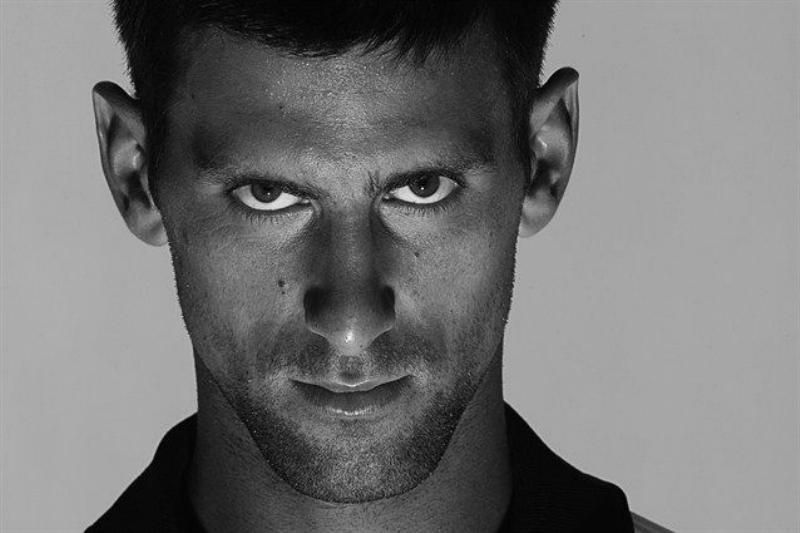
All is not as it seems.
Two days ago, GQ published an interview with tennis star Novak Djokovic, who in 2022 was supposedly detained and then deported from Australia due to his ‘unvaccinated’ status.
The deportation meant Djokovic could not compete in the Australian Open that year.
The GQ interview contained a bombshell allegation: Djokovic claims he was poisoned with lead and mercury while temporarily incarcerated in a Melbourne 'quarantine’ facility.
The full GQ interview can be accessed here. There’s quite a lot in that interview that Djokovic isn’t sharing with us, but before I explain more, let’s look at the portion dealing with his alleged maltreatment and incarceration by Australian officials prior to the 2022 Australian Open.
In January 2022, Djokovic arrived in Melbourne to play in the tournament at a time when Australia had a strict vaccination requirement for all citizens and visitors. A little after midnight on January 6, Djokovic was questioned by an Australian Border Force officer at the airport. He informed the officer that he was not vaccinated but had recently had COVID—and had received a medical exemption from an independent panel appointed by the Victoria Department of Health to visit Australia and play in the Open.
Things got very complicated from there. The officer and Djokovic went round and round for hours. Djokovic says the officer asked him to call the person who granted the exemption. It was the middle of the night. Nobody was awake. There was nothing he could do to satisfy the officer. So he was taken to a hotel that served as a detention facility to wait out an appeal. The story, which hit at a moment of potent COVID concern, went global—and seemed to penetrate like no on-court tennis story possibly could. The pile-on of criticism against Djokovic—who many people interpreted to be putting himself above the law or trying to skirt the requirements of the event and the country—was immense.
Now that we are three years on, how do you think about that moment—and has it evolved?
While he waited in the detention hotel, he says, “I had a paper with like a hundred items: from toothbrush, toothpaste, water, food, whatever. And I had to choose, tick the certain boxes, and each of these items carries a certain amount of points, and I had 60 points in total of what I was allowed to receive. So I did that 59 or 60 points, and I gave it to them. Twenty minutes later I come back and they say, we made a mistake, you don’t have 60, you have 30. So I was like, you must be kidding me.”
Still, he intended to continue preparing for the tournament. He’d been separated from his bags and was limited for a time to body-weight exercises—push-ups, sit-ups, running in place. The only food for the food-fastidious Djokovic was provided by the facility. “A lot of the athletes who were doing a quarantine for like 40 days before were also locked in the room,” he says. “But the difference is that obviously they were not in kind of a jail room and I was.”
He landed in Melbourne on Wednesday night into Thursday. He was in the hotel through the weekend. A court case on Monday that initially ruled on his status reinstated his visa. “And then when I won the case, I was free,” he says. “I mean free if you call this a freedom. Honestly, I was in a rented house and I was followed by police everywhere I went, and I had the helicopter hovering around the centre court where I was training. I was not allowed to access the locker room, main locker room. So they had to find an alternative locker room for me to change and take a shower and get me out of the site. So I was kind of like a fugitive there.”
A few days later—just before the start of the tournament—his visa was cancelled again and Djokovic was ultimately deported, he says, for being a “public threat.” For being “a ‘hero,’ ” he says, to the growing anti-vax sentiment in Australia just then.
“That’s the actual reason why I was deported from Australia,” he says. “That’s what the three federal judges said in the end. Their sentence is that they are not in a position to question the discretionary right of the [immigration] minister. It was so political. It had nothing really to do with vaccine or COVID or anything else. It’s just political. The politicians could not stand me being there. For them, I think, it was less damage to deport me than to keep me there.”
He says he never intended for the public to know whether he was or wasn’t vaccinated. He wasn’t trying to sneak into the country or skirt rules, he says. That’s the greatest misconception about the whole affair, he says. He’d applied anonymously and received the exemption anonymously, he says. This wasn’t about an exemption for the number one player in the world. He was only there because he’d received permission—he’d had COVID recently and consequently had antibodies. Later that year, Djokovic was unable to participate in the US Open due to CDC regulations barring non–US citizens from entering the country without being fully vaccinated. “With my situation in Australia, I was proclaimed to be a villain number one of the world,” he says. “And still even today, 99 percent of the people don’t know why I have been deported from Australia. On what basis. People think that I’ve been deported from Australia because I haven’t taken the vaccine. That I was unvaccinated and I tried to kind of force my way into Australia, which is completely untrue.”
“My stance is exactly the same today as it was a few years ago,” he says. “I’m not pro-vaccine. I’m not anti-vax. I am pro-freedom to choose what is right for you and your body. So when somebody takes away my right to choose what I should be taking for my body, I don’t think that’s correct.”
After being expelled from Australia, Djokovic boarded a private plane back to Spain, where his family was staying. On the way, he says, they rerouted his flight to Serbia. “Why? Because they had information through lawyers that if I land in Spain, I’ll probably go through the same thing as in Australia,” he says. And so he and his family met up in Serbia instead.
When he got home, he says, “I had some health issues. And I realized that in that hotel in Melbourne I was fed with some food that poisoned me.”
Wait, what do you mean?
“Well,” he says, “I had some discoveries when I came back to Serbia. I never told this to anybody publicly, but discoveries that I was, I had a really high level of heavy metal. Heavy metal. I had the lead, very high level of lead and mercury.”
You’re saying from maybe the food or something?
He shrugs and raises his eyebrows. “That’s the only way.”
(When reached for comment, a spokesperson from Australia’s Department of Home Affairs stated, “For privacy reasons, the Department cannot comment on individual cases.”)
So you were feeling very sick when you were going back to Europe.
“Yeah, very sick. It was like the flu, just a simple flu. But when it was days after that a simple flu took me down so much,” he says, he had an emergency medical team treat him at home. “I had that several times and then I had to do toxicology [tests].”
Can I assume that you never got the vaccination after all that?
“No, no,” he says. “Because I don’t feel like I needed one. I just don’t feel like I needed one. I’m a healthy individual, I take care of my body, take care of my health needs, and I’m a professional athlete. And because I’m a professional athlete, I’m extremely mindful of what I consume, and I do regular tests, blood tests, any kind of tests. I know exactly what’s going on. So I didn’t feel a need to do that. Also, what is important to state is knowing that I’m not a threat to anybody. ’Cause I wasn’t. Because I had antibodies.”
It all sounds pretty damning, but then Djokovic - who seems to be saying he was deliberately poisoned by bad actors in Australia - gets his forgive-and-forget on:
So given everything: As you return this year, is it water under the bridge for you in Australia?
“Well, for my wife and my parents and my family, it’s not,” he says. “For me, it is. For me, I’m fine. I never held any grudge over Australian people. In contrary, actually, a lot of Australian people that I meet, I met in Australia the last few years or elsewhere in the world, coming up to me and apologizing to me for the treatment I received because they were embarrassed by their own government at that point. And I think the government’s changed and they reinstated my visa and I was very grateful for that. It’s a new prime minister and new ministers, new people, so I don’t hold any grudge for that. I actually love being there, and I think my results are a testament to my sensation of playing tennis and just being in that country. I love the feeling of a kind of sports fever that is in that country throughout the entire year, particularly the tennis fever during that month. So I can’t wait to go back. I moved on. Honestly, I moved on completely. Never met the people that deported me from that country a few years ago. I don’t have a desire to meet with them. If I do one day, that’s fine as well. I’m happy to shake hands and move on.”
I should have known by the “I’m happy to shake hands and move on” sentiment in that last passage (shades of Bobbies Malone and Kennedy Jr) that something was amiss.
Has The Joker Been Pulling Our Leg?
Freemasonry is the apron-wearing cult that serves as a networking apparatus for globalist puppets. Among its prominent symbolism is the all-seeing eye.
Covering one eye to represent the all-seeing eye seems an especially popular method of signalling Masonic allegiance among entertainment and sports figures. Using the “666” symbol to do so suggests a penchant for Satanism and a signal that the individual has sold their soul to the devil, so to speak, in return for fame and riches.
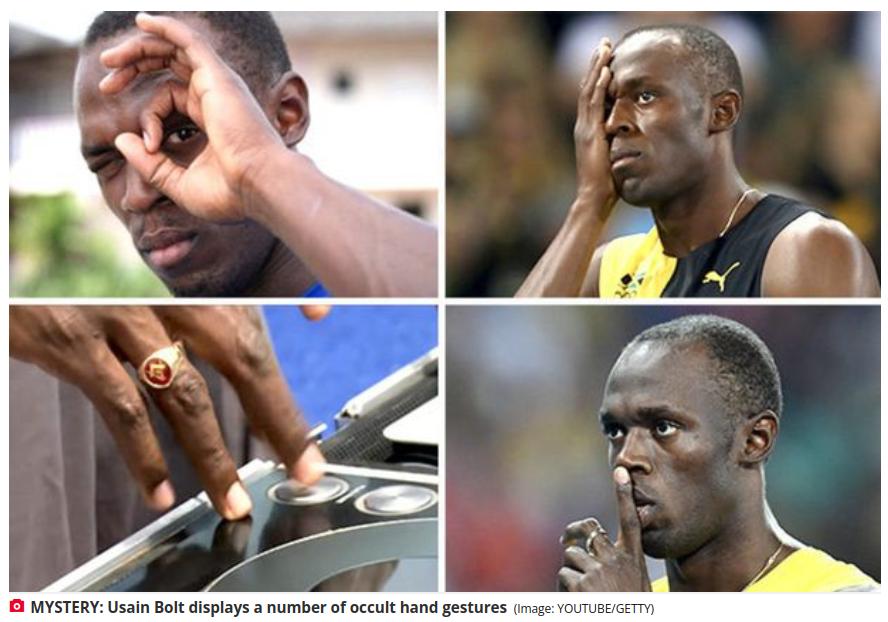
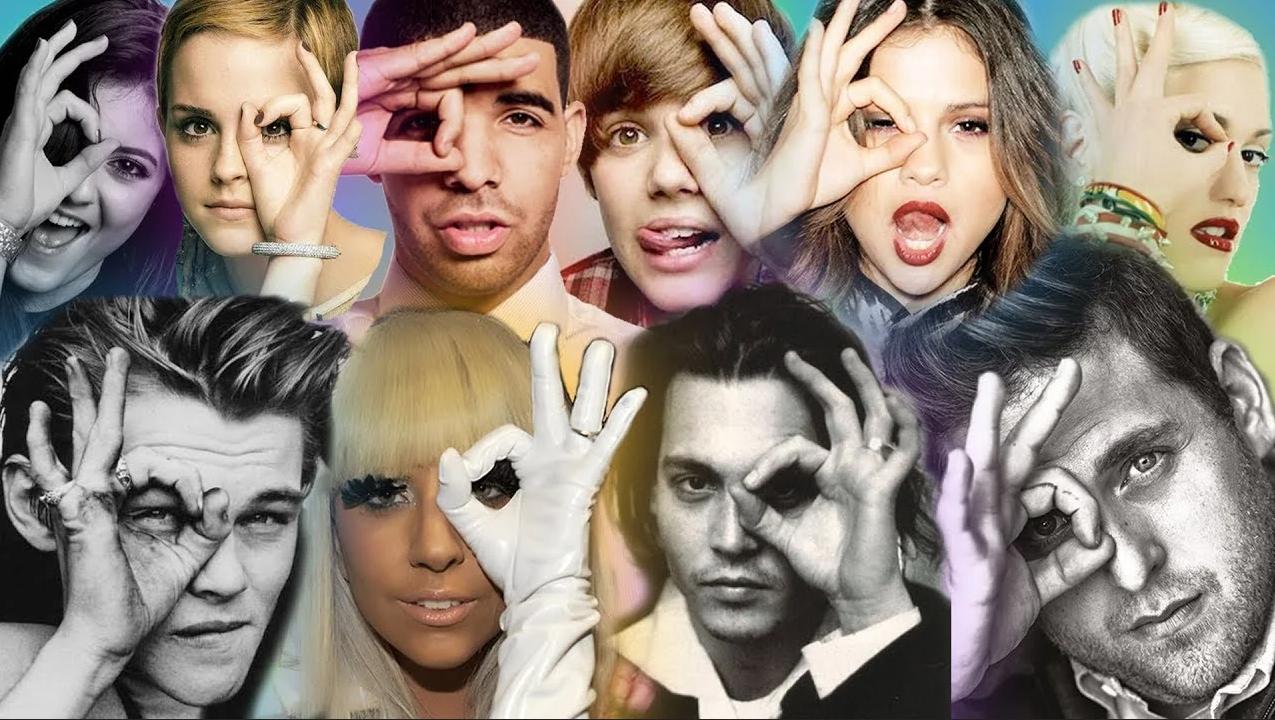
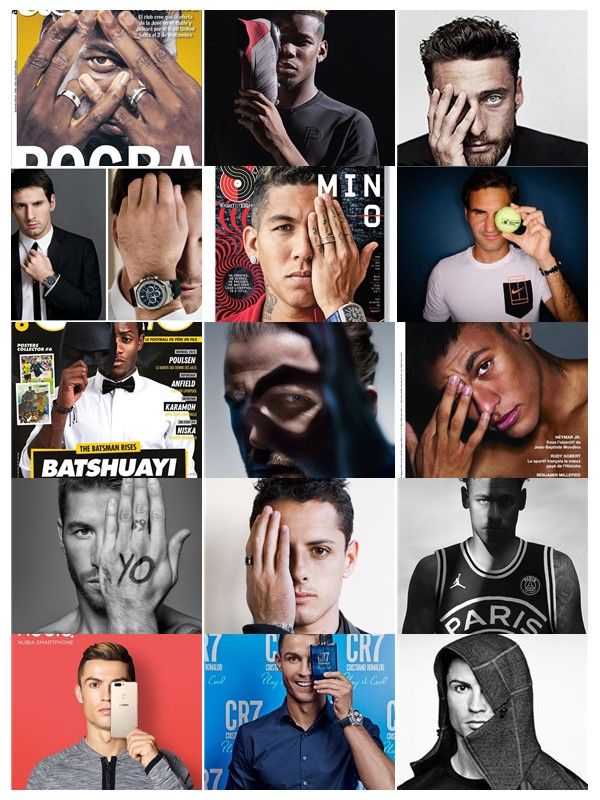
Okay, you get the point.
Freemasonry is a big cult, and if you’re reading this, you probably ain’t in it.
But it looks like Djokovic is.
In 2011, Djokovic was awarded the order of St. Sava of the First Degree, described as the highest distinction of the Serbian Church. The St. Sava Society was in fact founded in 1886 by “group of leading Belgrade freemasons from the 1890s.”
In 2012, Djokovic was awarded Serbia's Order of the Karadjordje's Star, First Class. The Order of Karađorđe Star was instituted by Serbian freemason King Peter I on 1 January 1904.
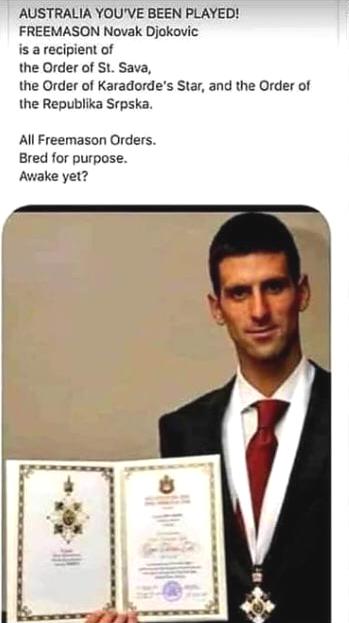
Masonic numerology is a common feature of psy-ops. Recent examples include Andrew Tate boasting of his 33 supercars to fellow globalist puppet, Greta Thunberg, and the initials of Corey Comparatore (C is the third letter of the alphabet, hence CC = 33).
All of which renders the video below especially revealing. It features Australian tennis star Nick Kyrgios interviewing Djokovic in front of a crowded stadium. The on-court interview occurred after Djokovic’s win against Taylor Fritz in the quarterfinals of the Australian Open 2024.
Kyrgios asks the Joker about a tree in Melbourne’s Royal Botanical Gardens that he allegedly hugs. “[C]an you just show me which tree that is cuz I need to get healthy cuz I'm sick of you winning on this court, and I just want to come back maybe once and beat you one time. Show me the tree, where's the tree?”
Djokovic replies: “Okay I'll show you the tree but you can't tell anyone, it's a big secret. So what you got to do is take off your shoes, climb the the tree, the highest point and hang upside down on one of the highest branches for 33 minutes and and 3 seconds and you're going to win a slam.”
Was this code for “Sell your soul to the devil, Nick, and maybe you too will finally win a Grand Slam”?
The highest level in Freemasonry is the 33rd degree. Along with the number 33, taking off one’s shoes also has a special significance in Masonry (“Third Degree: Removal of Both Shoes When On Sacred Ground”). Witness Trump wearing slip-on shoes to his WWE-style assassination hoax, then losing both during the pre-orchestrated fracas.
Jelena Djokovic and Marina Abramovic
Djokovic’s wife Jelena has publicly expressed her admiration for fellow Serbian, Marina Abramovic. Those of you who’ve done any research into the twisted tendencies of our so-called ‘elite’ (parasite) class will be familiar with this dubious character.
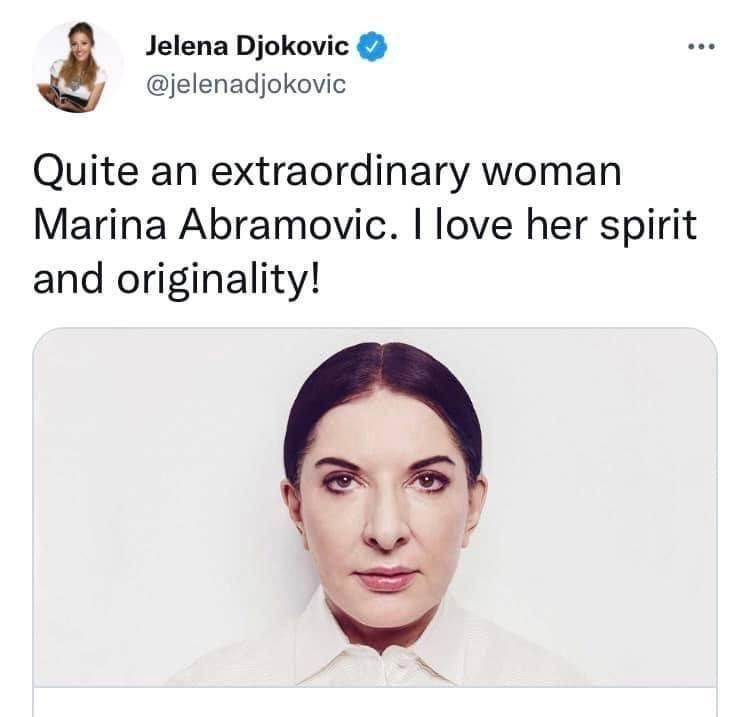
Abramovic, who also hangs out with dodgey celebrities like Kim Kardashian, is referred to by the media as a “performance artist.” This is how the globalist-owned fourth estate describes disturbing ‘art’ that promotes witchcraft and Satanism.
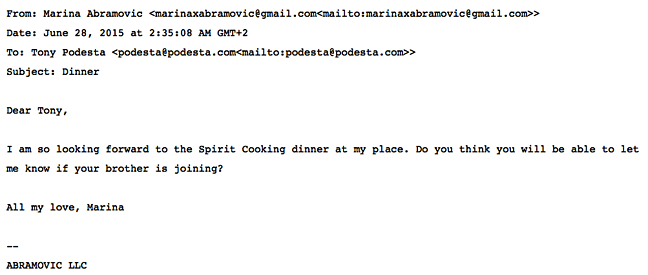
Exposed in the 2016 Wikileaks e-mail dump having connection to major politicians and celebrities, Abramovic’s activities include such kookiness as ‘spirit cooking’, which involves the using of real blood in creating her so-called ‘performance art’.
As if all that wasn’t damning enough, it turns out Djokovic has a close connection to none other than the World Economic Forum.
The Joker and the WEF
Like many wealthy folks, Djokovic has a foundation bearing his namesake.
That outfit, the Novak Djokovic Foundation, has partnered with the WEF to “reimagine education.”
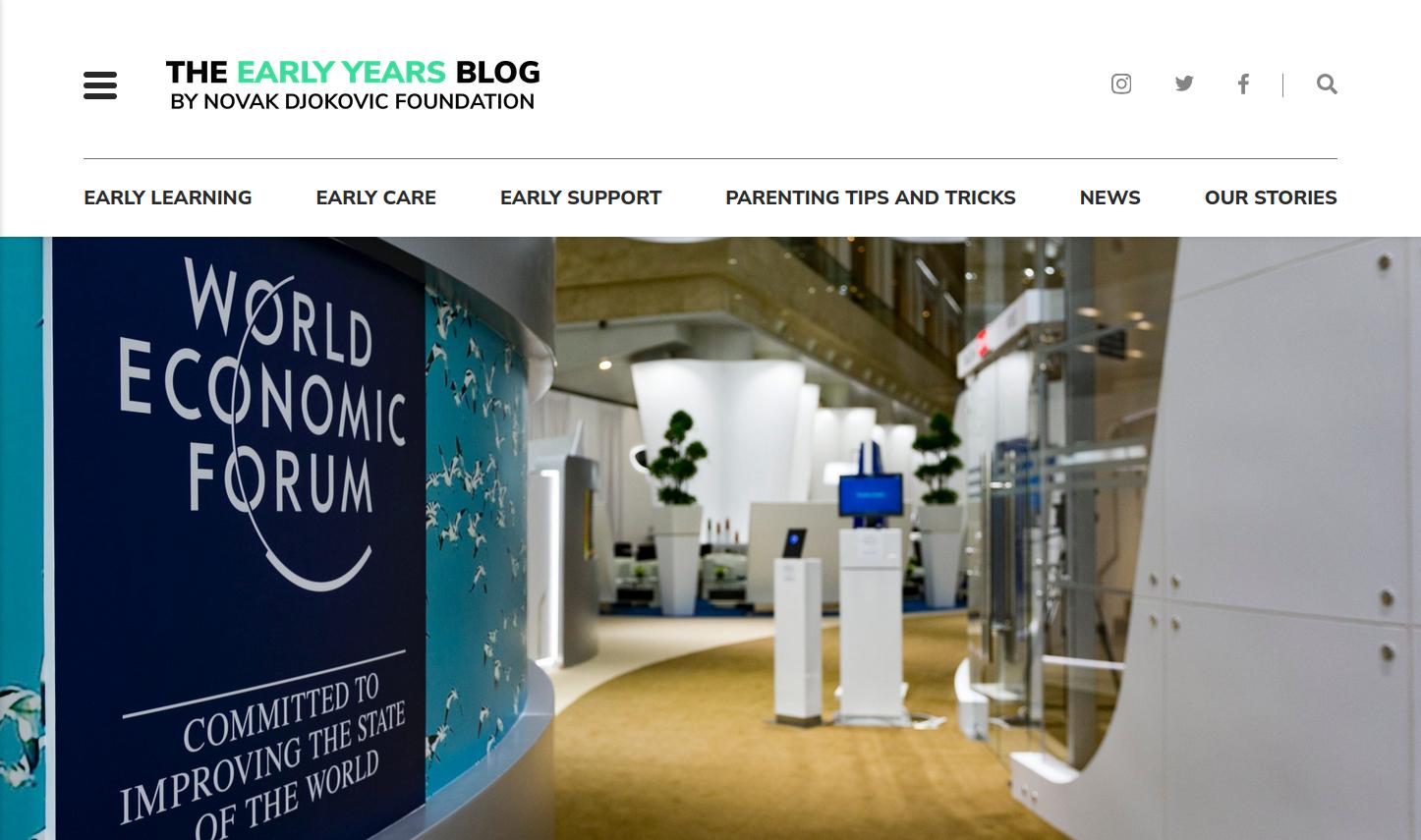
At a February 2021 Davos shindig - almost a year before the alleged “Novax” saga, which is now starting to look very non-authentic - the WEF and its predatory panelists made some worrying plans for the future of education.
The panelists gave lip service to developing “critical thinking,” which we all know is the last trait our puppetmasters want the compliant masses to develop.
The WEF was being far more candid when it said “Educational institutions will strive forwards a more holistic approach that will integrate interpersonal skills, ability to be a team player and a team leader.” (Bold emphasis added)
Far from cultivating critical thinking, the WEF seeks to further strengthen the current system of authoritarian leaders and unquestioning followers (team players).
“That’s why we need less much less focus on knowledge retention during early years. Acess to knowledge has expanded, so why do we educate in a same way?” (sic)
Yeah, why encourage kids to build a knowledge base inside their heads when they can simply absorb globalist-approved cognitive programming from digital media?
Novak Djokovic cannot seriously begin to claim he is unaware of what the WEF really stands for. He we are in January 2025, three full years after the highly publicized 2022 Australian Open drama, in which Djokovic was portrayed as the David facing down the Goliath of COVID tyranny. Yet his foundation’s website is still running propaganda for one of the most public faces of globalist tyranny.
But Wait, There’s More
Sky News reported on January 20, 2022 - as the “Novax” drama was playing out - that Djokovic holds a majority stake in Danish biotech firm QuantBioRes. Ivan Loncarevic, the CEO of QuantBioRes, said the Joker acquired the 80% stake in June 2020. He declined to say how much it cost.
The company has developed a peptide, Cov18A, to “inhibit” the non-existent Sars-Cov-2.
The company claims at its website that “QBRs peptide can be used to treat people who are ALREADY infected but also as PREVENTION of infections.” (sic)
Not surprisingly, it has zero published clinical evidence in real live people for this absurd claim.
Was It All A Lie?
When Djokovic returned to Melbourne in 2023 and won the Australian Open title yet again, anti-vaxxxers who couldn’t give two shits about tennis nonetheless reveled in his victory.
But the whole saga now looks very much like a pre-orchestrated sham.
If the Novax saga was a hoax, what was the purpose?
To create a highly public example of what awaits people who refuse the poison prick? To impress upon people that even the world’s highest paid sports stars aren’t exempt from vaxxxine mandates?
I’d be lying if I said I knew the answer.
What I can tell you is that Novak Djokovic is looking very much like another globalist puppet. Real freedom fighters and anti-vaxxxers do not partner with one of the world’s most notorious globalist outfits, they do not routinely flash Masonic symbolism and tell wanky stories to packed stadiums that involve Masonic numerology. They do not marry women who admire kooky artists whose work looks like an exercise in devil worship.
Novak Djokovic does all this, and more.
That alone makes him anything but a hero.
Note: This article, which originally focused on the recent GQ interview with Djokovic, was extensively updated on 12 Jan 2024 after I was made aware by kind readers of Djokovic’s WEF connections and his penchant for Masonic imagery (Bobby’s Network was one of the information providers who was all over this two years ago, while the rest of us were buying into the “Poor Novak!” charade). My profuse thanks to Inverted Reality for the heads up, and my apologies for not seeing through the “Novax” charade sooner.
Leave a Reply