Train shorter, more often: Get bigger and stronger, mo' quicker.
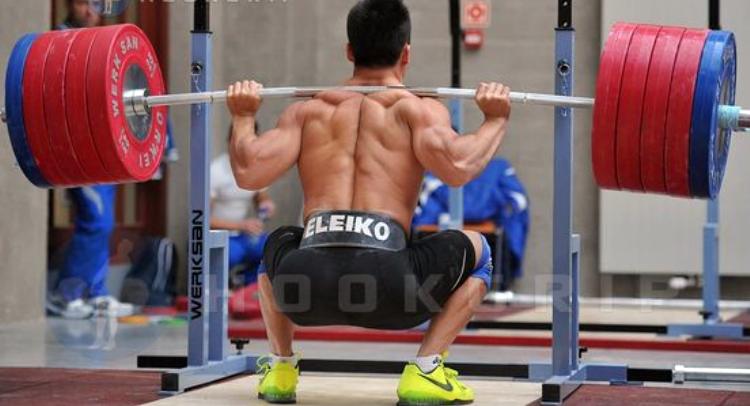
How many times should you train each muscle group per week?
The content below was originally paywalled.
When it comes to training frequency, the resistance training field is broadly divided into two camps.
The Ample Recovery Camp: At this end of the spectrum are those who believe a gym workout is an extremely taxing event, one that requires ample recovery. This camp typically believes you should never train a muscle while it is still sore, and that individual muscle groups should be trained only once or twice per week.
An example of someone who used a low-frequency approach with great success was Dorian Yates, who pretty much owned the Mr Olympia title throughout the 1990s. He trained 4 times per week, working each major muscle group once weekly.
The Frequent Stimulus Group: This camp operates on the premise that every workout is a growth stimulus, and therefore the more workouts you can perform and recover from, the more strength and hypertrophy you will experience. While this approach still struggles for acceptance in Western gyms, it has an indisputably world-class pedigree. Using very high-frequency training, the late Ivan Abadjiev transformed the tiny nation of Bulgaria into a gold medal factory that dominated international Olympic weightlifting until the early 1990s, at which point many Bulgarian lifters began migrating to other countries.
To address the inevitable rebuttal, yes, the Bulgarians used steroids, as did all their main competitors on lower-frequency programs, including the USSR and East Germany who had instituted extensive, state-sponsored doping programs.
As an aside, it’s interesting how steroid use only becomes an issue when people are seeking to discredit unconventional training paradigms. The gonzo steroid intakes of pro bodybuilders, who tend to use low-frequency routines, never seem to come up as an objection to training muscle groups only once or twice a week.
To comprehend just how remarkable it was for Bulgaria to trump the Soviets, consider this: According to weightlifting history buff Mark Morthier, in 1984, the USSR had 340,000 registered weightlifters. Bulgaria had only 5,000. This was a real life David beats Goliath story, and high-frequency training made it happen.
More recently, the Norwegian powerlifting team has used high-frequency training to produce numerous European and World champions. The team’s transformation began in 1997, when former German Olympic weightlifter and coach Dietmar Wolf was appointed as Norway's national powerlifting coach. He promptly began incorporating higher-frequency training methodologies from his weightlifting background, an approach subsequently validated in a study dubbed the Norwegian Frequency Project (see page 547 of this link for an abstract of that study).
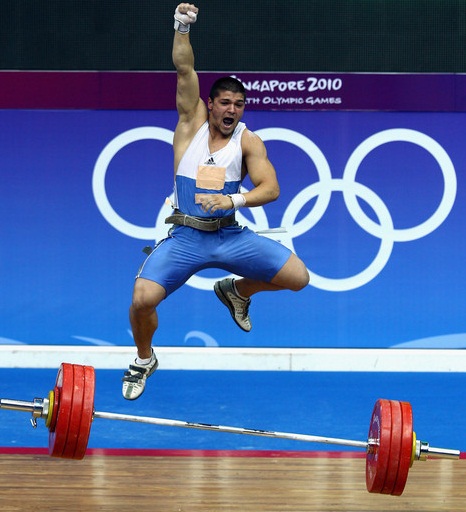
It must be noted that while Olympic lifting and powerlifting both involve picking up heavy objects and putting them down again, there are important differences between the two. The Olympic lifts involve hoisting heavy weights above your head, letting them crash to the floor, then doing the “oh, what a feeling!” jump when the judges green light the lift.
Powerlifting involves lifting even heavier weights, the kind you could never hoist above your head. The powerlifts (squat, bench, deadlift) involve grinding truck-heavy weights through much shorter ranges of motion. Not only are the weights much heavier, but there is a far more pronounced eccentric component to the lift, because you can’t just drop the weights when you’re done (you’d be disqualified if you did that on the squat or deadlift, and you’d promptly remove yourself from the gene pool if you dropped the weight after locking out on the bench press).
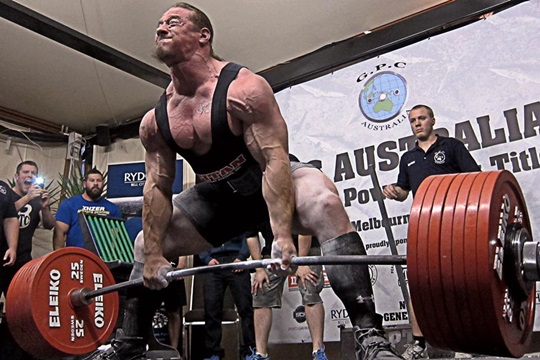
This helps explain why the Bulgarian Olympic lifters were able to train with near-limit singles and doubles on a daily basis, while the Norwegian powerlifters typically train using 71-80% of their 1RM.
Some commonsense is in order when performing daily training. If you do balls-to-the-wall squats, deadlifts and good mornings five days a week, expect to burn out and get injured.
Does This Work For the Average Person?
Some of you are probably thinking, “okay, high-frequency training might work for advanced athletes in Bulgaria and Norway, but they are genetically gifted athletes who probably tolerate higher training frequencies better than the average Joe and Jane. Therefore, I’m skeptical that high-frequency will work for regular folks.”
The Bulgarian and Norwegian regimens involve/d multiple daily training, up to six days per week. That is indeed a big ask for the average person holding down a full-time job. Even if we had the time, few of us would want to be hitting the gym multiple times a day. But that’s not what I’m recommending here. What I’m arguing here is that if high-frequency training enabled the Bulgarians to trounce an Olympic lifting superpower like Russia, a more moderate format might enable the rest of us to trounce slumps and sticking points in our own training.
Let’s quickly recap what the published research has found so far.
Follow the (Real) Science
In Part 1, we delved into the science of high frequency training. We saw how the research flatly contradicts popular bro-facts about training splits and frequency.
The science shows that, in populations ranging from complete newbies to professional rugby players and advanced bodybuilders, volume-equated full-body routines produced similar strength and hypertrophy outcomes to split routines.
The studies also showed total-body training performed 4-6 days a week produced similar results to both total-body and split routines in which muscle groups were trained 1-3 times weekly.
Not only that, but the high-frequency total-body routines tended to produce marginally better results. Sometimes the differences were statistically significant, in other instances they weren’t.
Three of these studies compared the ubiquitous Bro Split with 5 x a week total-body routines. In one study, the total-body routine produced greater gains in muscle thickness that were statistically significant. In all three studies, the total-body routines produced greater but non-statistically significant 1RM strength gains.
In stark contrast to reigning gym paranoia wisdom, the high-frequency total-body groups did not burn out or end up riddled with injury. Injury rates tended to be low, as all subjects were supervised by qualified trainers during their workouts. Dropout rates in the studies were similar between the higher- and lower-frequency groups.
Something Important Was Missing From the Low- vs High-Frequency Studies
To gain muscular body weight, you need to eat a calorie surplus. Sure, overweight people can simultaneously experience significant muscle gains and fat losses on a eucaloric (weight maintenance) diet, but someone already on the slim side is going to experience limited muscle gains unless they eat a calorie surplus.
Why am I mentioning this?
Because none of the studies comparing low- and high-frequency training routines accounted for this. In every instance, the subjects were either given no dietary advice or told to keep eating their usual diet. A few studies gave the subjects a drink containing 20-25 grams of protein after their workout, but none instructed the subjects to consume a calorie surplus.
If you search the web for information on high-frequency training, you’ll often see discussions about muscle protein synthesis, which is the incorporation of amino acids into skeletal muscle proteins. MPS is elevated after a workout, and is essential to the post-workout adaptations that can lead to increased muscle size.
To properly delve into MPS would easily fill a standalone article. In short, studies suggest MPS remains elevated for 24-48 hours after a workout. However, these studies almost unanimously show that around the 4-hour mark, MPS has already peaked and commenced its gradual decline.
One thing this tells us to pay close attention to is post-workout nutrition. I highly recommend, wherever possible, to consume a liquid source of high-quality protein and carbohydrate immediately after a workout, and a solid meal within 2 hours of consuming that drink.
The other thing the MPS research tells us is that the bulk of recovery after a workout may happen sooner than we think.
Which all got me wondering: What if the studies comparing low- and high-frequency routines had instructed the subjects to consume a high-protein, high calorie diet?
Earlier this year, I decided to find out, using myself as the guinea pig.
The Waiting For My Visa Experiment
Late last year, I figured I’d get out of anally-retentive Australia and try living in Thailand for a while. To those who’ve read my Mexico article, yes, I’m a glutton for punishment.
In order to obtain the requisite visa, my long time internet buddy Richard Nikoley highly recommended an immigration agent in Pattaya, a beachside city a few hours south of Bangkok.
Pattaya is famous for all the wrong things, and I’m not into any of them. But the visa process required handing over my passport to the agent while she worked her magic, which meant I was stuck in Pattaya for a full five weeks.
If you’ve ever been to Pattaya, you’ll know there’s not a whole lot to do there apart from go to bars and consort with shady ladies who love you “shot” time or long time, depending on how much money you wish to spend on meaningless, soulless sexual encounters (“you make choose, handsum!”).
The A-Train doesn’t pay for sex, nor does he make stops at STD Central to pick up promiscuous women.
I’d brought one of my bikes with me, but Pattaya isn’t exactly ideal cycling territory.
All of which meant I had a bit more time on my hands than usual. Which in turn provided an ideal opportunity to act upon the high-frequency training research I’d been reading, and to add the magic ingredient I felt was missing from that research: A hyper-caloric diet.
Within hours of busing into Pattaya, I was training at the local ‘hardcore’ gym. After a week of get-my-butt-back-into-gear training, I dived into daily workouts.
That second week, I trained for six days straight. And regretted it.
So I then promptly settled into a 5 x a week full-body routine, performed Monday through Friday.
The first week I trained legs daily, but lingering soreness in my right adductor/hip area told me to cut that back to 3 x weekly.
So I trained upper body 5 times a week, while thighs/hammies and abs were trained 3 times weekly (I don’t train calves in the gym because cycling alone gives me a decent set of diamonds).
On the left is a picture of yours truly, taken on February 18. By this point, I was around two weeks into high-frequency training. I liked what I was seeing and feeling, so figured I’d better start taking some happy snaps to document my progress. On the right is a more recent photo, taken on April 4.
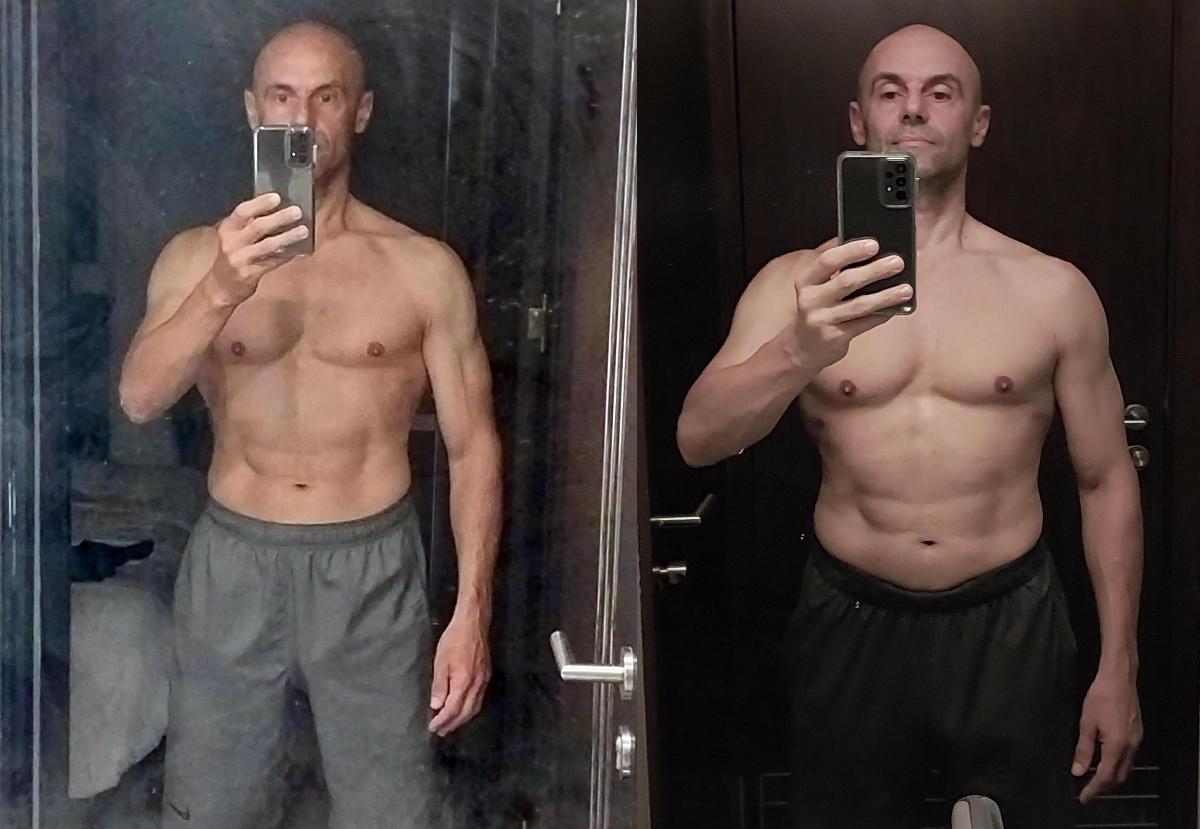
I don’t have a tape measure, so can’t tell you how my girth measurements have changed. I stepped on the scales at the gym yesterday, and the needle settled just above the 79 kg mark (I was 74.5 kg shortly before leaving Australia).
I know it’s not the most scientific of record keeping, but this whole experiment was a rather impromptu one. If it wasn’t for Pattaya and its dearth of non-sinful activities, this experiment may never even have happened.
What I can report is that I bought a pair of nice-fitting Helly Hansen shorts soon after arriving in Bangkok, that I subsequently had to discard in Pattaya because they became uncomfortably tight. The shorts I bought to replace them are now also on the verge of becoming indecently snug. All my tops are becoming noticeably tighter, too.
My strength has also increased steadily. In fact, at the Chiang Mai gym I’ve been training at more recently, I’ve been pushing the entire stack on the machine leg press for 30 reps - with one leg. Everything else has gotten stronger too. In fact, it’s been the longest, unbroken run of increased size and strength I’ve experienced in quite some time.
My purpose in posting these pics is not to impress upon readers what a magnificent specimen I am. Quite frankly, I’m nowhere near my all time best and still have some ways to go to get back there.
What I hope these pictures do show is that, even at age 56, it’s possible to not only tolerate daily upper body training and 3 x a week lower body training, but to thrive on it.
If this works for an old toot like me, imagine what some of you younger folks might be able to achieve with brief but frequent training.
I’ve been eating a lot, but by no means force-feeding myself. You can tell I’ve smoothed out a little since arriving in Thailand, but that’s pretty much inevitable on a bulking diet.
And before anyone asks, no, I’m not on the ‘Thai Vitamins’ or testosterone replacement therapy. I’m not even on creatine or BCAAs (my bike ate up most of my baggage allowance, and these types of supplements are quite expensive here in Thailand). For post-workout nutrition, I’ve been relying on milk protein drinks available here in supermarkets and convenience stores.
Which makes me wonder how much better my gains might have been if my usual creatine, BCAAs, whey and maltodextrin supplements were available.
Not to mention if I had access to proper cooking facilities. A ‘kitchen’ in a Thai condo typically means two induction hot plates and a microwave - not a real oven in sight. Ugh.
Some Key Considerations if You Want to Try High-Frequency Training
I’ve used high-frequency, full-body routines previously, but more as a short-term strategy to switch things up.
I’ve also used one-set-to-failure, or ‘HIT,’ training in years gone by, with mixed success.
I’ve always experienced my best results with higher frequencies. In fact, if I wanted to guarantee myself zero training progress, a Bro Split training individual muscle groups only once a week would be the ticket.
Prior to leaving Australia, I had already switched over to HIT training, but had discovered through experimentation that I got better results performing three full-body workouts weekly, compared to split routines where each muscle was trained only once or twice per week.
HIT advocates, heavily influenced by the late Mike Mentzer, often state that weight training should be “brief and infrequent.”
My own observations tells me it should be brief and frequent. If the late Mentzer and Abadzhiev sat down for a drink or three, and warmed to each other's ideas, this is what the resultant routine may have looked like.
If you want to try it, don’t dive straight into 5 or 6 full-body workouts per week. You’ll spend much of the weekend unsuccessfully fighting off an irresistible urge to sleep, like I did.
I’d start with 3-4 full-body workouts weekly, and ramp that up to 5 once you’ve settled in.
Unless you move quickly and train at a quiet gym, performing 3-5 work sets on a full-body routine will mean very long workouts. It’s not necessary. There is little to no quality research to suggest multiple sets are superior to single sets (see here). When you factor in the time spent:results achieved ratio, it’s a no contest. I tend to get in and out of the gym while others are still doing their 15th set of machine flyes.
I typically perform one work set, preceded by however many warm up sets I feel are necessary. Typically this will be a set using 50% of my working weight, followed by a set of around 75%, then my work set, where I typically shoot for 10 reps. With leg exercises, I aim for at least 15 reps.
I train to failure, but rarely beyond - save for the occasional drop set when I overshoot a weight increase and fall short of my target reps. Another exception is static holds at the end of a set of machine side lateral raises. Just because.
I typically perform 1-2 exercises per muscle group. I tend to use the same leg exercises on the M, W, F workouts. With upper body, I will use the same exercises M, W, F, and an alternate sampling on T, T. For example, you may wish to do flat bench presses or the chest press machine on M, W, F, and the incline equivalent on T, T.
It’s important to record the weights you use on your work or ‘top’ sets. Get your geek on and either take a notebook and pen with you to the gym, or use a phone app to log your workouts. The purpose of this isn’t just to stroke your ego when the weights go up (which, let’s face it, is always gratifying). Recording the weights you’ve used also serves as a very important recovery marker.
When I have a workout where the poundages stall or even reverse, despite doing everything else right (eating enough, sleeping well, etc), it’s red flag time. If I’m feeling a bit flat, then I take 7 days off. If this happens twice in a row, then no matter how I feel, I immediately take 7 days off.
This reliably happens to me every 4 to 6 weeks, no matter the routine. If I’ve stalled out on a Friday, I take a break from the gym and return the following Friday. I’ve done this twice since my first workout in Pattaya.
This is also why it’s important to establish a set routine. You can vary it slightly from day to day, but the format should be the same each week. This way you can reliably monitor your weight increases at least on a weekly basis. If you keep chopping and changing your workouts, this kind of monitoring becomes near impossible.
This is not a fat loss routine. Performing full-body routines 5 times weekly is taxing, and not something I would undertake on a hypocaloric diet.
Those still worried about training full-body on consecutive days might want to consider the results of two recent and interesting trials.
Consecutive versus Non-Consecutive Training Days
Traditionally, 3 x a week total-body routines entail at least one day’s rest between workouts. Yang 2018 (Singapore) and da Silva Carvalho 2018 (Brazil) compared a traditional 3-day per week full-body routine with the same routine, also performed weekly but for 3 days in a row.
In both studies, the traditional and consecutive-day routines induced similar improvements in strength and body composition.
The Possible Role of Individual Response
Damas et al 2019 (Brazil) reported on 20 subjects who were instructed to train one leg 2-3 a week, the other leg 5 x a week. At each workout, 3 sets of leg extensions were performed to failure. This was not a volume-equated study, which meant the legs subjected to higher frequencies were also subjected to a higher overall training volume.
Each protocol was assigned so that it occurred in an equal number of dominant and non-dominant legs.
To determine hypertrophy, changes in vastus lateralis muscle cross sectional area were measured by ultrasound before and after the 8-week intervention. Strength was measured by a unilateral 1 repetition maximum (1RM) test.
After eight weeks, the overall strength and hypertrophy increases were similar between groups. Individual results, however, showed wide variation.
For muscle hypertrophy, 6 individuals (31.6% of the sample) responded more to high-frequency, 7 individuals (36.8%) responded more to low-frequency, and the other 6 individuals (31.6% of the sample) showed no difference.
Regarding muscle strength, 5 individuals (26.3%) increased their 1RM more with high-frequency, 3 (15.8%) for low-frequency, and the other 11 (57.9%) showed similar responses between frequencies.
No significant correlations were found between total training volume and hypertrophy or 1RM, suggesting that frequency per se was responsible for the differences.
Another interesting finding was that individual muscle hypertrophy and strength responses were not aligned between training frequencies, i.e., some individuals showed better hypertrophic responses to high-frequency, but greater strength increases with low-frequency LF, and vice versa. Only 6 of 19 subjects (32%) showed an aligned response for muscle strength and hypertrophy with the same training frequency.
This was a small study that only trained a single muscle group with a single isolation exercise, which is a far cry from performing a total-body routine. However, the individual variation in results tentatively suggests some people may do better on high-frequency, others on low-frequency.
You won’t know until you’ve tried both.
A Change of Routine is as Good as a Holiday. Or Something.
Earlier in the article I mentioned how I’ve previously used high-frequency total-body training as a short-term ‘booster’ (the kind that reignites your training, not damages your myocardium). Researchers have recently stated there may be something to this.
Schoenfeld et al 2015 compared two different 3-day-a-week routines. One involved a full-body routine performed on each of the three training days; the other was a 3-way split routine where each muscle group was trained once per week.
After eight weeks, subjects on the total-body routine enjoyed greater and statistically significant increases in muscle thickness of the forearm flexors. Greater effect sizes were also noted for forearm extensor and quadriceps thickness, but the differences were not statistically significant.
In terms of strength, effect sizes for 1RM bench press favored total-body compared with split, but again the difference was not statistically significant.
The authors noted that during pre-study interviews, 16 of the 19 subjects reported training with a split routine on a regular basis.
"Thus," they opined, "it is conceivable that those in [total-body group] benefited from the unaccustomed stimulus of training more frequently.
A similar observation was made in Zaroni et al 2018 (where Brad Schoenfeld was also a co-author). Pre-study interviews revealed all the subjects regularly trained with a frequency between 1 and 2 sessions per muscle group per week. Therefore, the subjects who were randomized to the full-body group were all being exposed to a new stimulus in the form of a much higher weekly frequency (5 times per muscle group per week).
Conclusion
For at least some of us, working a muscle group only once or twice a week does not mean extra recovery and growth - it means losing whatever gains we achieved by the time the next workout rolls around. More frequent workouts mean more frequent incremental gains in size and strength. High frequency gets a high rating from yours truly.
Leave a Reply