The art of the bamboozle: How to turn a load of nonsense into a revered training principle.

Ever since the mid-1990s, bodybuilding and strength authors have been banging on about the importance of “time under tension” (TUT). Increase TUT, they claim, and you will increase muscle and strength gains.
But what on Earth are they talking about? Do they themselves even know?
Ladies and gentlemen, today we’re going to take a closer look at the TUT phenomenon, and discover why it may just be the most useless training principle of all time.
The content below was originally paywalled.
Much Ado About Nothing
I just typed “time under tension” into DuckDuckGo, and this is the AI-generated answer I got:
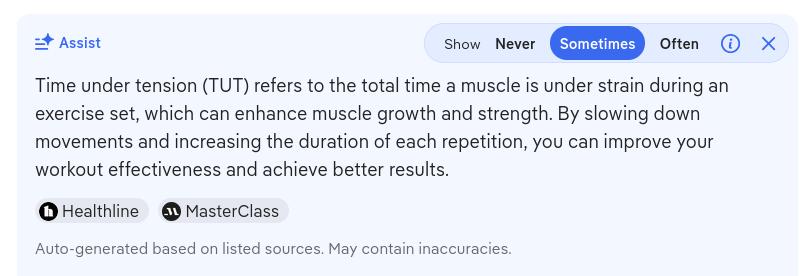
So if we are to take this TUT charade literally, the best way to get bigger and stronger is to keep our muscles under tension every waking moment. Lift weights all day, every day! An do it s-l-o-w-l-y!
“Tim, why are you doing reps with the water cooler? Aren’t you supposed to be working on the McDoherty account?”
“Sorry boss, no time for work, I need to keep my muscles under constant tension!”
This website claims:
“Time Under Tension is a crucial factor in stimulating muscle growth and strength gains. By increasing the duration of tension on the muscle fibers, TUT creates a greater metabolic stress and mechanical tension, both of which are essential for muscle adaptation and growth.”
“A slower tempo, such as a 2-4 second eccentric (lowering) phase and a 1-2 second concentric (lifting) phase, increases the time spent under tension for each repetition. This prolonged time under tension places a greater demand on the muscles, leading to increased muscle fiber recruitment and potential growth.”
No research is cited to support these claims.
This writer similarly claims:
“Lifting at a Slow Rate Creates a Higher Time Under Tension … The nice thing about a higher TUT is you will get better results.”
No research is cited to support this claim.
Meanwhile, this website says:
“Simply increasing total TUT may not be enough to maximize your workout and help you to get the most hypertrophy … Research suggests that paying more attention to the reps, slowing them down and controlling them, and doing fewer is the more effective way to increase TUT and reap the benefits. For example, instead of powering through 12 to 18 reps for 60 seconds, slow it down and do just 4 to 6 reps in 60 seconds. This will increase the window of time during which the muscles are actually under tension, therefore giving you more muscle growth.”
You’ll note how the author claims “research suggests” this is all true, but no such research is actually cited.
Because there is none.
TUT is a total crock.
The Rep Tempo Scam
Slowing down your reps does not make you bigger and stronger.
I completely dismantled the slow tempo charade a couple of months ago, right here.
To recap, studies consistently show that slowing down your reps makes you acutely weaker. Remove the arbitrary 60-second time limit cited above, and you will still won’t be able to perform as many reps, because you’ve neutered your force production by going unnaturally s-l-o-w.
What about over the longer term? Do slower reps that take longer to complete trigger some magical, mystical adaptation that leads to greater hypertrophy and strength gains?
Nope.
A review of intervention studies found hypertrophy outcomes were similar when training with rep durations ranging from 0.5 to 8 seconds.
Strength gains, meanwhile, are reduced with slower repetitions, with “super slow” reps (taking 10 seconds or more to lift the weight) producing the poorest strength outcomes of all.
Slowing down your reps does not increase “tension” in your muscles; to the contrary, it reduces your rate of force production. It does not increase muscle growth, and it retards your strength gains.
What about other methods of increasing “time under tension”, like using lighter weights so you can do more reps on every set?
Well, that will increase the time component, but reduce the tension because you’re lifting lighter weights which won’t require the same amount of contractile force.
For strength training, that’s a bad thing. When researchers get together and review the published intervention studies, they all arrive at the same conclusion:
Training with heavier loads (which limits the amount of reps you can perform per set) produces much greater increases in 1 repetition maximum (1RM) than training with lighter weights.
Meanwhile, hypertrophy gains tend to be similar when high-load and low-load training routines are compared (see Lacio 2021; Refalo 2021, Schoenfeld 2021).
Failure versus Non-Failure Training
If you are training alone and a stickler for good technique, the furthest you can take a single set of an exercise without resorting to partial movements is to the point of momentary muscular failure. This is where the weight stops moving, and you can’t complete another full repetition no matter how hard you try.
Obviously, taking a set to failure results in a greater “time under tension” than stopping short of momentary muscular failure.
If greater TUT increased strength and muscle growth, then this would mean training to failure would consistently lead to better strength and hypertrophy gains.
Except that is not what the research shows.
Numerous reviews have examined this issue, and they have consistently found little difference in strength outcomes when failure and non-failure training are directly compared in intervention studies. In fact, there seems to be a non-significant trend in favor of non-failure training (Vieira 2021; Robinson 2024).
Keep in mind these studies rarely last longer than 3 months. Training to failure every workout, every week, every year, will very likely lead to a level of fatigue that will stall your strength gains.
When it comes to hypertrophy, things get a little murkier. Those same reviews indicate training to failure may enhance hypertrophy gains, but the evidence is inconclusive.
A number of recent intervention trials have thrown further doubt as to just how necessary training to failure is for muscle hypertrophy.
Lasevicius et al 2022 found 8 weeks of training to failure or not to failure using a 80% 1RM load led to identical increases in quadriceps cross-sectional area. The mean number of reps per set in the failure and non-failure conditions was 12.4 and 6.7, respectively.
When a very light 30% 1RM load was used, training to failure produced a similar increase in quad CSA to the heavier loads (7.8%). However, no significant change was observed when the 30% 1RM load was employed without training to failure (2.8%). The mean number of repetitions in the 30% 1RM failure and not to failure conditions was 34.4 and 19.6, respectively.
The subjects were untrained, so this study underscores that newcomers need to be drilled on good technique and training habits, rather than flogged mercilessly to failure.
But what about trained subjects?
Ruple et al 2023 recruited participants whose mean self-reported resistance training experience was 6 years, and randomly assigned them to either a low-repetitions-in-reserve (RIR) or high-RIR group.
RIR is a method of gauging training ‘intensity’ that relies on subjective perception of how many more reps you can pump out before hitting failure. For example, if you shoot for a 5 RIR, you will terminate the set when you perceive you have another 5 reps in the tank. If your target is 1 RIR, it means you’re aiming to stop one rep short of failure. If your target is 0 RIR, you’re training to failure.
The RIR method is gaining in popularity, probably because it reduces the need to modulate training load with (sometimes elaborate) percentage calculations. Unlike programs based on rigid percentages of a 1RM you hit a few months ago, RIR also accommodates for the fact that your energy and strength fluctuates from day to day.
Ruple and colleagues had their subjects train thrice weekly for 5 weeks, performing the squat, bench press, and deadlift twice a week. One group was instructed to perform each training set with 0–1 RIR, while the other group was instructed to maintain a 4–6 RIR.
After 5 weeks, similar increases in vastus lateralis CSA and squat, bench, deadlift 1RM were observed in both groups.
Refalo et al 2024 also used the RIR method with resistance-trained subjects (mean 7+ training years) during an 8-week intervention involving two weight sessions per week. Lower limbs were randomized to perform the leg press and leg extension exercises either to momentary muscular failure or a perceived 2-RIR and 1-RIR, respectively.
So each subject had one leg trained to failure, while the other leg was trained using the RIR targets.
Before- and -after increases in quadriceps thickness were similar for failure training [0.181 cm] and RIR training [0.182 cm].
Conclusion
Time under tension just may be the dumbest and most pointless training principle I’ve come across. Saying you should increase time under tension is like saying you should wear more clothes to the gym. Why? Is the heating system broken? Is it an an unusually cold day? Or did some bloke wake up one morning, read an article about the importance of layering to keep muscles warm, and invent the “clothes over muscles” principle that holds the more garments the better, no matter the ambient temperature?
There is no science that shows performing a set for a given number of seconds is the ultimate way to train. Furthermore, the science shows quite conclusively that slow tempo training is a crock; it does not enhance hypertrophy gains and actively hampers strength gains.
The practice of extending a set by training to failure, while increasing this mythical “time under tension” factor, is also being challenged by emerging research. Regularly training to failure does not seem to enhance strength gains, and the hypertrophy benefits are inconclusive.
TUT is one training principle you can scrunch up in a ball and toss into the waste basket of history. It’s practical utility is essentially zero.
If your focus is on increasing absolute strength, you will need to train using heavier loads and lower reps. If your primary goal is hypertrophy, you will likely benefit from employing a range of loads and repetition ranges during the course of your training. Simply shooting for some arbitrary set duration, and slowing down your reps to get there, is supported by about as much science as the COVID scam.
None.
Leave a Reply