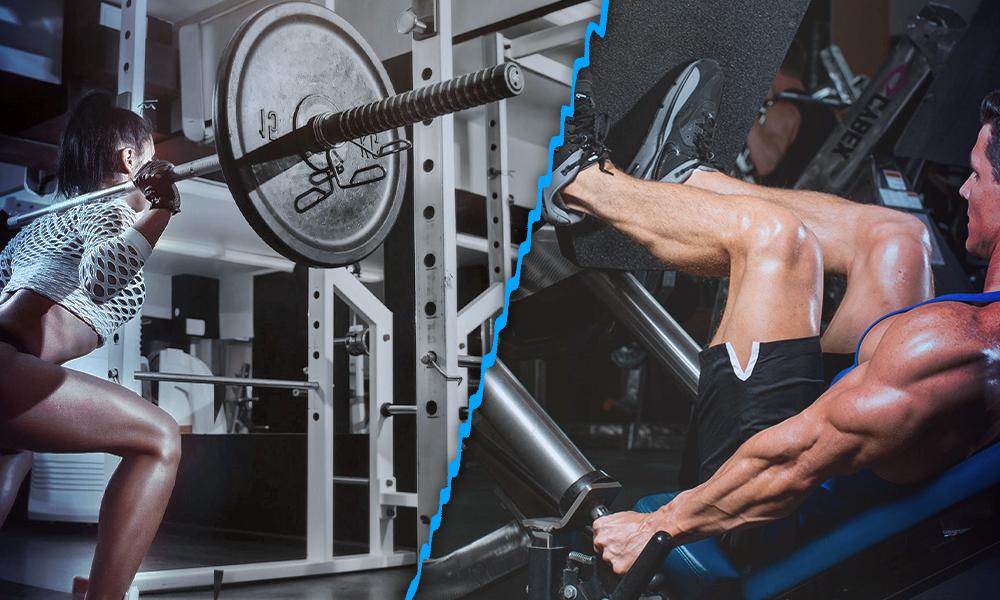
There's no shortage of things to argue about when it comes to resistance training. One of the most enduring debates concerns the value of free weights versus machines.
Free weight proponents argue the inherent instability of barbell and dumbell exercises increases the recruitment of "stabilizer" muscles. The increased involvement of these muscles, it is claimed, leads to greater increases in strength and muscle hypertrophy.
Advocates of machines argue they are safer, and that increased stability is in fact an advantage because it allows you to focus on the task at hand: Generating force against heavy weight.
So who's right? Is one training modality better than the other? Or does the answer lie somewhere in the middle?
The content below was originally paywalled.
Let's start by looking at the "stabilizer" argument. EMG research does in fact support the claim that using free weights leads to the recruitment of additional muscles.
When comparing the barbell bench press with the Smith machine bench press, for example, researchers found no difference in the EMG amplitude for the pectoralis major ("pecs") or anterior deltoid (the front third of your shoulder muscles). However, activation of the medial (or "side") deltoid was significantly greater during the barbell bench compared with the Smith machine version.
A comparison of barbell and Smith machine squats found the free weight version triggered greater EMG activity for the gastrocnemius (upper calf), hamstrings, and vastus medialis (the "teardrop" thigh muscle that sits above the knee). While there were no significant differences between barbell and Smith machine squats for any of the other muscles, overall EMG activity for all muscles was 43% higher for the free weight version.
So based on these studies, we would expect free weights to be clear winners for increasing strength and muscle growth. But what happens when, instead of observing short term EMG results, you actually compare the longer term strength and hypertrophy results of routines comprised of free weights versus machines?
A group of Norwegian sports scientists recently published a systematic review and meta‐analysis on the effect of of free weight versus machine‐based training on maximal strength, hypertrophy and jump performance (explosive jump tests are often included in strength training studies as a marker for "functional" improvements, as they are easy to administer).
Their literature search retrieved thirteen studies. Maximal strength increases were assessed in 12 studies, jump performance in 5, and muscle hypertrophy in 5. The studies included a total sample of 1,016 participants (789 men, 219 women). Six of the studies involved trained and 7 involved untrained participants. None of the studies examined competitive athletes.
The average duration of the studies was 8.9 weeks, and the training frequency was from 2 to 4 sessions per week. Common exercises in the free weight groups were barbell exercises such as the back squat and bench press, whereas leg press, chest press and various Smith machine exercises were often used in the machine groups.
The Results
Hypertrophy: While the "stabilizer muscle" paradigm would suggest greater hypertrophy from using free weights, the authors found no difference in hypertrophy between groups trained on machines versus free weights. So if getting buff is your priority, both free weights and machines will do the job.
Dynamic Strength: The most common strength test in the analysed studies was a one repetition maximum (1RM). Not surprisingly, subjects who trained on free weights got stronger on free weights, and subjects who trained on machines got stronger on machine exercises.
When machine-trained subjects were tested for improvements in free weight strength, and vice versa, the results were what we would expect based on the principle of specificity. That principle stipulates that you tend to get better at the specific activity you train - which is why great cyclists aren’t necessarily great runners, and great runners aren’t necessarily great cyclists. Although they are both lower body-dominant endurance activities that require a high level of aerobic conditioning, each activity requires different muscle recruitment patterns.
Strength in free weight tests increased significantly more as a result of free weight training than with machines.
Meanwhile, strength in machine-based tests tended to increase more with machine training than with free weights.
Train on machines, and you’ll get stronger on machines than someone who uses free weights. Train with free weights, and you’ll get stronger on free weight movements than someone who uses machines.
Isometric Strength: In the three studies which tested isometric strength, no differences between free weight and machine-based strength training were detected. Isometric strength is measured by exerting maximal force against an immovable object, and of course does not require the technical skill required to execute free weight movements like squats or bench presses.
This would suggest both strength and machine training lead to similar improvements in overall, non-specific strength, although the studies weren't equipped to confirm or refute this.
Jump Height: Changes in countermovement jump performance did not differ significantly between groups, but the results leaned towards the free weight group. The authors note that when a study by Schwarz et al was removed from the sensitivity analysis, the results were further skewed in favour of the free weight group.
They don't discuss why they dropped that study (involving untrained women), so I pulled it up. Turns out women in that study using a hack squat machine experienced significantly greater improvements in average and peak jump power, than women performing free weight squats. The hack squat group also experienced greater increases in vertical jump height, although the difference did not attain statistical significance. Both groups performed explosive type exercises prior to doing the squats. In the first of 2 weekly sessions, all subjects performed counter movement jumps and drop jumps prior to doing squats. In the second session, subjects performed zig-zag change-of-direction drills and 30-meter sprints prior to squatting.
So, when the Schwarz et al results are ignored, the results of the meta-analysis would suggest free weight squats lead to greater improvements in counter movement jump height. Which makes sense on an intuitive level, because free weight squats bear more resemblance to a counter movement jump (where, you squat down then explode upwards and jump vertically as high as possible).
However, including actual explosive jump movements in training creates even more specificity to jump tests. When this was done in the Schwartz et al study, the group using hack squats made significantly greater improvements in jump power and possibly height than a group using free weights. Interestingly, these results were obtained despite a significant increase in total body mass (+1.7 kg) only for the hack squat group.
Schwarz et al speculate that greater emphasis on force output rather than technique could have contributed to slightly more hypertrophy in the hack squat group. It could also be that, after the challenge of jumps and sprints, hack squats led to less nervous system exhaustion than free weight squats, allowing for greater recovery and progression in the jump movements.
More Recent Research
This recently-published meta-analysis included studies appearing on online databases up to January 1, 2023. Since that date, another relevant trial has been published, this one by researchers from the Human Performance and Sports Science Laboratory, University of Murcia in Spain.
The Spanish researchers noted that most resistance training recommendations for athletes cite the alleged superior efficacy of free weight over machine-based training. This assumption, they note, has mainly been supported by acute EMG studies with little in the way of long-term research to back it up.
And so they randomized thirty-four men with at least 2 years' resistance-training experience to participate in an 8-week program based on free weight or machine training. Training variables were identical for both groups, differing only in the use of a barbell or specific machines to execute the squat, bench press, prone bench pull, and shoulder press exercises.
One aspect of the study protocol that differed from the way most serious folks train is that the number of repetitions in all training sets corresponded to half of the total reps possible with that weight, meaning the subjects did not train anywhere close to failure.
Changes in muscle structure were determined via ultrasound. The subjects were also tested before and after on a battery of performance tests including 20-meter sprints, countermovement and squat jumps, zig-zag change-of-direction, anaerobic capacity and power, balance and strength tests.
And the results?
After eight weeks, both groups experienced similar strength increases in their respective training modalities.
Both groups experienced similar improvements in countermovement and squat jumps.
Sprint times changed little in either group, while change of direction improved significantly only in the free weight group.
Both training modalities similarly improved lower limb anaerobic capacity and power, while only the machine-based group significantly increased upper limb anaerobic power.
Muscle architecture changes that would reflect greater strength and hypertrophy barely changed in either group. The researchers noted this may be due to the low levels of intraset fatigue incurred by the training approach. Stopping a set halfway to failure can increase strength but it's not a good way to stimulate muscle growth.
"Based on these results," concluded the researchers, "athletes incorporating resistance training as a complement to their field-or track-specific training could use free-weight or machine-based exercises depending on their possibilities or preferences."
My Thoughts
Traditional gym wisdom has long held that free weight exercises are superior to machine exercises for strength and size gains. The research I've discussed above challenges that dogma.
If you want to compete in powerlifting or Olympic lifting, then free weights will by necessity dominate your routine. The competitive lifts in both of those sports are all barbell movements.
If you are an athlete, there is no clear evidence to show free weights offer a performance advantage over machine training. In fact, for athletes whose sports training involves high-intensity efforts or high-volume loads, the increased stability of machines may possibly reduce injury risk and nervous system exhaustion. Athletic training often involves speed, agility and plyometric training that occurs irrespective of traditional weight training. Further improving qualities like speed and explosiveness via resistance training may be more a matter of load and technique, not equipment (i.e. barbell jump squats with a lighter weight may serve this purpose better than traditional heavy barbell squats).
Everyday folks who find barbell squats daunting or problematic due to injuries/joint issues, or are too shy to ask for a spot on the bench press, can rest assured that using the machine equivalents will not sabotage their progress.
If your main goal is muscle growth, then both free weights and machines will do the trick.
I think the best routine for most folks is a mix of both free weights and machines. There are highly beneficial exercises offered by both modalities, each offering unique advantages.
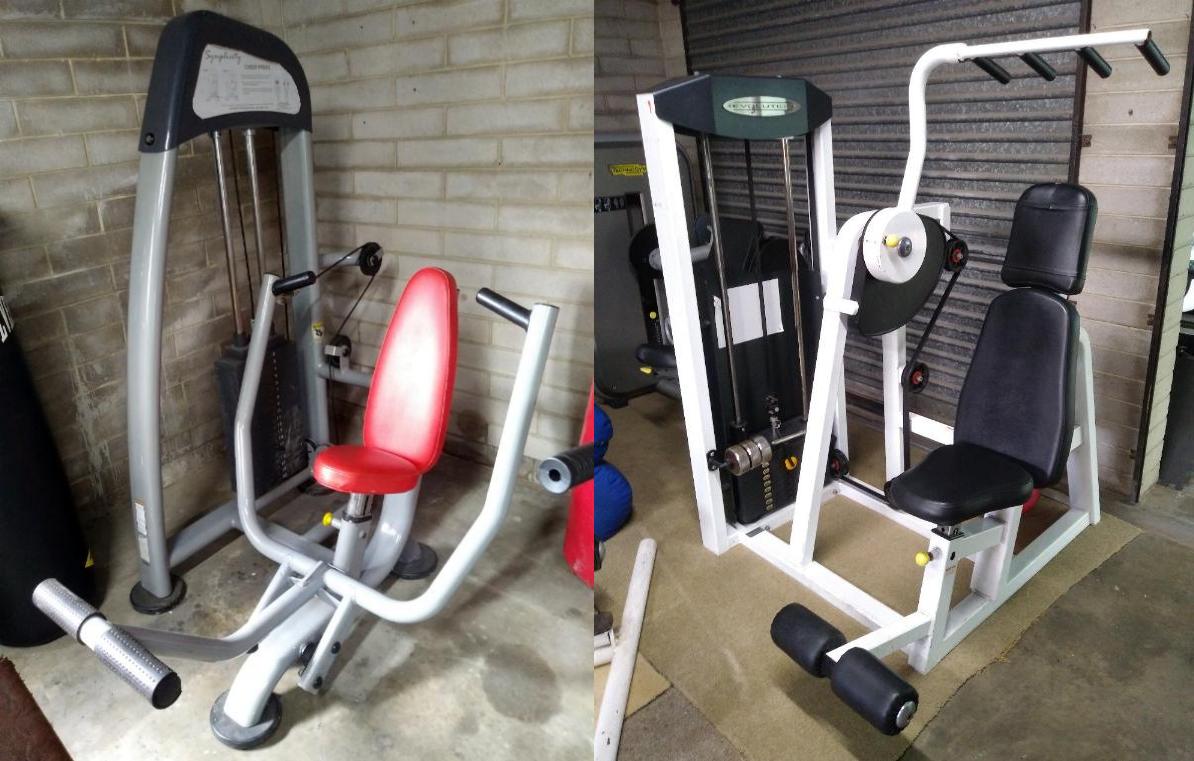
On a personal note, I find myself using more machine exercises as I get older. Thanks to following bad advice in my beginning years of weight training, my bench press has always sucked due to shoulder injuries. I toyed around with partial reps and every push-up variation known to humankind, but nothing was hitting the magic spot. Recently, I purchased a chest press machine that contains a foot lever, allowing me to both maneuver the weight into the fully extended position and also to do negatives once I reach concentric failure. It's given my chest training a new lease of life, and my shoulders are pretty happy about it too. The increased stability in this case is a definite advantage, because I’m in complete control over both the path of travel and speed of movement.
Another recent purchase was a pullover machine. I've always loved what dumbell pullovers did for my lats and triceps, but hated what they did to my rotator cuff muscles. The pullover machine, in my opinion, is a clear example of a machine movement that is vastly superior to its free weight equivalent. At the top, gravity is not pulling your arms to the floor as it is with the dumbell version, greatly reducing the stress on your vulnerable rotator cuff muscles. And the pullover machine offers a greater range of motion, allowing you to pull the bar down to your lap whereas the dumbell version terminates once the weight is hovering above your midsection.
Bottom line: Don’t be dogmatic. Free weights versus machines is not the make-or-break issue some folks claim it is. Both free weights and machines work, but stick to the basics. Don’t abandon compound free weight movements for finicky machine isolation exercises. Dropping squats for leg extensions or machine adductions is indeed a step backwards, but hard work on the leg press will also build a mighty set of pins.
Leave a Reply