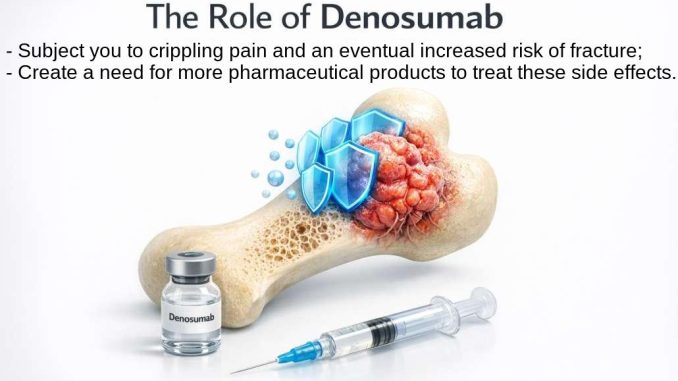
I recently became aware of yet another highly problematic drug that causes far more harm than good. A drug so bad that people are forced to endure crippling pain that makes life seem unbearable.
I learned of it after a loved one - a highly resilient individual not known for whining about aches and pains - constantly complained about excruciating muscle and joint pain. They could barely stand for more than a few minutes, and shopping trips became such a draining ordeal they needed to rest in their car for ten minutes to muster up enough energy to drive home.
They couldn’t work out what was causing this extremely frustrating situation, so I asked for a list of the drugs they’d been prescribed.
When I read through the list, one name immediately stood out because I’d never heard of it before:
Prolia.
Within minutes of typing that name in to a search engine, it became crystal clear this nasty concoction was the culprit.
A Poison is Born
Unlike most drugs, denosumab is not taken orally. Instead, it is administered by subcutaneous injection, usually one shot every six months.
Developed by US drug firm Amgen Inc., denosumab is a “monoclonal antibody against the receptor activator of nuclear factor-κB ligand (RANKL), a cytokine that is essential for the formation, function, and survival of osteoclasts.”
In plain English: This drug inhibits the formation of osteoclasts, the bone cells that remove bone tissue.
Using the same moronic, simple-minded reasoning that gave us toxic blockbuster drugs like statins and antidepressants, the brains trust at Big Harma arrived at the following formula:
Inhibit osteoclasts > less bone breakdown > stronger bones > f**kin’ aye!
To the naive, this sounds great on paper. Just like communism.
The problem is that osteoclasts aren’t useless calcium thieves; they play a crucial role by removing old and damaged bone tissue during the ongoing process of bone remodeling.
When dishonest entities use moron-level reasoning to tinker with critical bodily processes, expect stuff to go wrong.
Very wrong.
Denosumab was first approved, as Prolia, in June 2010 by the FDA for the treatment of postmenopausal women with osteoporosis who were deemed to be at high risk for fracture.
Subsequent approval expansions included:
September 2011: Treatment of bone loss in men receiving androgen deprivation therapy for nonmetastatic prostate cancer and women receiving aromatase inhibitor therapy for breast cancer.
September 2012: Treatment of glucocorticoid-induced osteoporosis in men and women at high risk of fracture.
May 2018: Treatment to increase bone mass in men with osteoporosis at high risk for fracture.
Under the name Xgeva, denosumab was also granted a number of approvals for use in patients with bone metastases, giant cell tumors of bone and multiple myeloma.
Over on the Continent, denosumab, as Prolia, was authorized for medical use in the EU in May 2010, and as Xgeva in July 2011.
Making Your Bones Stronger (Allegedly) by Leaving You in Constant Pain
Because of time limitations, I’ll confine this discussion to denosumab’s use in people deemed to be osteoporotic and at high risk for fracture.
In other words, people who would almost certainly benefit from a variety of non-drug measures, such as performing resistance training on a regular basis, increasing their protein intake, and supplementing with nutrients like calcium and magnesium.
But hey, why encourage people to embrace measures that could not only improve their bone health but overall quality of life, when you can instead prescribe them some toxic garbage?
The great thing about toxic garbage is that it creates side effects. You can then prescribe more toxic garbage to treat those side effects. When the toxic garbage that you prescribed to treat the side effects of the original toxic garbage causes even more side effects, you of course prescribe even more toxic garbage to treat those side effects.
This creates a never-ending merry-go-round of toxic idiocy which benefits everyone except the patient. The patient’s condition worsens, creating a ‘need’ for more doctor’s visits, more specialist referrals, and more drugs to counter the adverse affects of the original drug/s.
“I’m not sure why this drug is producing these side effects in you, Mrs Jones. I mean, it’s not like putting foreign substances into someone’s body has ever hurt them. Tell you what, let’s adjust the dosage of this foreign substance and put an additional foreign substance into your body and see what happens!”
As the patient’s condition worsens, hospitals and surgeons also get to stick their fingers into the highly lucrative toxic garbage pie. In this self-perpetuating business model, everyone gets richer except the patient, who pays through the nose for the ‘privilege’ of deteriorating health.
Surprise, Surprise: A Study by Researchers Receiving Lots of Money from Amgen Finds Prolia Safe&Effective™
On what evidence base was this drug approved and unleashed on an unsuspecting public?
In 2009, Amgen issued a press release stating it just had a meeting with the FDA’s Advisory Committee for Reproductive Health Drugs. At that meeting, the Committee recommended approval of Prolia for the treatment of postmenopausal osteoporosis and for the treatment of bone loss in patients undergoing hormone ablation for prostate cancer.
The press release claims the FDA Committee arrived at this decision “[a]fter reviewing safety and efficacy data from 30 clinical studies involving more than 12,000 patients.”
But in its labelling information for Prolia, the FDA cites a grand total of one (1) 3-year RCT of Prolia in support of its use in osteoporotic postmenopausal women. This was the so-called FREEDOM study, an allegedly randomized, double-blind, placebo-controlled trial conducted by Amgen.
Six of the FREEDOM researchers were both Amgen employees and shareholders. Another nine had received direct financial remuneration from Amgen (along with a raft of other drug companies).
One of those researchers, Ethel S. Siris, M.D., was also “the immediate past president of the National Osteoporosis Foundation”, now the Bone Health and Osteoporosis Foundation, which purports to be an independent charity “solely dedicated to osteoporosis and bone health”.
Amgen claims its mission is to “serve patients”. The Thousand Oaks, California company further claims it “reaches millions of patients with its medicines, helping make people’s lives easier, fuller and longer.”
Nowhere in its self-aggrandizing blurb does Amgen mention the US $1 billion dollars of penalties it has accumulated since 2000, the majority of which were for “off-label or unapproved promotion of medical products”.
In other words, the FDA approved the use of Prolia for postmenopausal women based on a study conducted by a company with a long history of dishonesty and researchers who are lavishly remunerated by that very same company.
While drug companies should absolutely fund research into their own drugs, the phase 3 trials they use to gain regulatory approval should absolutely be conducted by carefully screened and monitored independent third party organizations.
In Amgen’s case, they could have used the $8.7 billion in underpaid taxes they were recently penalized for to fund such research.
The pharmaceutical industry would of course object this would “stifle innovation”, but that’s exactly the point. If their ability to manipulate and sway the outcome of their clinical trials was greatly reduced, drug companies would indeed have far less incentive to ‘innovate’ toxic garbage.
Sadly, the current and egregiously compromised approach is standard operating procedure, and the rest of us are supposed to sit and watch like dopey ciuccios and believe everyone involved is wonderfully impartial and ethical, despite the Everest-sized pile of evidence demonstrating otherwise.
So What Did the FREEDOM Trial Find?
The published NEJM paper for this trial reports enrollment of 7,868 women between the ages of 60 and 90 years with a bone mineral density T score between −2.5 and −4.0 at the lumbar spine or total hip.
Subjects were randomly assigned to receive either 60 mg of denosumab or placebo subcutaneously every 6 months for 36 months.
All women received daily supplements containing at least 1,000 mg of calcium.
The primary end point was new vertebral fracture. Secondary end points included nonvertebral and hip fractures.
Before we discuss the results, its worth pointing out that Amgen not only designed the study protocol but “was responsible for the management and quality control of data collected by the clinical sites. A data and safety monitoring committee reviewed unblinded data at least twice yearly.”
So in this so-called double-blind study, some of the Amgen-funded researchers did in fact have regular access to unblinded data from the study.
Which, to this jaded observer of pharma shitefookery, means the reported data is about as reliable as a chocolate teapot.
I mean, it wouldn’t be at all difficult to manipulate the study data when you get an unblinded gawk at it every six months, would it?
Not that I would ever suggest a wonderful outfit like Amgen, with a long history of being penalized for dishonesty offences, would ever stoop to such behavior, no sirree, not me.
In the results section, the researchers actually admit in a throwaway line that of the 7,868 subjects, “60 (31 in the in the denosumab group, and 29 in the placebo group) were excluded from all analyses because the participation of their study center was halted owing to issues related to study procedures and the reliability of data.”
That’s a statement that demands further elaboration.
What, exactly, were the issues? Which study center was this, and how many other subjects were at this center? What reassurance do we have that these issues, occurring in a study conducted by a serial corporate offender with unblinded access to the study data, did not extend to other patients and centers?
No answer. Instead, the researchers continue on as if they immediately forgot what they just said.
True to form, the peer reviewers at the New World Order England Journal of Medicine were also evidently non-plussed by this important admission.

The researchers claimed the 36-month incidence of vertebral fracture was 2.3% (86 of 3,702 subjects) in the denosumab group and 7.2% (264 of 3,691 subjects) in the placebo group.
They claimed denosumab also reduced the risk of nonvertebral fracture, with a cumulative incidence of 6.5% in the denosumab group, compared with 8.0% in the placebo group (hazard ratio, 0.80).
They further claimed denosumab decreased the risk of hip fracture, with a cumulative incidence of 0.7% in the denosumab group versus 1.2% in the placebo group (hazard ratio, 0.60).
They claimed denosumab was associated with a relative increase in bone mineral density of 9.2% at the lumbar spine and 6.0% at the total hip, compared with placebo.
Because these figures come from a flawed study and a source that any reasonable person would consider highly biased, they mean nothing to me. They may be 100% accurate, they may be 100% bullshit. While I certainly have my suspicions, without fly-on-the-wall knowledge of what really went on, I can’t say either way.
However, I have no hesitation in declaring that the safety and adverse event claims made in the paper stink like a truckload of pigshit on a 40°C day.
The researchers claimed there “were no significant differences between subjects who received denosumab and those who received placebo in the total incidence of adverse events, serious adverse events, or discontinuation of study treatment because of adverse events.”
This is not true, even of what I suspect to be the highly sanitized published data.
Cellulitis occurred in 12 (0.3%) denosumab patients, compared to only 1 (<0.1%) placebo patient (P = 0.002).
Eczema was also significantly higher in the denosumab group, as was flatulence.
Falls and concussions, meanwhile, were reportedly higher in the placebo group.
The researchers claimed 70 subjects (1.8%) died in the denosumab group and 90 (2.3%) in the placebo group (P = 0.08, non-significant difference).
Now, if the adverse event rates were so hunky dory, it begs the question as to why the FDA panel that approved Prolia recommended it should “have a Risk Evaluation and Mitigation Strategy (REMS), which could include a medication guide and a healthcare provider communications plan.”
Why would Amgen need such a plan if its RCT showed no difference in adverse event rates between Prolia and placebo?
Now, Meet the REAL Prolia
Remember how I said a loved one had been prescribed this junk, and it made their life a living hell?
What is especially infuriating is that this loved one, while elderly, does not have osteoporosis. They had received prednisolone over 2 years ago for around 6 months; shortly after this they were placed on Prolia. They were given three shots over an 18 month period.
They have since abandoned the drug, and over six months has now passed since their last shot. They are feeling noticeably better; the constant, crippling pain has now greatly diminished.
So this is yet another case where the patient did not have a genuine use case for this drug, but where the doctor embraced a “hey, why not?” approach and prescribed the drug anyway as some sort of misguided preventive/pre-emptive strategy.
As is so often the case when employing this dipshitted strategy, which involves subjecting patients to unnecessary risk, the end result was unnecessary harm and suffering.
Since refusing the fourth shot, this loved one has learned two other people they know (a relative and friend) were also prescribed Prolia, again on extremely questionable grounds. In one case, Prolia was prescribed after a knee surgery to “assist healing” - an utterly moronic rationale.
Both of them experienced adverse events including pain; both also abandoned the drug.
Now, let’s go over to Drugs.com, which has a page for denosumab, listing 18 brand names including Prolia, and also a dedicated page for Prolia.
At these two pages, we learn that denusomab/Prolia is not the sweet little bone-builder Amgen and the FDA would have us believe.
Instead, we learn that common side effects of this porqueria include back pain, pain in extremities, and musculoskeletal pain.
A most curious set of side effects for a drug that’s supposed to improve skeletal health.
Prolia, it turns out, carries a boxed warning for life-threatening severe hypocalcemia (very low calcium levels); the risk is higher in patients with advanced chronic kidney disease (CKD), particularly those on dialysis.
We further learn that serious and life-threatening hypersensitivity reactions have occurred with Prolia, including anaphylaxis.
“Seek emergency help or tell your doctor immediately if you experience shortness of breath, throat tightness, swelling of the airways and throat, itching, low blood pressure, or hives.”
Better yet, tell your doctor to vaffanculo when he suggests this stuff in the first instance.
Osteonecrosis of the jaw has been reported with Prolia. Osteonecrosis is the death of bone tissue due to a lack of blood supply, which can lead to bone collapse and joint pain.
Again, a most ironic side effect for a drug that is supposed to strengthen your bones.
If you are unfortunate enough to be taking this drug, make sure you let your dentist know, especially if you have any dental procedures scheduled.
Atypical low-energy or low-trauma femoral fractures have been reported with Prolia. Contact your doctor immediately, advises Drugs.com, if you develop thigh or groin pain.
Drugs.com notes that multiple vertebral fractures have been reported following Prolia discontinuation, which is something I’ll further address in a moment.
Serious infections, including skin infections, may occur, including those leading to hospitalization.
Other severe side effects include severe skin rashes and eczema, bone over-suppression, or severe bone, joint, or muscle pain.
“Tell your healthcare provider immediately,” advises Drugs.com.
This will allow your provider to tell you its just part of “getting old” and/or all in your mind.
Which it most certainly is not.
Drugs.com allows patients to rate their drugs, a feature that makes for interesting reading.
For denosumab in general, 419 reviewers collectively rate it a 3.1 out of 10.
Prolia gets a 2.9 out of 10 from 387 reviews.
That’s not just a fail, that’s a “give up, you’re a bloody disgrace!”
Do not even think of taking this filth without first reading the reviews.
Here’s a brief sampling...


If I were a judge, and denosumab were a person, I’d sentence it to life imprisonment with a mandatory bi-weekly bashing by the guards and other inmates, to constantly remind it of the harm it had caused to others.
But the story does not end there. Oh no.
Denosumab, the Psycho Ex Who Leaves You Stuck With the Repair Bill
So you’ve quit denosumab, and you’ve told your doctor that if he/she ever even dares suggest it to you in the future, you will shove it so far up his/her keester even the world’s best search and rescue team won’t be able to retrieve it.
The side effects have pretty much diminished, and life feels like it’s getting back to normal.
All’s well that ends well, right?
Unfortunately, quitting denosumab isn’t such a clean cut affair.
You see, irrespective of whether the fracture reduction figures in the pharma-sponsored trials are genuine or a fabrication, there appears to be a very real increased ‘rebound’ fracture risk resulting from discontinuing denosumab.
The problem is so well-documented that modern medicine has created a strategy to deal with it.
Yep, you guessed it:
More drugs.
As a recent review states:
“Discontinuation of denosumab in postmenopausal osteoporosis causes a rebound phenomenon with a rapid increase in bone turnover markers and accelerated bone loss, often within 6–12 months. Without an appropriate relay therapy, up-to 10% of the patients experience multiple vertebral fractures. This phenomenon is linked to a multifactorial dysregulation of bone remodelling.”
The review further notes that the optimal strategy for mitigating the rebound phenomenon after denosumab withdrawal is still a matter of debate. Most of the focus seems to be on bisphosphonates (Mo Drugs!) as an “antiresorptive bridging therapy” even though “dedicated studies (mostly retrospective studies, with a few randomized controlled trials) show discrepancies regarding the protective effect.”
In other words, modern medicine will mess you up with denosumab, scratch its head, then throw you on the toxic garbage merry-go-round and start the meter running again.
This is another instance where an ounce of prevention is better than a ton of cure. When your doctor tells you to take a drug, it really is important to do your own research. In the case of denosumab, failing to do so can literally open you up to a world of pain.
If you’ve recently stopped denosumab, then the first 6-12 months are a danger period. You need to be extra careful, and I would strongly recommend strategies to increase bone and muscle strength and reduce fall risk such as resistance and proprioception/balance training. For obvious reasons, if you have little to no experience in these activities, it is very important to consult the services of a qualified expert, as opposed to copying some peanut on YouTube doing barbell squats on a Swiss ball.
Anyhow, have some provolone (around 214 mg of calcium per 1-oz serving).
Ciao,
Anthony.