Is acetaminophen taking one for Team Vaccine?
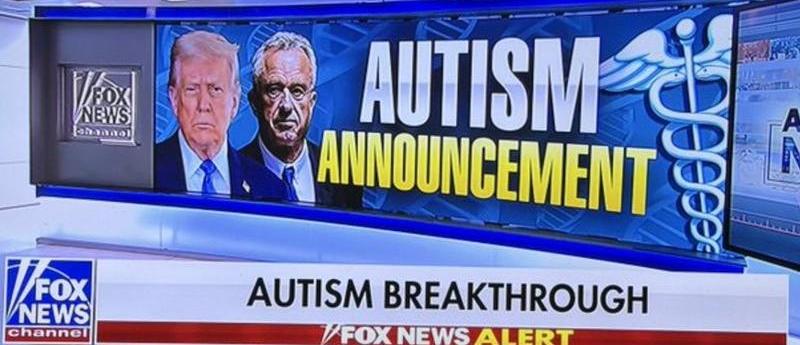
Despite solid form for causing liver failure and around 500 deaths annually in the US alone, acetaminophen has largely avoided negative publicity.
Until recently, that is.
Last month, the White House released a statement titled “FACT: Evidence Suggests Link Between Acetaminophen, Autism”. The statement claimed “There is mounting evidence finding a connection between acetaminophen use during pregnancy and autism”.
But is there really?
The content below was originally paywalled.
Rather than dissect every subject on the topic, what I’m going to do in this article is first trace the history of the acetaminophen-autism link. I’m going to highlight some interesting ‘coincidences’ in the timing of research in this area. Finally, I’ll explain why - even if the currently inconclusive research one day establishes causality - I don’t believe the Trump administration is acting in good faith. Rather, I suspect they’re using acetaminophen to throw up a smokescreen.
To my knowledge, the first paper examining a link between acetaminophen and child developmental disorders was published in 1987. That was the year Streissguth et al from the University of Washington, Seattle, published a paper titled “Aspirin and Acetaminophen Use by Pregnant Women and Subsequent Child IQ and Attention Decrements”.
The researchers conducted a longitudinal prospective study of 1,529 Seattle pregnant women receiving prenatal care in 1974-1975, an era when aspirin use was still fashionable for expectant mothers.
Information about aspirin, acetaminophen, and other drug use was obtained by self-report at 5 months’ gestation.
At 4 years of age, the offspring of these women were administered child IQ and computerized vigilance (attention) tests. The latter consisted of a display of a house, with the child instructed to press a button whenever the silhouette of a cat appeared in a window.
These follow-up tests yielded data for 421 children.
Of these youngsters, aspirin was used by 45.6% of their mothers when pregnant, and acetaminophen used by 43.5%. Frequency of aspirin and acetaminophen use during the first 5 months of pregnancy ranged from 1 per month (23.5% and 18.3%, respectively) to several per day (4.3% and 4.0%, respectively).
The researchers found child IQ at 4 years was significantly and negatively related to prenatal aspirin exposure. Meaning that, as aspirin use during pregnancy went up, child IQ tended to decline. The correlation remained after the researchers adjusted for a variety of covariates, including acetaminophen, antibiotics, alcohol, nutrition, maternal and paternal education, race, sex, birth order, mother-infant interactions, preschool experience, maternal smoking and caffeine use.
Girls were significantly more affected than boys. The gender/aspirin interaction, using the variable of aspirin use several times a week or more, translated to an estimated 10.1-point difference in mean IQ for girls and only a 1.3-point difference for boys*.
Errors of omission on the laboratory attention task were also significantly related to aspirin exposure several times a week or more after adjustment for covariates.
Acetaminophen, in contrast, was not significantly related to child IQ or attention test outcomes.
It would be some time before a possible link between acetaminophen and child neurological disorders would again come under scrutiny. In the meantime, something else became linked to autism in children, and the pharma-owned orthodoxy was none too happy about it.
The 1998 Wakefield et al Paper
It was in 1998 that Andrew Wakefield and colleagues infamously published a Lancet paper that sent medicine, pharma and the mainstream media into a prolonged state of global apoplexia.
That paper was a case series report on 12 children presenting with chronic enterocolitis and regressive developmental disorder; nine of the children had autism. The paper noted that onset of behavioural symptoms was associated, by the parents, with measles, mumps, and rubella (MMR) vaccination in eight of the 12 children.
Contrary to what the hopelessly dishonest and shameless claim, Wakefield et al explicitly stated in their 1998 paper: “We did not prove an association between measles, mumps, and rubella vaccine and the syndrome described.”
However, because onset of symptoms occurred after MMR vaccination, they sensibly stated: “Further investigations are needed to examine this syndrome and its possible relation to this vaccine.”
The worlds of pharma and medicine clearly didn’t want that to happen, so they launched a hysterical campaign against Wakefield, based on outright defamation and lies. The Lancet paper was retracted, Wakefield was struck off the medical register for “serious professional misconduct”, and the defamation campaign continues to this day. Almost three decades later, any mention of his name by the mainstream media is invariably accompanied by the word “disgraced”.
Not only did this diminish the link between vaccines and autism in many people’s eyes, it also delivered a clear warning to other researchers that questioning vaccines was professional suicide.
Torres 2003
Okay, now let’s fast forward to 2003. That’s the year an Anthony R Torres**, from the Centers for Persons with Disabilities at Utah State University, published a paper titled “Is fever suppression involved in the etiology of autism and neurodevelopmental disorders?”
Torres’ 2003 paper was a hypothesis presentation. These are papers where you present a hypothesis about a pressing issue. You make your case as to why it’s worthy of consideration by the research community. Hopefully, other researchers will heed the call and start investigating your hypothesis further.
Torres noted that infections often “result in fever that is routinely controlled with antipyretics such as acetaminophen”. His hypothesis was that blockage of fever with antipyretics during pregnancy and early childhood “interferes with normal immunological development in the brain leading to neurodevelopmental disorders such as autism in certain genetically and immunologically disposed individuals.”
To test his hypothesis, Torres suggested a number of research avenues, including epidemiological studies and animal experiments.
The 2008 Schultz et al Paper
The first research outfit to publicly explore Torres’ hypothesis was a group of San Diego researchers led by Stephen T. Schultz***. Schultz et al had previously published (in 2006) the results of a case-control study, using data from an online parental survey, which suggested “children who were not breastfed or were fed infant formula without docosahexaenoic acid/arachidonic acid supplementation were significantly more likely to have autistic disorder.”
Despite the greatly increased odds ratios generated by their analysis, Schultz et al appear to have lost interest in the breast-feeding/essential fatty acid link, and published nothing further on the topic. Instead, they turned their attention to acetaminophen. In 2008, they published a paper in Autism titled “Acetaminophen (paracetamol) use, measles-mumps-rubella vaccination, and autistic disorder: The results of a parent survey.”
The paper reported on another case-control study, this time using the results of an online parental survey conducted from 16 July 2005 to 30 January 2006.
The study did not examine prenatal acetaminophen exposure. Instead, parents were asked whether their child was given an analgesic to prevent or treat a reaction to the MMR vaccination. Parents were also asked whether their child was given aspirin, acetaminophen, or ibuprofen during the ages of 12 to 18 months.
Parents were also asked if their child appeared sick at the time he/she was given the MMR vaccination. The survey also included a question asking whether their child had any of the following reactions to the MMR vaccination: fever, rash, diarrhea, irritability, and/or seizures. No other reactions were asked about.
The researchers claimed to have initially recruited 113 case and 109 control surveys between the ages of 12 months and 18 years. Despite also asking about ibuprofen and aspirin, the researchers admitted “the main question of interest in this study was whether children had been given acetaminophen after MMR vaccination”. Over a quarter of parents did not answer the question, so their surveys were excluded from the analysis.
However, an even greater proportion of parents failed to answer whether their child had been given ibuprofen, yet their surveys were still included in the analysis.
The researchers reported that acetaminophen use after MMR vaccination was significantly associated with autistic disorder when considering children 5 years of age or less (odds ratio 6.11), after limiting cases to children with regression in development (OR 3.97), and when considering only children who had post-vaccination sequelae (OR 8.23), adjusting for age, gender, mother’s ethnicity, and the presence of illness concurrent with MMR vaccination.
However, the presence of illness concurrent with MMR vaccination showed an even stronger association with autistic disorder. After adjusting for age, gender, mother’s ethnicity, and acetaminophen use after MMR vaccination, illness concurrent with MMR vaccination in children 1–18 years produced an odds ratio of 8.81. In children 1–18 years with regression, the OR jumped to 17.2.
The researchers concluded in the abstract:
“This preliminary study found that acetaminophen use after measles-mumps-rubella vaccination was associated with autistic disorder.”
And in the main text:
“This is the first case-control study to show a possible association of acetaminophen use with AD, and is consistent with our ecological study (Schultz et al., submitted). The findings may be coincidental. More research needs to be completed to confirm the results of this preliminary study.”
What immediately strikes one about this paper are its similarities to the Wakefield et al 1998 paper. It was an epidemiological study relying on parental reports about symptoms arising after MMR vaccination. Both papers found an association and emphasized that further research needed to be done to confirm whether the association was causal.
The key difference was that Wakefield et al suggested an association between autism and the MMR vaccine; Schultz et al pointed to acetaminophen as the potential culprit.
Which would go a long way towards explaining why Schultz et al were never the subject of a frenzied global defamation campaign.
Schultz 2010
In 2010, Schultz published a solo paper reviewing ten studies that purported to examine the link between thimerosal exposure and autism. Eight of those studies claimed to find no link; at least one of them (Madsen et al 2003) has since been exposed as a fraud. Madsen et al excluded data showing a decline in autism rates after thimerosal was removed from childhood vaccines in Denmark.
In his 2010 paper, Schultz also reviewed seven studies examining the link between non-vaccine sources of mercury and autism, 3 of which found no association.
Schultz concluded “The evidence presented here does not support the association between autism and mercury exposure from the pharmaceutical preservative thimerosal. The evidence is equivocal for an association between other environmental exposures with autism. … Since mercury is a known neurotoxin, more research should be undertaken to define the relationship between mercury exposure and the risk for autism.”
Becker and Schultz 2010
Also in 2010, Schultz co-authored a paper with Kevin G. Becker, from the Biomedical Research Center at the NIH’s National Institute on Aging. The duo discussed how autism and asthma had risen since the 1980s.
The paper then attempted to tie the rise in autism with acetaminophen on the flimsiest of grounds. The authors write that in 1980, the CDC issued a caution about a possible Reyes Syndrome-aspirin association, which was followed by a public and professional warning by the United States Surgeon General. This, write the researchers, was accompanied by a “sharp rise” in autism cases. But a similar rise was seen three years earlier, when an FDA Advisory Committee recommended all Tylenol products include a clear warning about exceeding maximum daily dosages and the risk of liver damage (the FDA ignored the committee’s warning until 1994, when Johnson & Johnson was sued by a patient who needed a liver transplant after taking Tylenol and consuming alcohol).
Not to be deterred by these conflicting events, Becker and Schultz write:
“In 1982 and again in 1986 there were product tampering cases where acetaminophen tablets were laced with cyanide resulting in eight deaths. Acetaminophen sales collapsed after each tampering event, but recovered in less than a year in each case. These dates roughly correspond to the slight downturns in asthma and autism cases mentioned above.” (Bold emphasis added)
They weren’t kidding when they said “roughly”. Here’s their chart depicting this correlation:
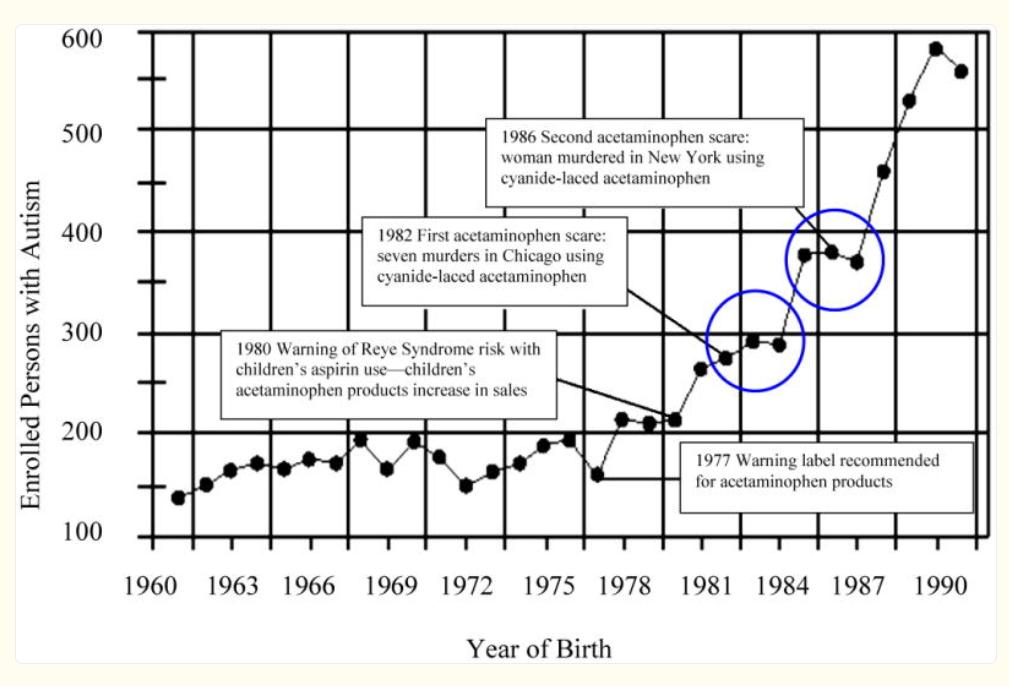
The 1982 scare was followed by a continued increase in autism incidence, followed by the slightest and briefest of dips.
The trajectory for autism incidence had already flattened in 1985, the year before the 1986 acetaminophen scare. After the scare, the trajectory again experienced the slightest and briefest of dips.
In terms of evidence for a link between acetaminophen and autism, such brief and tiny aberrations in the autism trajectory are essentially meaningless. No multi-decade trajectory ever goes up in a neat, straight line - be it for disease incidence, house sales, or stock prices.
Indeed, 1990 saw the commencement of a sharper dip in the autism rate than seen after either of the 2 previous acetaminophen scares. However, the authors had no acetaminophen scare to explain this more substantial dip, so they ignored it.
What Becker and Schultz don’t mention is that in the mid-1980s, the childhood vaccine schedule experienced a notable increase in volume.
“Since the mid-1980s, many vaccines have been added to the schedule. The result is that the vaccine schedule has become more complicated than it once was, and children are receiving far more shots than before … Now, children could receive as many as 27 shots by 2 years of age and up to six shots in a single visit.”
That quote comes, not from an ‘anti-vaxx’ website, but direct from the Children’s Hospital of Philadelphia Vaccine Education Center.
Schultz et al 2016
In 2016, Schultz co-authored another case-control study, this time exploring use of acetaminophen for fevers and the risk of autism spectrum disorder. Schultz and co-author Georgianna G. Gould set out to “determine if acetaminophen use for fever in older children was associated with ASD.”
They used data from another study, which yielded 118 case children with ASD and 79 control children. The cohort averaged 11 years of age, so was older than the one featured in their 2008 paper.
The results were the exact opposite of those reported in their 2008 paper.
Using acetaminophen as a first choice to treat fever was 83% less likely in children with ASD, while use of acetaminophen if other medication didn’t bring down fever was 82% less likely in children with ASD.
A significantly higher number of children with ASD versus controls used ibuprofen to bring down their fever versus rarely or never using ibuprofen.
In other words, the study failed to find a positive association between acetaminophen use and autism.
However, that’s not how the researchers reported it. They instead spun the results, claiming “Because these children are older than in our first study, the association is reversed.”
They speculated that children with ASD might experience a decrease in acetaminophen effectiveness due to endocannabinoid system dysfunction, and therefore switch to ibuprofen as they get older. However, they presented no actual evidence to support this hypothesis.
It seems the evidence didn’t suit their acetaminophen-autism hypothesis, so they changed the hypothesis to fit the evidence.
Incidentally, the 2016 paper was funded by the the Eunice Kennedy Shriver National Institute of Child Health and Human Development - the NIH division named after RFK Jr’s late paternal aunt.
The 2010s
It took several years, but eventually the Schultz papers were followed by research from other groups, many of whom examined acetaminophen intake by pregnant women and its relationship to development of neuro-developmental disorders in their offspring.
One of the key studies cited by the White House in its recent ‘breakthrough’ announcement was a recent review of the epidemiological prenatal acetaminophen research by Prada et al. Of the 46 studies included in their analysis, all but one (Streissguth et al 1987) were published from 2013 onwards.
Trump and RFK Jr to the Rescue. Not
So let’s get back into our flying DeLorean and return to 2025. We step out of the car and find ourselves in April. We turn on the news and learn that Bobby Jr has vowed to find the cause of autism by September.
September rolls around and, of course, Bobby Jr has done no such thing. Instead, the White House releases a statement insisting evidence “suggests” a link between acetaminophen and autism.
No statement from the Trump team would be complete without a touch of indignant drama queenery, and the September 22 release is no exception. “Predictably, the Fake News immediately went into frenzied hyperventilation with their usual smears, distortions, and lies,” it reads.
This “frenzied hyperventilation” by the press was allegedly in response to the “bold new initiatives” Trump and his cronies were employing to “tackle the autism epidemic.”
The first of those “bold new initiatives” was a label update for leucovorin (folinic acid) for cerebral folate deficiency, the latter of which has been “associated” with autism and hence will be the subject of the update. Following the label update, “state Medicaid programs will be able to cover leucovorin for the indication of ASD. Finally, the National Institutes of Health (NIH) will launch confirmatory trials and new research into the impact of leucovorin including safety studies.”
“While promising, it is important to note that leucovorin is not a cure for ASD and may only lead to improvements in speech-related deficits for a subset of children with ASD.”
Needless to say, subsidizing folinic acid that “may” help some autistic kids with speech problems does not establish a cause of autism, nor is it a cure for such.
The second “bold new initiative” by Team Trump pertains to acetaminophen. The FDA plans to issue a physician notice and initiate a safety label change for acetaminophen, while the HHS will launch an ad campaign “to inform families”.
Why?
“The FDA is responding to prior clinical and laboratory studies that suggest a potential association between acetaminophen use during pregnancy and adverse neurodevelopmental outcomes.
FDA also recognizes that there are contrary studies showing no association and that there can be risks for untreated fever in pregnancy, both for the mother and fetus.
Given the conflicting literature and lack of clear causal evidence, HHS wants to encourage clinicians to exercise their best judgment in use of acetaminophen for fevers and pain in pregnancy by prescribing the lowest effective dose for the shortest duration when treatment is required.”
(Bold emphasis added; hyperlinks in original)
Again, Bobby Jr promised he would find the cause of autism. What we instead get is label changes, PR campaigns, and weasel words. We get talk of studies that “suggest a potential association” between prenatal acetaminophen and childhood developmental disorders.
Highly conspicuous by their absence in the recent spate of Trump statements is any mention of vaccines and environmental neurotoxins such as mercury and aluminum (both of which have seen use as adjuvants in vaccines).
But What About the Research?
But what about the studies they cite? Is there anything to this acetaminophen-autism link?
The link between acetaminophen relies, not on clinical trial or experimental evidence, but entirely on epidemiological studies.
Even Team Trump had to acknowledge the results of these studies are mixed. Some show a link, others do not.
One of the studies hyperlinked in the White House statement was conducted by Ji et al and published in 2019.
This was a prospective cohort study analyzed 996 mother-infant pairs who were enrolled at birth and followed up prospectively at the Boston Medical Center from October 1, 1998, to June 30, 2018.
Three acetaminophen metabolites were measured in archived umbilical cord plasma samples collected at birth. Levels of these metabolites were then matched with physician-diagnosed ADHD, autism spectrum, and other developmental disorders as documented in the children’s medical records.
The researchers reported that, compared with the first tertile, the second and third tertiles of cord acetaminophen levels were associated with higher odds of ADHD and autism diagnoses.
But this doesn’t really tell us much.
The use of cord plasma acetaminophen metabolites imparts the study with an air of precision, the kind that can’t be achieved from studies relying on accurate recall by participants.
However, the plasma study relied on a one-time measurement of cord acetaminophen metabolites at birth. Given the half-life of acetaminophen in adults is under 3 hours, this tells us little about how much and how often the women used the drug during their pregnancy.
Furthermore, there was no control sample that had not been exposed to acetaminophen.
Again, the problem with the evidence cited by the White House is that it relies on epidemiology that is often flawed, prone to confounding by other variables, and contradictory. It’s the kind of research that can serve as a useful lead to more tightly controlled studies, but cannot itself be cited as proof of anything.
There is a dearth of human clinical trials and animal experiments on the subject. We do know fetal exposure to acetaminophen in rodents can cause reproductive disorders of the male urogenital tract, including abnormalities in testicular function, sperm abnormalities and sexual behavior.
In Summary
The bottom line is that no-one knows for sure what role acetaminophen plays in the development of child neuro-developmental disorders such as autism.
The connection is concerning, but definitely requires more research before one can claim acetaminophen - consumed by pregnant women or directly by youngsters - causes autism.
Rest assured, I’m not defending acetaminophen. To the contrary, I think it is toxic junk. I’ve never understood why people pop it like candy for ‘fever’ or at the first sign of a headache.
Despite its widespread perception as an innocuous drug, acetaminophen remains a leading cause of poisoning, responsible for 56,000 emergency department visits annually in the US alone.
It has a special affinity for beating up livers, and is the world’s second most prolific cause of liver transplantation.
There are other ways to deal with flu-like symptoms and “mild to moderate” headaches and muscle pains than ingesting cleverly marketed toxins.
Whatever future research finds, I sincerely doubt acetaminophen will ever be shown to be the sole reason for a historical rise in autism diagnoses.
Further, I find the timing of acetaminophen-autism investigations curious, if not suspicious.
Acetaminophen was introduced in 1959, and by the mid-1980s had become the analgesic of choice for pregnant women. Yet the first study hypothesizing a role for acetaminophen in autism causation was not published until 2003 - five years after the Wakefield paper linking MMR vaccination and autism caused a global hissy fit.
It was not until 2008, ten years after the Wakefield et al paper, that Schultz et al published the results of a parental survey linking acetaminophen to autism. The Schultz paper just happened to survey mothers of children who had the MMR vaccine, and blamed subsequent autism diagnoses on acetaminophen, even though illness concurrent with MMR vaccination was the strongest predictor of a subsequent autism diagnosis.
Fast forward to the new abnormal, where a reality TV actor resides in the White House and a philandering chameleon acts as the Federal health guru.
RFK Jr achieved much of his popularity by masquerading as an anti-vaxxer, even though he is in fact “fiercely pro-vaccine”.
So when he promised to the world he was going to find the cause of autism, it was pretty clear he would never point the finger at vaccines. Even if the data linking vaccines to autism is compelling enough that some researchers have to engage in outright fraud to cover it up.
That’s a problem for the Bobster, because the vaccine-autism controversy just won’t go away. Furthermore, the COVID fraud and its resultant pseudo-vaccines have left increasing numbers of people highly skeptical of ‘immunization’.
When Trump and RFK Jr needed something, anything but vaccines, to blame for the rise in autism diagnoses, they pointed the finger at acetaminophen - even though the evidence is far from conclusive, and doesn’t even begin to rule out other potential causes.

Vaccines are intensely profitable. As the COVID operation demonstrated, they also make a great Trojan horse for fatal poisons when you decide the herd needs culling.
Acetaminophen is also highly profitable, but confining remedial action to mere label updates directed at a clearly defined subset of users (pregnant women) is unlikely to have a substantial impact on its $10 billion in annual global sales.
If drugs could undergo humiliation rituals that ultimately preserve the status quo, the result would look like what is happening with acetaminophen right now. The analgesic is taking one for the team, so that its vaccine captains can keep playing without interruption.
Trump and Bobby Jr are puppets following a script. They would never tell you the truth about what really causes ill health, even if they had a clue.
*A 1988 paper by Klebanoff and Berendes from the NIH National Institute of Child Health and Human Development, looking only at aspirin, failed to replicate the IQ findings. They used a much larger sample of 10,159 women exposed to aspirin during the first 20 weeks of pregnancy, and a control sample of 9,067 women who did not report any aspirin use. There was little difference in mean IQ between the offspring of exposed and non-exposed mothers; in fact, after adjustment, children of non-exposed mothers showed a slightly higher mean IQ (less than 1 point).
**Torres received his MD degree at the University of Utah and completed his postdoctoral training as a Research Associate at the National Institutes of Health (NIH) and as a resident at Yale University.
***While the paper listed Schultz’s affiliations as “University of California San Diego, and San Diego State University”, his email address in the paper featured a @med.navy.mil suffix. A disclaimer at the end of the paper stated:
“The views expressed in this article are those of the authors and do not reflect the official policy or position of the Department of the Navy, Department of Defense, or the United States Government.”
Leave a Reply