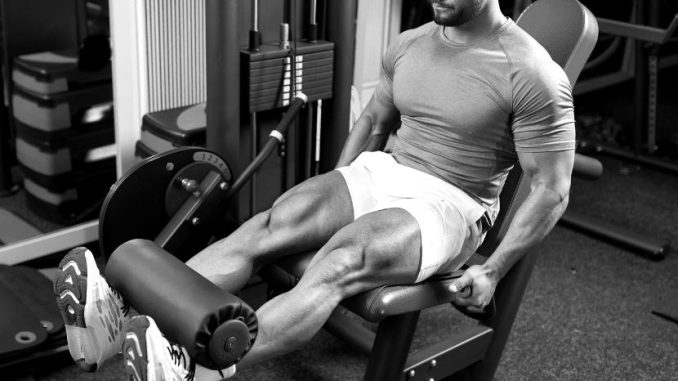
Many moons ago, the leg extension (aka knee extension) was a staple exercise in gyms. Back in the 1980s, a typical leg routine included squats or leg presses (often both), the leg curl, and the leg extension.
As a new millennium dawned, so did a new approach to training. Powerlifting and 'functional' training began exerting a much greater influence on exercise prescription, and isolation movements like the leg extension fell out of favor.
Movements like squats and lunges had obvious real world transfer. But leg extensions? Apart from kicking someone under the table, when do you need to extend the knee joint with force while seated in the real world?
Leg extensions were thusly relegated to the status of a 'shaping' exercise, something bodybuilders did in their obsessive pursuit of maximal and symmetrical muscular development.
I must confess that, until recently, I didn't pay much heed to the leg extension exercise either.
"What benefit is there to leg extensions when you're already doing the big compound movements like the squat or leg press?", I used to think.
Turns out leg extensions have a very important potential advantage over squats and leg presses. One so important, I immediately started hunting for a leg extension machine. I duly scored a bargain-priced unit from a local auction house, which now takes of pride of place in my garage gym.
Why the change of heart?
It was prompted by a paper from Kinoshita et al (2026), recently published in Medicine and Science in Sports and Exercise.
They wanted to explore the effects of isolation versus compound movements on quadriceps muscle hypertrophy (growth). The quadriceps femoris constitutes the largest muscle group in the human body, comprised of the rectus femoris, vastus lateralis, vastus medialis, and vastus intermedius.
Needless to say, the quads are an extremely important group of muscles.
The two exercises examined by Kinoshita et al were the knee extension (single-joint) and the leg press (multiple-joint).
The Japanese researchers were not the first to perform such a comparison. Previous studies directly compared knee extension and the leg press or squat, with the results suggesting the knee extension preferentially trains the rectus femoris, and the leg press/squat may preferentially train the vastus lateralis.
However, these studies were relatively short in duration (5–8 weeks) and relied on ultrasound measurements of muscle thickness. The problem with ultrasound is that it captures changes at specific locations (the spot where the tester places the ultrasound probe) and hence may fail to detect overall hypertrophy.
Magnetic resonance imaging (MRI), in contrast, provides a broader picture and is considered the gold standard for assessing changes in muscle volume.
Kinoshita et al note a poor correlation between training-induced changes in muscle thickness at limited regions and MRI-derived total muscle volume.
"So why don't researchers just use MRI instead of ultrasound?" you might be wondering.
According to the interweb, an MRI machine typically costs between US $1 million and $3 million, while an ultrasound machine costs between $20,000 and $200,000.
Few sports research facilities can afford an MRI unit, which means less-accurate but far more affordable ultrasound has become the more common method for assessing changes in muscle volume.
Kinoshita et al, however, had access to MRI. So they conducted two experiments and hypothesized that:
(1) hypertrophy of the quadriceps, particularly the rectus femoris, would be greater after the knee extension than after the leg press.
2) as a multi-joint exercise, leg press would induce hypertrophy not only in the quadriceps but also in other lower-limb muscles (e.g., glutes), leading to greater overall lower-limb muscle hypertrophy than the knee exetension;
(3) EMG muscle excitation during exercise would broadly support and explain the different hypertrophic effects (e.g., rectus femoris excitation would be greater during knee extension than leg press).
To test their hypotheses, they performed two experiments.
For experiment 1, they recruited seventeen untrained healthy young adults (11 males and 6 females, mean age 23.3 years) who had not performed knee extension, leg press, or similar exercises such as the squat in the past 12 months.
A separate cohort of 11 healthy males (24.0 years) participated in Experiment 2.
None of the participants had a history of competitive strength-sport participation (e.g., powerlifting or bodybuilding).
Experiment 1
Participants in Experiment 1 were instructed to refrain from any additional lower-limb resistance exercise during the 12-wk intervention and to otherwise maintain their habitual physical activity.
Each participant had one leg assigned to knee extension and the other to leg press, with dominant and non-dominant legs counter-balanced across participants.
As a result, each participant effectively acted as their own control.
Exercises were performed unilaterally using Life Fitness knee extension and leg press machines. Participants performed a standardized warm-up, then 5 sets of 10 repetitions for each exercise. For each repetition, the concentric and eccentric phases lasted 2 seconds each and were guided by a metronome (60 bpm).
A 2-minute rest interval was given between sets.
After completing one leg, the contralateral leg was trained. The starting leg in the first session was counterbalanced across participants and alternated in subsequent sessions.
Training was conducted twice per week on nonconsecutive days for 12 wk. The load was progressively increased during the first three sessions (50%, 60%, and 70% of pre-training one-repetition maximum [1RM]).
When participants completed all sets without assistance in the third and subsequent sessions, the training load was increased by 5% of 1RM in the following sessions. This progression typically resulted in failure or near-failure in sessions three and later, especially in the latter sets.
MRI scans were obtained before and after the 12-wk training intervention to assess lower-limb muscle volume.
All MRI data were anonymized, and investigators were blinded to training conditions.
1RM for both exercises was assessed unilaterally in each leg before and after the intervention, always following the MRI measurement.
Experiment 2
In experiment 2, the researchers estimated muscle excitation during maximal isometric contractions in the knee extension and leg press exercises. They did this by recording surface EMG signals from the rectus femoris, vastus lateralis, vastus medialis, gluteus maximus, biceps femoris long head, and semitendinosus on the dominant leg.
Results: Experiment 1
Both knee extension and leg press 1RM increased significantly after the intervention. In line with the principle of specificity, knee extension 1RM increased a significantly greater amount in limbs that were trained with knee extension, and leg press 1RM increased by a significantly greater amount in limbs trained with the leg press.
Pre- and post-training rectus femoris volume significantly increased after knee extension (+13.2%) but not after leg press (+1.1%).
Conversely, volumes of the gluteus muscles (+12.0%), gluteus maximus (+15.4%), adductor muscles (+4.1%), and adductor magnus (+6.2%) significantly increased after the leg press, but not after knee extension (ranging from –0.9% to +0.2%).
Total muscle volume increased after both exercises, with a greater increase from the leg press (+6.3%) compared to knee extension (+2.8%).
Results: Experiment 2
The EMG analysis revealed significantly more intense muscle activation during knee extension for the rectus femoris. Non-significantly higher muscle activation was also seen for the vastus lateralis and vastus medialis.
In contrast, muscle activation during the leg press was significantly higher for the gluteus maximus, biceps femoris long head, and semitendinosus.
In summary, the main findings of this study were:
(1) hypertrophy of the rectus femoris was greater after knee extension, whereas hypertrophy of the vasti muscles and overall quadriceps femoris was similar between exercises;
(2) The leg press, but not knee extension, induced significant hypertrophy of the gluteus maximus and adductor magnus, resulting in greater overall lower-limb muscle volume gains with the leg press;
(3) Differences and similarities in muscle excitation levels measured during exercise were generally consistent with the hypertrophic responses observed after the training intervention.
These findings largely support the authors' hypotheses and indicate that the leg press is highly time-efficient for inducing hypertrophy across multiple lower-limb muscles, including the quadriceps.
However, the knee extension appears to be essential for effectively targeting the rectus femoris, supporting the notion that biarticular muscles undergo minimal hypertrophy when trained with multi-joint exercises in which their action at one joint conflicts with the required action at the other joint.
Why This is Important
Some of you might be thinking, "why should I give a rat's rectum about the rectus femoris? I'm a busy person who never skips leg day and my thighs are fine. My legs are strong independent limbs that don't need no isolation exercise! I'd rather spend a night in the woods with a bear than do leg extensions!"
Yeah, no worries.
Listen to me, and listen to me good. The rectus femoris is no ordinary muscle. It's the only one of the four quad muscles that crosses both the knee and hip joints, as the following illustration shows (the vastus intermedialis is not visible in the pic because it sits underneath the rectus femoris).
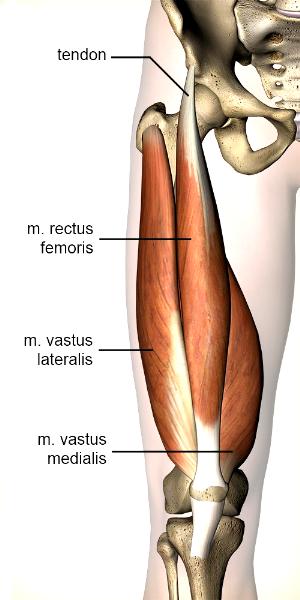
Another thing you'll notice from the above picture is the location of the rectus femoris. It occupies the central area of the thigh, and hence you'd expect it to play a key role in maintaining proper knee alignment and stability. The rectus femoris also plays a critical role in the deceleration that occurs when you try to suddenly slow from a sprint or quickly change direction.
Unfortunately, eccentric-heavy deceleration movements are linked to a high incidence of non-contact injuries, particularly in sports like soccer.
As Mendiguchia et al (2013) note, "Quadriceps muscle strains frequently occur in sports that require repetitive kicking and sprinting efforts and are common in football in its different forms around the world. The rectus femoris is the most commonly injured muscle of the quadriceps muscle."
In their 2023 review, Knapik et al found soccer (70.5%) and rugby (15.2%) accounted for most RF injuries reported in the literature. The most commonly reported mechanisms of injury were kicking (47.6%) and excessive knee flexion/forced hip extension (42.9%).
A quadriceps femoris injury is no joke, folks.
Knapik et al noted avulsion injuries were reported in 86% of athletes. Nonoperative management was reported in 19.7% of athletes, with operative management performed in 80.3%.
Return-to-play rate was 93.3% in nonoperatively treated and 100% in operatively treated athletes, and the mean RTP time was 11.7 weeks (range, 5.5-15.2 weeks) in non-operatively treated and 22.1 weeks (range, 14.0-37.6 weeks) in operatively treated athletes. Complications were reported in 7.7% of nonoperatively treated and 18% of operatively treated athletes.
Now, a quick disclaimer: I'm not saying throwing in a set or two of leg extensions automatically makes you immune to rectus femoris injuries. An effective injury prevention program needs to take into account the needs of your sport, and your own strengths/imbalances/injury history. It may include deceleration drills and other single joint exercises like reverse Nordic curls.
What I'm saying here is to avoid simplistic thinking ("Compound good! Isolation bad and wussy!") and that the often overlooked leg extension deserves serious reconsideration both as an injury preventive and for balanced quadriceps hypertrophy and strength development.
But Aren't Knee Extensions Bad for the Knees?
There's a longstanding belief that leg extensions are bad for the knees. This belief arises from the fact that leg extensions are a single-joint exercise, where all movement takes place around the knee. This, so the story goes, places undue sheer forces on the knee joint, unlike squats and leg presses where the load is more evenly spread among the hip, knee and ankle joints.
Sounds reasonable in theory, but so does trickle down economics, which we now refer to in the real world as "getting pissed on by evil billionaires".
If leg extensions really did produce dangerous sheer forces, then one would reasonably expect them to wreck the knees of susceptible patients.
You know, like patients who have had anterior cruciate ligament injuries and even ACL surgery.
Turns out there's been quite a bit of relevant research done in this demographic. Before we look at what that research shows, let's discuss another important manner of classifying exercises.
Closed Chain vs Open Chain Exercises
Your typical gym rat tends to classify resistance training movements as either compound or isolation movements.
Sports scientists and phsyiotherapists have an additional system of classification: Open chain and closed chain exercises.
Movements like bicep curls, bench presses, leg extensions and leg curls (which target the hamstrings) are what are known as open chain exercises (where the hand or foot is free to move).
Conversely, closed chain exercises are those where the foot or hand position is fixed, like squats, leg presses or push-ups.
The big deal and the reason for this separate grouping is that, out of the gym, open chain movements are typically conducted with little or no resistance, while closed chain movements like squatting or pulling yourself up or out of something involve moving your body weight.
Anyways...
Use of open chain exercises after ACL injury and reconstruction remains contentious, due to the aforementioned belief they may cause greater shear forces at the injured joint. But these concerns are not supported by the published literature.
Perriman et al (2018) found no difference in anterior tibial laxity, strength, patient-reported function, or physical function with early or late introduction of OC exercises in ACL reconstruction patients, when compared to CC exercises at all follow-up time points.
A more recent review by Pamboris et al (2024) found OC exercises appear to be superior to CC for improving quadriceps strength 3–4 months post-injury, and either superior or equally effective to CC for improving knee laxity.
Mikkelson et al (2000) found, compared to patients who trained with CKC movements only, patients training with CKC plus OKC exercises starting from week 6 post-ACLR experienced similar knee stability and significantly greater improvements in quadriceps torque. Additionally, a significantly higher number of patients performing both OC and CC exercises returned to sports at the same level as pre-injury, and they did so 2 months earlier.
Again, I must add a disclaimer that none of this constitutes medical advice, and if you are recovering from a knee injury or surgery, you should be working with the most competent therapist/s you can find. Unfortunately, the quality level of physiotherapists ranges from Dipshit to Genius. Physiotherapy students who scrape through with barely passing grades get the same degree as those who maintain a high-distinction average, so caveat emporum.
After knee injury or ACL reconstruction, it is common for the injured leg to suffer a significant strength deficit. Therapists and trainers often have patients perform unilateral exercises to establish what is known as the Limb Symmetry Index (LSI).
They then repeat these tests periodically to ascertain whether the injured limb is regaining strength.
One advantage of unilateral OC exercises like the single-leg extension is that they isolate the knee extensors, thereby minimizing the possibility that compensatory movement patterns involving increased use of muscles like the glutes are distorting the true LSI picture.
It's also important when attempting to restore LSI that the patient keeps working the non-injured side. Failure to do so likely means achieving parity occurred at least partly because the non-injured side got weaker, not because the injured side returned to pre-injury strength levels (Patterson et al., 2020; Moran et al., 2022).
Good Form, Good Results
If you spend enough time in gyms, you'll see people performing isolation movements as if they were Olympic movements.
Don't do this.
When performing leg extensions, don't kick the weight up in a spastified manner. Use a controlled tempo and aim for full extension at the top of the movement. If asked to do so, you should be able to at least momentarily hold the weight at the top fully extended position before lowering it.
One last important tip: When performing leg extensions (or their complimentary movement, seated leg curls), please don't scream like you are giving birth to a baby whale. People will laugh at you, your partner will leave you, and your PhD will be exposed as fake.
Forewarned is forearmed.
Ciao,
Anthony.
References
Kinoshita, M., Maeo, S., Kobayashi, Y., Eihara, Y., Nishizawa, N., Kusagawa, Y., Sugiyama, T., Wakahara, T., Kanehisa, H., & Isaka, T. (2026). Hypertrophic Effects of Single- versus Multi-Joint Exercise: A Direct Comparison between Knee Extension and Leg Press. Medicine and Science in Sports and Exercise, 58(7), 1566–1580. https://doi.org/10.1249/MSS.0000000000003957
Knapik, D. M., Alter, T. D., Ganapathy, A., Smith, M. V., Brophy, R. H., & Matava, M. J. (2023). Isolated, Full-Thickness Proximal Rectus Femoris Injury in Competitive Athletes: A Systematic Review of Injury Characteristics and Return to Play. Orthopaedic journal of sports medicine, 11(1), 23259671221144984. https://doi.org/10.1177/23259671221144984
Mendiguchia, J., Alentorn-Geli, E., Idoate, F., & Myer, G. D. (2013). Rectus femoris muscle injuries in football: a clinically relevant review of mechanisms of injury, risk factors and preventive strategies. British journal of sports medicine, 47(6), 359–366. https://doi.org/10.1136/bjsports-2012-091250
Mikkelsen, C., Werner, S., & Eriksson, E. (2000). Closed kinetic chain alone compared to combined open and closed kinetic chain exercises for quadriceps strengthening after anterior cruciate ligament reconstruction with respect to return to sports: a prospective matched follow-up study. Knee Surgery, Sports Traumatology, Arthroscopy, 8(6), 337–342. https://doi.org/10.1007/s001670000143
Moran, T. E., Ignozzi, A. J., Burnett, Z., Bodkin, S., Hart, J. M., & Werner, B. C. (2022). Deficits in Contralateral Limb Strength Can Overestimate Limb Symmetry Index After Anterior Cruciate Ligament Reconstruction. Arthroscopy, Sports Medicine, and Rehabilitation, 4(5), e1713–e1719. https://doi.org/10.1016/j.asmr.2022.06.018
Pamboris, G. M., Pavlou, K., Paraskevopoulos, E., & Mohagheghi, A. A. (2024). Effect of open vs. closed kinetic chain exercises in ACL rehabilitation on knee joint pain, laxity, extensor muscles strength, and function: a systematic review with meta-analysis. Frontiers in sports and active living, 6, 1416690. https://doi.org/10.3389/fspor.2024.1416690
Patterson, B. E., Crossley, K. M., Perraton, L. G., Kumar, A. S., King, M. G., Heerey, J. J., Barton, C. J., & Culvenor, A. G. (2020). Limb symmetry index on a functional test battery improves between one and five years after anterior cruciate ligament reconstruction, primarily due to worsening contralateral limb function. Physical Therapy in Sport: Official Journal of the Association of Chartered Physiotherapists in Sports Medicine, 44, 67–74. https://doi.org/10.1016/j.ptsp.2020.04.031
Perriman, A., Leahy, E., & Semciw, A. I. (2018). The Effect of Open- Versus Closed- Kinetic-Chain Exercises on Anterior Tibial Laxity, Strength, and Function Following Anterior Cruciate Ligament Reconstruction: A Systematic Review and Meta-analysis. Journal of Orthopaedic and Sports Physical Therapy, 48(7), 552–566. https://doi.org/10.2519/jospt.2018.7656
Powers, C. M., Ho, K. Y., Chen, Y. J., Souza, R. B., & Farrokhi, S. (2014). Patellofemoral joint stress during weight-bearing and non-weight-bearing quadriceps exercises. The Journal of orthopaedic and sports physical therapy, 44(5), 320–327. https://doi.org/10.2519/jospt.2014.4936