Why the 'science-based' fitness influencers wouldn't know science if it crawled up their keesters and started a symposium.
Ah, influencers. That pack of hyperbolic, algorithm-obsessed narcissists who pump out more bovine excrement than a Kansas feedlot. Those cocksure mannequins who speak with the authority of Moses, yet wouldn’t know the fundamentals of their chosen topic even if they were compressed into a 100% natural, sustainably-sourced, vegan-friendly suppository and shoved up their keesters.
It’s bad enough these people tend to be ignorant and dysfunctional characters, but the human predilection for exalting the worst among us sees to it that these influencers often become very famous and rich.
One thing that really gets my goat is the current gaggle of ‘science-based lifting’ influencers who have reached immortal status on the Suckernet.
Don’t get me wrong: I’m a research geek myself, and always endeavor to back up what I say about diet, health and training with peer-reviewed evidence.
If the ‘science-based lifting’ influencers were doing the same, then I’d wish them every good fortune.
But they do no such thing.
Jeff Nippard: Expert, or Just Winging It?
Jeff Nippard, not a sports scientist but a biochemist, has 7.79 million YouTube followers, a massive following gained by masquerading as a nerdy nice guy who bases his resistance training advice on ‘science’.
Nippard sells poorly designed weight training programs not based on science. When called out on their abundant flaws, he proffers such excuses as the programs are “very old” and concocted during a period where he was “massively overestimating how advanced” his audience was.
But that didn’t stop him from continuing to sell them until publicly called out last year.
When criticized for the unrealistically high volume in his Women’s Specialization Program, Nippard contended “super high volume was actually pretty in line with what a lot of the top ‘science guys’ were promoting then.”

In other words, Nippard wasn’t going along with the science - he was going along with the ‘experts’.
You know, just like the majority of sheeple did during COVID.
But Nippard had millions of people believing otherwise. He convinced his followers he was a stickler for science, scouring the journals first-hand to sort fact from fiction.
For years, Nippard sang the praises of high-volume resistance training. He pushed the belief that continued progress in the weight room meant progressively increasing the number of sets.
“More is better” is not science - it’s an irrational faith in the superiority of excess.
According to Nippard, if you were in your advanced phase (which, according to his chronology, is your fourth year of training and beyond), you required somewhere between 12 to 25 sets per muscle per week.
So if you trained legs twice weekly, this would mean up to 12-13 sets of quadriceps and 12-13 sets of hamstrings exercises per workout. If you do calves, add up to another 12-13 sets.
Forget walking home, I guess.
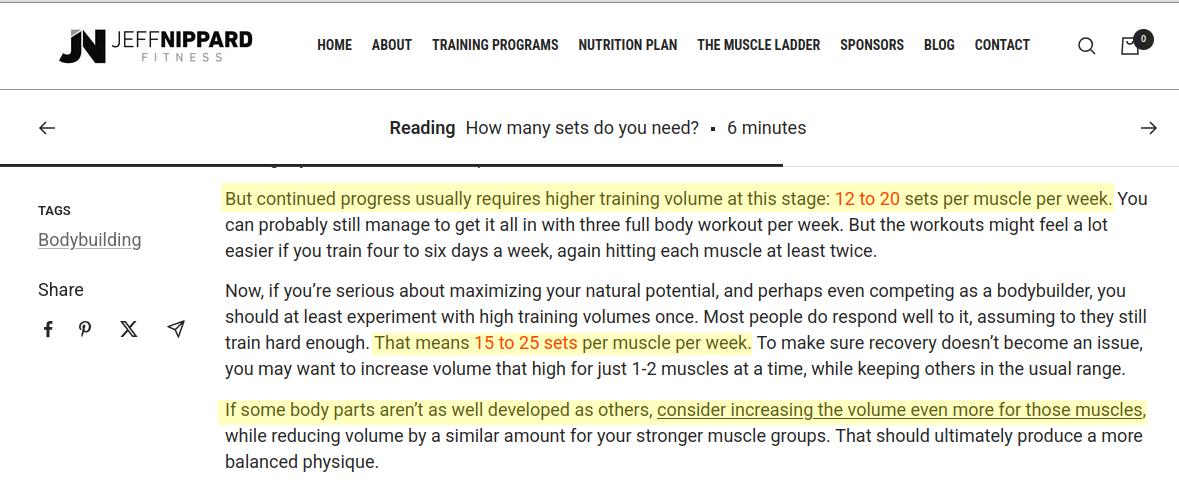
You would reasonably expect a ‘science-based’ influencer to include some references, enlightening readers as to just what science was used to derive these fanciful set numbers. You’ll note, however, that Nippard has included zero references to support what he’s saying in the above passage.
Instead of a reference list, he finishes his article with an invitation to purchase two of his bodybuilding programs for the “best gains possible.”
I’ll pass.
Whatever research base Nippard was using to support his high-volume recommendations couldn’t have been very robust, because he’s now singing an entirely different tune.
Two weeks ago, he posted a video titled “I Cut My Workouts In Half (And Maybe You Should Too).”
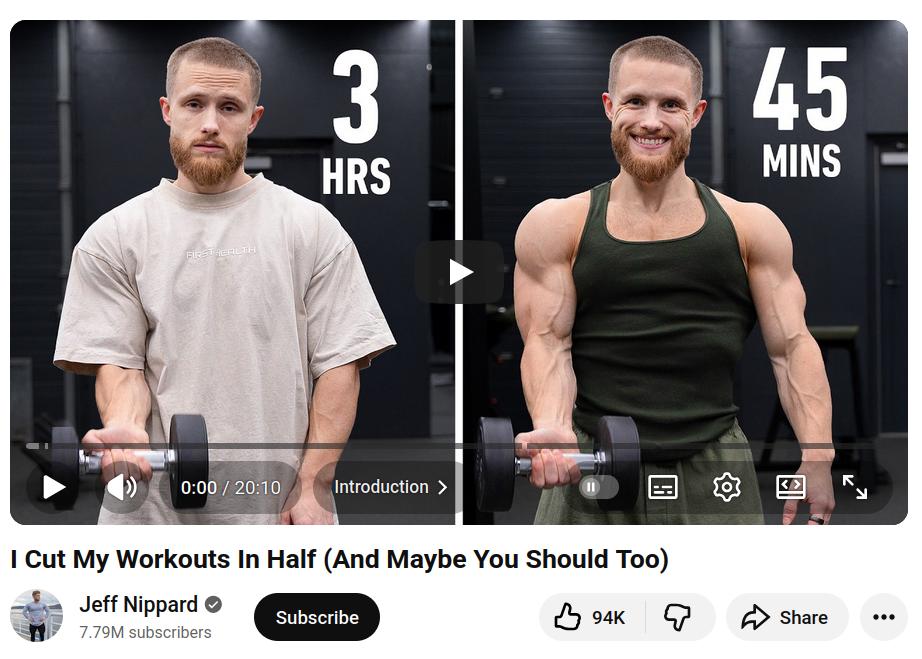
Turns out Nippard, who has been training a lot longer than 4 years, and who insisted that those of us who have done likewise need 200 or so sets per week, has discovered the benefits of low-volume training.
For 100 days, he drastically cut his volume. Instead of endless sets, he did one all-out set per exercise, “sometimes two”.
He liked it. He lost some body fat. He improved his leg extension strength. While I personally think the leg extension machine is one of the dumbest and most useless ever invented, Jeff was pretty excited (his results are posted here).
So the guy who was telling us to perform a crap-ton of sets each week is now advising us that we should maybe do 1 and sometimes 2 work sets per exercise.
Like others have been recommending for eons.
Admitting you got it wrong isn’t easy, so Nippard sets out to apportion blame elsewhere.
“For as long as I’ve been training, I’ve always been a pretty high volume guy. For one, that’s what the bodybuilding greats, like Arnold, Ronnie Coleman, Jay Cutler all trained.”
That right there is enough to flush Nippard’s credibility down the toilet. Masquerading as a science-based training advocate while recommending high volume training based on the feats of genetically gifted individuals who used liberal amounts of anabolic drugs is about as scientific as reading tarot cards and doing rain dances.
But Nippard isn’t completely about anecdote. He’s a science-based bro, remember.
“And,” continues the Nipster, “it’s also what the science suggested was most optimal.”
Bollocks.
To support this nonsensical, face-saving claim, Nippard offers up five papers as “Examples of Studies Supporting Higher Volumes”.
The list is a real hoot.
Study 1 involved a mere eight (8) untrained subjects in their 20s who trained nothing but their biceps twice per week for 12 consecutive weeks. The arms were randomly assigned to training with 1 or 3 sets. The 3-set protocol increased cross-sectional area more than 1 set (1 set, 8.0%; 3 sets, 13.3%, p < 0.05). Gains in strength with the 3-set protocol “tended” to be greater but were not statistically significant.
So not only were the differences between the 2 treatments far from spectacular, at no point was a high volume protocol explored. The study literally compared a total of 2 sets versus 6 sets per week for a single muscle group!
Study 2 compared low- and high-volume routines in untrained healthy older women, which I confidently surmise is not Bro Jeff’s target market. For 20 weeks, the subjects trained twice-weekly on a full body routine using 1 or 3 sets per exercise. If you scroll down to Table 2 of the study, you’ll see the reported strength gains (save for knee extension) were near identical between groups. At 20 weeks, quadriceps muscle thickness increased 12.6% for the 1-set group and 17.2% for the 3-set group. Biceps muscle thickness increased 15.9% for the 1-set group and 14.5% for the 3-set group.
Again, the differences were negligible, the researchers did not test strength gains on more relevant compound movements, and the so-called ‘high volume group’ used nowhere near the kind of volume recommended by Nippard and his fellow ‘science guys’.
Study 3 compared three sets per exercise per training session with five sets per session in resistance-trained men. After eight weeks of three weekly sessions, strength and muscle endurance increased in both groups, with no significant between-group differences.
Study 4 involved untrained subjects and concluded 3-sets were superior to 1-set for strength and muscle mass gains in the legs, but found no difference in upper-body strength or muscle gain.
Study 5 involved untrained men assigned to perform 1, 3 or 5 sets. This was the anomaly-ridden Radaelli et al 2005 study that I’ve dismantled previously; if you’re a paid subscriber, you can read the full breakdown here. Needless to say, when a study finds a control group that did no weight training gained a mean 2.91 kg of lean mass - far more than the single set group and similar to the 3-set group - you know something is amiss.
So Jeff the Science Guy was apparently basing his previous belief in the superiority of high volume training for advanced lifters on five studies that did not even begin to examine the kinds of high volumes he was eagerly recommending to his followers for years on end.
Not only that, but four of those studies involved untrained subjects, and the one study involving trained subjects found no difference between ‘low’ and ‘high’ volume routines. In that study, 3 sets is classed as ‘low’ volume, while in the others it is deemed ‘high’ volume.
Do I really need to go on?
Jeff Nippard is not a scientific expert nor an adept researcher. Like many of his followers, he’s learning as he goes along. That would be perfectly fine if, instead of masquerading as an expert and selling programs, he admitted he was on a voyage of discovery, still trying to find out what works.
Mike Israetel
Mike Israetel’s Olympic-level delusion and Netanyahu-like arrogance is enough to make even the most jaded observer reach for the barf bucket.
Israetel, whose YouTube channel Renaissance Periodization has 3.84M subscribers, constantly boasts of possessing a 160+ IQ and parades his PhD status every chance he gets. His sport physiology PhD was attained at East Tennessee State University. It seems the academic standards at this institution, ranked outside the world’s top 200 sports science universities, were especially low when Israetel was enrolled there.
When Australian fitness industry analyst Solomon Nelson got a hold of Israetel’s PhD thesis, titled “The Interrelationships of Fitness Characteristics in Division 1 Athletes,” the contents were shocking.
The thesis involved 80 NCAA Division 1 athletes from four sports and aimed to explore the extent to which athletic performance can be understood through various physical attributes.
Now, a PhD thesis should be original and show that its author brings something new and promising to the field, but Israetel’s thesis told us what everybody with eyesight already knows:
Stronger athletes tend to be more muscular;
Athletes with higher relative force and power output demonstrate superior jumping and sprinting abilities;
Leaner athletes tend to outperform less lean athletes across various metrics.
It’s not just that Israetel’s PhD thesis looks like it was written by Captain Obvious. The data he included contained statistical absurdities, some of which were flat out impossible. The standard deviations included in his tables meant some of the college athletes were 3.46 meters tall and -1.6 years of age.
In response, Israetel absurdly claimed the thesis Solomon analysed was just a draft copy and not the final. If true, that would mean East Tennessee State University somehow published the wrong thesis.
Turns out Mike was simply talking out his posterior, because he later admitted the thesis Solomon critiqued was indeed the one he submitted for his PhD.
Which, I must say, goes a long way towards explaining East Tennessee State University’s lowly ranking.
A case study in mental illness, Israetel told one interviewer, “I think about violence all the time. Well, if your testosterone is 25 times what it’s supposed to be, what the hell do you think it’s gonna make you think about?”
I submit that a guy who swallows and injects so many drugs that his testosterone is allegedly 25 times higher than normal, and by his own admission will probably subtract 10 years from his lifespan, has absolutely nothing of value to offer drug-free lifters. Heck, even those judiciously cycling on and off steroids would have little to gain from listening to a chemical kamikaze pilot like Israetel.
When breaking through a plateau consists of upping your already excessive drug dosages, then you live in a completely different realm to those who lift without chemical assistance.
“I live in a really beautiful area in Michigan, and I walk out to this pond and these trees, and I know that I like looking at them, but it’s a memory to me. I look at the pond and the trees, and I’m like, all I feel is rage and frustration and anger and anxiety. That’s my daily life.”
Israetel, I remind you, is one of the most popular ‘fitness’ influencers in the world.
Even though he’s terribly unfit.
Israetel’s arrogance and delusion recently reached its pinnacle, after bad-mouthing late bodybuilding legend Mike Mentzer in an expletive-laden rant. Israetel even declared himself to be smarter, bigger and stronger than Mentzer, the first man to ever win Mr Universe with a perfect score. Mentzer was also an avid proponent of single-set training, which Israetel’s buddy Nippard is now hailing as some remarkable new discovery.
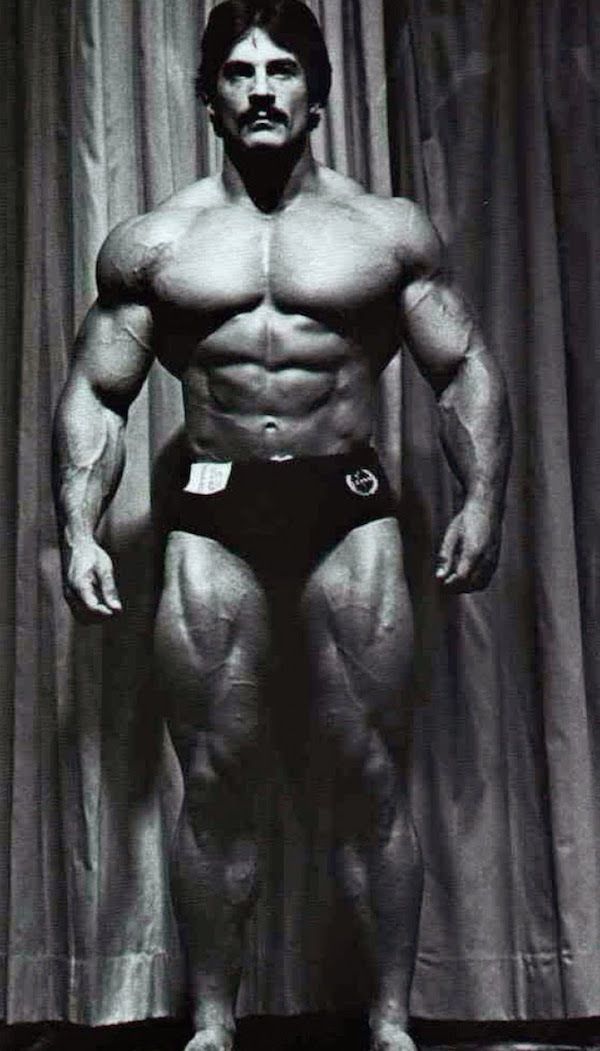
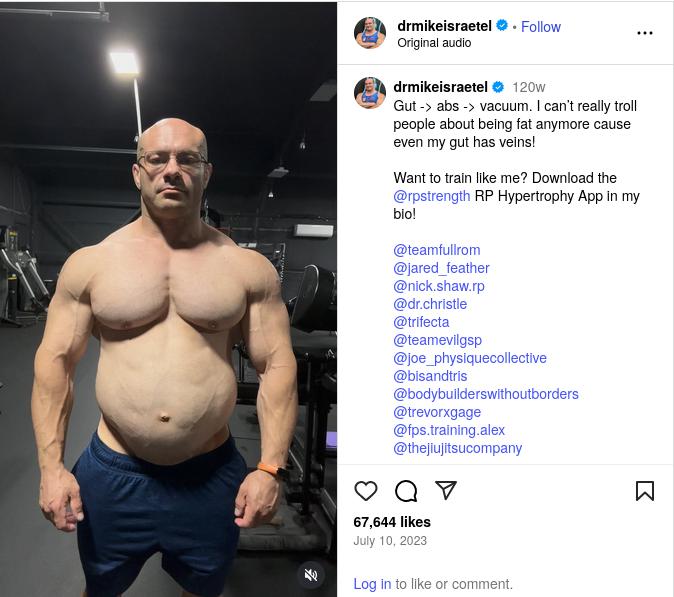
The ludicrous spectacle of a guy who can’t get an IFBB pro card declaring himself superior to one of the iron game’s all-time greats was a bit too much for Dorian Yates, the six-time Mr Olympia winner who was heavily influenced by Mentzer’s training philosophies.
Dorian recently posted this message for Israetel:
Jeff Caviliere (Athlean-X)
Jeff Caviliere, who runs popular YouTube channel Athlean-X, is another master of ‘science-based’ BS.
His anti-scientific nonsense is so prolific that an hour-long compendium of his poor advice merely scratches the surface.
What really exposed Caviliere as an out-and-out sham was his use of fake weights.
When he posted footage of himself easily deadlifting 500 lbs for 2 reps, many viewers noticed his weight plates looked suspiciously like those available on websites selling fake Olympic plates.
Caviliere set out to prove these critics wrong, and in the process confirmed they were right.
He subsequently posted a video of himself deadlifting 425lbs. Not only was this 75lbs lighter than the lift where he was using fake plates, but his form with this lighter weight was appalling. As he struggled to pull the weight, he showed more lumbar flexion than the Sydney Harbour Bridge.
Take note of how, after completing this terrible lift, he slams the weight down and makes a gesture indicating a mix of triumph and anger, as if to say, “take that, all you evil bastards who had the temerity to call me out for shamelessly lying!”
The self-entitlement of the self-deluded: It’s ugly.
Lying about your athletic pursuits, including the amount of weight you can lift, is not okay - especially when you are using those claims to enrich yourself at other people’s expense.
Despite being unmasked as an obvious liar, Caviliere’s Athlean-X channel has a whopping 14.2M subscribers.
Because humankind adores its charlatans.
There are influencers, and there are information providers. Be sure you are listening to the latter.
Great stuff!! Its sad how much money these guys make. Im 46 years old and I thought it was hard enough finding good info as a young man. It’s even harder nowadays. Thankfully I stumbled onto Stuart McRobert. Even Lyle McDonald does some good stuff.
Remote tribes in the Amazon live an active lifestyle and eat only natural substances, and often walk & run for many, many miles when hunting, and climb trees. Photographs of the tribes do not reveal ripped abs or biceps. In fact, they often have a pot belly. They resemble 20-something men in the US with a BMI between 23 & 28 who’s only exercise in life was PE class in high school and since their main hobby has been playing video games. Even men who work at manual labor jobs all day are in general are strong but not lean & ripped.
The law of energy conservation applies to the human body. Muscles require significant energy to build and maintain, even at rest, compared to adipose tissue. The body will store enormous amounts of fat but only build larger muscles if they are necessary for survival. One rep 3x a week is just enough for the body to think strained muscles are being used to kill or run down prey.
Gym rats trick their bodies into building more muscles than a caveman would ever need to survive. So what’s the point of getting ripped? Attracting the opposite sex and impressing the same sex, mainly. Which explains dad bods.
That was an excellent definition of influencer, but I just say con man. The guys pop up on my feed periodically and I rarely watch them but the video with Dorian Yates caught my eye. Of all the body builders who’ve ever lived, Mike Mentzer was probably the most scientifically minded guys in the business. Now we get these charlatans.
What you think about “I AM longevity” and/or “60-Is-The-New-30″ at Youtube.
As someone who is over 60 I find him quite interesting and that he shows a lot of science behind his claims re for ex the importance of the Motor units in the body.
” Description
Welcome to my journey.
I’m 61 years old, and this channel documents my pursuit of longevity — my mission to reach 100 while still moving like someone half my age. For over 45 years, I’ve trained to keep my body explosive, agile, and strong, doing what you rarely see from people over 60: powerful jumps, zig-zag movements, real athletic motion — not just upper-body exercises.
This channel is not about teaching or coaching. I’m simply sharing my own path, my own discipline, and my own discoveries. If you find inspiration or gain something from what I share, that’s great — but I’m here to show what’s possible, not to lecture or sell you anything.”
Israetel has the ugliest physique I’ve ever seen. It looks like he’s wearing a pregnancy prosthetic to prove that men can be “pregnant people” who “chest feed”!
This was really good.
Your first section quickly got me thinking of Mike Mentzer, and then you actually mentioned him and Dorian Yates. I discovered Mentzer’s lifting philosophy years ago and tried it out. Just as Mike said I would, I saw gains in either weight or reps every single workout. Never had better, more consistent results. High weight, 10-12 reps to failure, one or two sets only, with multiple days of rest in between gym visits.
Mentzer’s interviews on the subject may be on YouTube by now. If so, I recommend listening, even if more recent discoveries/improvements may have been made to the high intensity training philosophy since that time. Mike seemed like a truly good guy.
Chilling revelations, especially about Athlean-X whom I considered legit. Thanks for your work Anthony.