
Important update 18-4-2016: It was never my intention for this article to serve as some kind of advertisement for Coca-Cola, but after reading Michael Blanding's book The Coke Machine: The Dirty Truth Behind the World's Favorite Soft Drink
As I discussed in a recent article, the benefits of consuming quickly absorbed carbohydrates during strenuous endurance activities have been well-established. As a result, nowadays there's a plethora of carbohydrate supplements on the market, many featuring all sorts of additional bells and whistles such as multiple-chain carbohydrates, electrolytes, vitamins, herbs, and amino acids. Some feature unusual carb sources such as waxy maize, heavily marketed on the basis of their (alleged) superior absorption.
And so it may come as a surprise to you that the most popular carbohydrate 'supplement' among participants of one of the penultimate endurance sports - professional road cycling - is a rather unsophisticated product introduced way back in 1886, almost 20 years before the first Tour de France kicked off.
Yep, I'm talking about Coca-Cola.
Things Go Better With Coke. Well, at Least During a Grueling 150km Tour Stage.
Years ago I was talking with a competitive masters road cyclist, and the subject turned to what we put in our water bottles. He was explaining that during races and long rides, he put Coke in his bidons, because not only did it contain plenty of carbs in the form of readily-absorbed sugar, but also caffeine. I must confess to thinking at the time that, with the vast array of woohoo you-beaut electrolyte-enhanced multiple-chain carbohydrate supplements on the market, drinking plain old cola during a race was ... well, you know ... kind of primitive.
Fast forward a few years, to when I started plowing my way through Louise Burke's Practical Sports Nutrition (an invaluable resource for any serious sports trainer). In the chapter on cycling, she mentioned how "de-fizzed" cola was traditionally a favourite in-race drink among pro cyclists.
Hmmm.
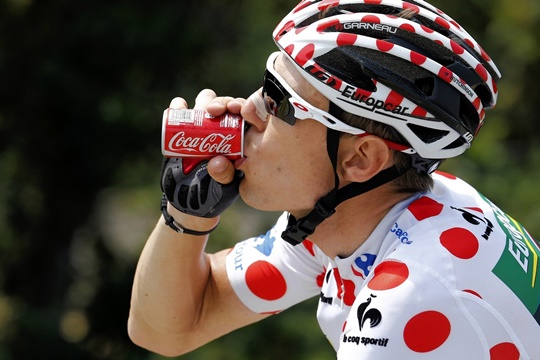
After my recent article discussing the optimal amount of carbohydrate to consume during exercise/competition, I got an email from one of my readers who'd observed lots of other athletes drinking Coke. He wanted to know if I'd heard about this, and if I'd ever used it personally as a sports drink. Before replying, I searched around on the Internet to see if I could uncover any more info on the pro cycling-Coke phenomenon, and promptly came across this:
http://sportsci.org/news/news9711/martin.html#VanHandel
It's an article published in a 1997 issue of Sportscience News by Australian Institute of Sports (AIS) researchers. They noted that, despite getting nutritional counseling from the Institute in line with the latest scientific wisdom, high level Australian road and mountain cyclists and cross-country skiers routinely drank Coca-Cola during competition.
The regular consumption of soft drinks, especially colas, by athletes had been documented in the research literature back in 1977 by VanHandel et al. Like yours truly, the AIS researchers had figured top athletes would've since switched to the new generation of recommended sport drinks. So they decided to do a survey during the US Professional Cycling Championships to find out what the best cyclists were using as a sports beverage.
(Almost) Always Coca-Cola.
During the 1997 CoreStates US Professional Championship Road Race held in Philadelphia, they approached race soigneurs in the feed zone and asked whether they'd be willing to fill out a questionnaire designed to understand which sport drinks were being consumed by professional cyclists during racing (soigneurs are the team assistants responsible for feeding, clothing, massaging, and escorting riders). The soigneurs were informed the survey was not sponsored by a sport drink company.
Representatives from 11 of 19 professional men's cycling teams completed this survey. Most of the cyclists were from the United States, but the teams also included riders from Australia, Belgium, Canada, Czech Republic, France, Great Britain, Germany, Italy, Netherlands, Russia, and Spain.
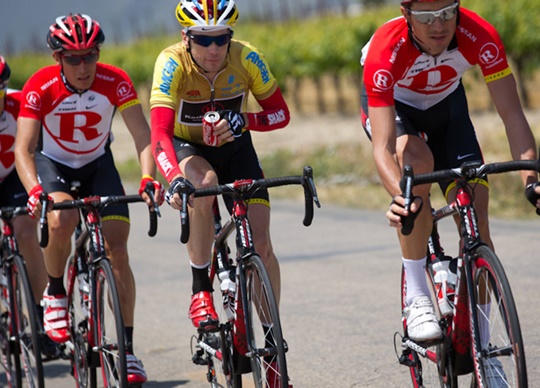
In six of the 11 teams, all of the riders drank Coca-Cola during the race. In four teams, over two-thirds of riders drank Coca-Cola. Only one team was identified that did not drink Coke during the race. Thus, roughly 90% of the teams surveyed consumed Coca-Cola.
In all cases, the researchers noted, Coca-Cola was consumed during the last half to the last quarter of the race and was used as a supplement to some other type of carbohydrate electrolyte drink. In seven of the 10 teams using Coca-Cola, the drink was handed out to the riders "de-fizzed." In other words, the soigneurs opened the cans/bottles and let the Coke air so it would not be fully carbonated at the time of consumption.
Coca-Cola was also consumed as a post-race drink along with some other type of carbohydrate, electrolyte or protein drink in eight out of the 11 teams surveyed.
Soft Drink Consumption in Other Sports
Pro cyclists are hardly the only ones who use soft drink for sports nutritive purposes. When Green Bay Packers quarterback Aaron Rodgers drank grape-flavored Crush during a postgame news conference in November 2014, social media lit up. Many people assumed the only reason a pro athlete would publicly consume the sugary soft drink was to have a dig at the purple-clad Minnesota Vikings, whom the Packers had just beaten.
Rodgers dismissed the idea as “ridiculous”, and revealed a far simpler explanation: He’s been drinking grape or orange soda after every game for seven years.
The 'shocking' revelation that healthy, high level athletes were using soft drinks, despite the vilification of sugary drinks as a contributor to the obesity 'epidemic', inspired a Wall Street Journal article titled "The Athletes Who Train With Soda".
Journalist Rachel Bachman cited numerous other instances of soft drink consumption by world class athletes:
French tennis pro Gaël Monfils apparently "amused spectators" in September of last year when he drank from a can of Coke during a fourth-round victory over No. 7 seed Grigor Dimitrov.
The Ironman triathlon series serves flat (de-fizzed) cola and Red Bull to competitors in its grueling events.
Camille Herron, the 2:37 marathoner and 2015 World 100km Champion who, in an impassioned defense of soft drink at her website, says she drinks 2-3 cans of soft drink a week to help provide calories for her strenuous training regimen.
Distance runner Kenny Moore, who recalled University of Oregon track coach Bill Bowerman (later the co-founder of Nike) handing him and his teammates various beverages during long training runs in the mid-1960s. Compared with orange juice, lemonade, coffee and others, Coke “gave me a little lift, a feeling of being a little stronger as I ran,” Moore recalls.
Frank Shorter, Moore’s teammate on the 1972 Olympic team, who adopted his regimen of drinking de-fizzed Coke during races. Shorter swigged Coke along the Olympic marathon course in Munich and won the gold medal. Moore finished fourth. “You go with what works,” Shorter told Bachman. He says he drank de-fizzed soda in dozens of other marathons.
"This is Bradley. We can't show you his face, because he's a professional cyclist. But like 9 out of 10 pro cyclists, he uses Coke ..."
Ted King, a member of the Cannondale Pro Cycling team, estimated that 90% of the riders on the Tour de France drink Coke at some point during the race. “A really cold soda on a hot day is that blast of energy you need,” King told Bachman. “There’s something about the quick caffeine and simple sugar that helps fuel the final bit of a race.
Pro cyclists can burn 800 to 1,000 calories per hour and ride for five or six hours on a race day, King notes. “Your palate can only take so many sports-specific things." Drinking Coke has become a tradition among riders, he says.
No Rain on the Plane, but the A-Train Drank Mainly Cola in Spain.
As to the question of whether I'd ever personally used Coke as a sports drink, until recently the answer was no. However, I've just spent four weeks in Spain, chugging my way up the beautiful climbs of Anadalucia and Mallorca. Normally, my peri-ride carb source of choice is maltodextrin, which I buy cheaply in bulk from a local supplier here in Australia. But because my bike case chewed up the bulk of my airline baggage allowance and I therefore needed to travel as lightly as possible, and because I didn't fancy explaining to customs officers why there were multiple bags of fine white powder in my luggage, I left the maltodextrin at home.
Which meant I needed to hunt down an effective peri-ride carb source soon after I touched down in España. I found it at a nearby supermarket:
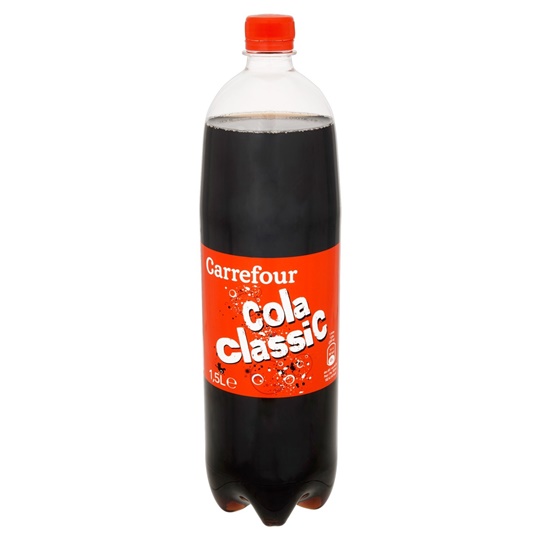
During my month in Spain, I used both generic colas and "The Real Thing" as my peri-ride carbohydrate source, and they all worked a treat. And, I must say, tasted a damn sight better than maltodextrin, even with added salt.
The long-held recommendation is that sports drink solutions should contain between 5-10% of carbohydrates; any more than this allegedly raises the risk of gastrointestinal distress. The carbohydrate concentration of Coke is a whisker over 10%, and the primary source of carbs in the cola versions I used was sucrose (not high fructose corn syrup). During the hundreds of KMs I clocked up in Spain, I experienced no GI distress whatsoever (in contrast, sucrose-rich Gatorade at the recommended concentrations plays havoc with my stomach).
For the traveling cyclist, cola constitutes a tasty, effective and very economical sports drink.
The Inevitable Controversy
When I write articles like this, I'm not making recommendations to anybody. I'm simply presenting facts and opinions, and whether people choose to act on this information is something they must decide for themselves.
Sugar has long been the subject of controversy, but recent years have seen a marked intensification in anti-sugar sentiment. In some instances, this vilification has approached levels that can only be described as extremist. Pediatrician Robert Lustig, for example, has made a name for himself with his bombastic rants against fructose. In a Catalyst segment he made the absurd claim that sugar is "the new thalidomide", and in a Nature article even likened fructose to alcohol, claiming "excessive" consumption of both caused obesity, hypertension, fatty liver, and insulin resistance.
No shit, Sherlock. Excessive consumption of any calorie-containing foods and beverages will cause these problems. Here in Australia, for example, consumption of sugar has actually decreased in recent decades, but overall calorie intake has remained the same while physical activity levels have declined, seeing to it that Australians have become one of the fattest Western populations in the world.
When I told a close friend, who happens to be a GP, about Lustig's fructose-is-like-alcohol article, his facial expression promptly turned to one of disgust. When you've had to attend to victims of alcohol-related violence, Lustig's claims come off like crazy-talk. Unlike alcohol, fructose does not cause people to bash their wives, does not cause drunken thugs to fatally king hit unsuspecting punters, and does not cause people to crash their cars and kill innocent people. Oh, and nor does it cause unwanted pregnancies nor foster the spread of sexually transmitted diseases as a result of ill-considered casual sex encounters.
Sorry folks, but I have to seriously question the mental competence of someone who would even begin to compare fructose to a substance that does all these things and more.
It's high time to bring a little perspective to this whole sugar debate.
Insisting sugar should be banned because it causes ill-effects when consumed in excess is somewhat disingenuous. On that criteria, we should also ban meat, vegetables, pulses, coffee, dairy, plant oils, and nuts. Oh, and dried fruits - ever eaten prunes in excess? Now there's a fun day in.
Just about everything causes problems when consumed in excess. As the old saying goes, the poison is in the dose.
And therein lies the real issue with sugar. It's a highly palatable substance, and therefore is used to bolster the taste of an endless array of beverages and foods. This problem was exacerbated by the anti-fat mania that kicked off in earnest during the early 1980s. With the demonizing of dietary fat, food manufacturers promptly turned to sugar to bolster the taste of otherwise bland low-fat foods. Sugar proved so effective that manufacturers began using it to boost the taste of just about everything.
And the general population, effectively brainwashed and inculcated with anti-fat dogma, came to consider calories irrelevant. As long as a food was low in fat, they earnestly seemed to believe they could eat it with impunity, overall energy intake be damned.
And so people got fatter. Gee, who would've thought?
Sugar just plain tastes good. And so in people/populations lacking restraint, sugar-rich foods are routinely consumed in excess. I've emphasized the aforementioned words for good reason. In populations that do not overindulge in sugar, few if any of the attendant effects that the anti-sugar crowd continuously bang on about are observed. If you've ever visited the Mediterranean, you'll know these countries are hardly shy when it comes to sugar-rich treats. Cafes with an endless array of tantalizing cakes and biscuits are everywhere, yet the populations in these countries are much slimmer than those of the Anglo-Western world. Women in Italy - home of cannoli, casata, gelati, panforte, tiramisu, and an endless array of sugar-rich biscotti - constitute the second slimmest female population in all of Europe.
The slimmest female population in Europe, by the way, is found in Switzerland.
Why?
Because these countries generally have a more temperate and balanced approach to eating, drinking and life in general (sadly, in some countries the younger generations are departing from the traditional model of temperance. I've never been to Ibiza, but have been informed by a number of unrelated sources that the biggest drunken dickheads polluting the clubs there are males from Italy. Given the world famous bad behaviour of boozed-up Brits in the Ballearic region, that's really saying something). Drunken young wankers that disgrace their country notwithstanding, Italians have traditionally taken an "everything in moderation" approach to eating and drinking, and I saw the same approach before my very eyes in Spain. "Supersizing" simply isn't part of their common vernacular.
Switzerland provides an especially lucid example of temperance. Due to its unique military system, which relies on a "militia" comprised of trained males from the general population as opposed to a standing army, gun ownership rates in Switzerland are among the highest in the world. Yet compared to the United States, where there are 10.5 gun-related deaths per 100,000 people annually, Switzerland has only 2.91 deaths per 100,000 people.
I'd posit the reason there are far less firearm-related deaths in Switzerland than in the USA is, again, because we're dealing with a far calmer and more moderate population. Anglo-Western countries like Australia and the USA seem to possess an inherent preference for excess, both in eating and general behaviour. Whether it's genetic or simply the byproduct of decades of generally uninterrupted affluence, many people in those countries seem to believe they are entitled to have what they want, whenever they want. Woe-be-tied anyone who comes along and suggests that their problems are largely caused by their own behaviour and that maybe they should exercise a little more restraint.
But in people who possess such traits as self-restraint and self-responsibility, sugar is not a problem. Smart athletes can drink sugar-rich beverages for performance-enhancing purposes and experience nothing but benefits, because they only consume them during and immediately after exercise.
If you've read my book The Fat Loss Bible, you'll already know I recommend the avoidance of sugar-containing beverages except immediately before, during, and after exercise. If you're not an athlete in hard-training, there is no simply no good physiological justification for you to be consuming sugar-rich beverages. I never cease to be amazed by the number of sedentary folks I see with Powerade bottles sitting next to their computer keyboards.
Sugar is not a poison. It is a substance that - like much of what we put into our mouths - has both positive and negative characteristics. Which of those characteristics predominates in your physiology depends on how you choose to consume it.
If you choose to consume it during and after vigorous exercise, then you will be availing yourself of a cheap but effective substance that has been scientifically demonstrated to enhance physical performance.
Outside of exercise, if you choose to consume it in moderation (as per the traditional Mediterranean approach), then you will be availing yourself of a substance that greatly enhances the taste and palatability of your food, without any adverse affect on your health or bodyweight. While the anti-sugar crowd repeatedly bang on about the alleged fattening effects of sugar, studies have repeatedly shown that refined sugars simply do not cause weight gain independent of overall caloric intake.
Ingesting too many calories is what makes you fat. This is, and has always been, the primary non-genetic determinant of how much fat you carry.
Where those calories come from is a secondary issue.
If you consume sugar-rich treats to the point where they are crowding out whole foods like meat, eggs, vegetables, and tubers from your diet, then yes, you have a problem. But when you are an hour into a ride, powering your way up a steep hill, the last thing your body wants is steak and broccoli. What your body really needs at that point is some readily available and quickly assimilated sugar to assist your dwindling muscle glycogen stores.
As 100K champion Camille Herron is fond of pointing out, “If the furnace is hot enough, it will burn anything.” Rest assured, any sugar you ingest while you're steaming along on your bike and burning up to 1,000 calories an hour is not going to cause insulin resistance or weight gain. In fact, those potential outcomes will be the least of your worries when you're powering up a 7 degree incline that stretches for 15 kilometres, and your glycogen stores are starting to dip perilously low!
To someone inculcated with the extremely dogmatic SUGAR IS BAD, ALWAYS AND FOREVER! mentality, this may seem like a really hard concept to grasp. To those unaffected by such propaganda, what I'm saying here is simply plain commonsense.
Interestingly, an anti-sugar documentary that recently aired on Australia's ABC featured footage of Robert Lustig proudly telling a live audience, "I don't believe in commonsense."
No kidding.
I think it's worth noting that in every photograph and every piece of video/TV footage I've seen of Lustig, he's sporting a rather prodigious belly. This would be irrelevant if his field of expertise was accounting or engineering, but for an individual who positions himself as an expert health commentator and vigorously blames sugar for the obesity epidemic, it speaks volumes. If sugar really is the cause of obesity, then Robert clearly isn't following his own advice. But if he is avoiding sugar, then he's simply living proof that too many calories and/or not enough physical activity are the true causes of overweight.
Don't be like Lusting and the myopic anti-sugar crowd. Act like a grown-up, take responsibility for your own actions, and start exercising some moderation. And stop constantly placating your children with sugar-laden foods, sodas, and juices - their Wii/Playstation lifestyle simply doesn't justify them. If you're not prepared to do this, then expect big government to step in and do it for you, in the form of increased restrictions and taxes on sugar and sugar-rich foods (which is exactly what Lustig is campaigning for).
Consumed during exercise, sugar is like nitrous oxide. You wouldn't run NOS in your family car on a trip to the supermarket, but in a high-performance vehicle during a race, it provides an instant and powerful boost to performance.
Outside of exercise, small amounts of sugar can enhance what should be one of life's greatest pleasures: Eating.
My Italian-Australian elders, many of whom lived into their late 80s and early 90s - the kind of longevity no now-deceased low-carb guru has been able to match - routinely put sugar in their coffee and ate post-dinner Italian treats. What they did not do was burp, slurp and fart their way through supersized portions of sugar-laden drinks and foods every chance they got, then blame it on Big Food/Big Sugar as is commonplace nowadays. They were hard-working, self-reliant people who migrated to Australia with little more than a suitcase containing the entire family's possessions. Apart from a stamp on their visa, they received absolutely no government assistance upon arriving in Australia - and nor did they expect any. They accepted that their new destiny was for them to create, and went about it without fuss.
Perhaps the anti-sugar crowd can learn something from that.
Or maybe not - they're a rather stubborn bunch.
Adios,
Anthony.
---
Note: The author of this article does not receive and has never received any form of compensation from Coca-Cola, soft drink manufacturers, the sugar industry, nor any other food industry group.
Anthony Colpo is an independent researcher, physical conditioning specialist, and author of the groundbreaking books The Fat Loss Bible

The Mandatory “I Ain’t Your Mama, So Think For Yourself and Take Responsibility for Your Own Actions” Disclaimer: All content on this web site is provided for information and education purposes only. Individuals wishing to make changes to their dietary, lifestyle, exercise or medication regimens should do so in conjunction with a competent, knowledgeable and empathetic medical professional. Anyone who chooses to apply the information on this web site does so of their own volition and their own risk. The owner and contributors to this site accept no responsibility or liability whatsoever for any harm, real or imagined, from the use or dissemination of information contained on this site. If these conditions are not agreeable to the reader, he/she is advised to leave this site immediately.